
Embrace synonym: the best replacement depends on which sense of “embrace” you mean. For a physical hug, use hug or cuddle. For accepting an idea, a change, or an opportunity, use adopt, welcome, or espouse. For including something as part of a whole, use include or encompass. Embrace is a warm, generous word — and the right synonym keeps that warmth while saying exactly what you mean.
What Does “Embrace” Mean?
Embrace is a verb with two main senses, plus a noun sense:
- To hug; to hold someone in your arms with affection. “She embraced her daughter at the airport.” “They embraced after years apart.” This is the oldest and most literal sense — the Wiktionary entry for “embrace” gives it first: to clasp someone in the arms with affection, to take in the arms, to hug.
- To accept or welcome something gladly. “He embraced the new challenge.” “The town embraced the festival.” Here embrace means more than just accepting — it means accepting eagerly, with warmth and willingness.
- To include or surround. “The course embraces everything from history to art.” “Hills embrace the village.” In this sense, embrace means to contain within a whole, or to encircle.
As a noun, an embrace is the act itself: “a warm embrace,” “locked in an embrace.” The noun almost always means a hug, not an acceptance.
Pronunciation and Word Forms
Embrace is pronounced /ɛmˈbɹeɪs/ — “em-BRAYSS.” The stress falls on the second syllable. The word comes from Middle English embracen, from Old French embracer, from Late Latin imbracchiāre — in- (“in”) + bracchium (“arm”) — literally “to put in the arms.” That history is why the hug sense came first, and why even the figurative sense still feels warm and physical.
Useful forms to know:
- embrace (verb) — “She embraced the idea.”
- embraces (third person) — “He embraces change.”
- embracing (present participle) — “Embracing new ideas takes courage.”
- embraced (past tense) — “They embraced at the station.”
- embrace (noun) — “a warm embrace”
- embraceable (adjective) — able to be embraced; lovable
Synonyms for a Physical Hug
When embrace means holding someone in your arms, these are the closest replacements:
- hug — the best all-round replacement: “She hugged her son.” Shorter, plainer, and the word most people reach for first.
- cuddle — a longer, softer, more affectionate hold, often sitting or lying close: “They cuddled on the sofa.”
- clasp — to hold tightly, often with both arms: “He clasped her to him.” Slightly more formal and literary than hug.
- squeeze — a brief, tight hug: “She gave him a quick squeeze.” Casual and warm.
- hold — the plainest option: “She held him close.” Works when the affection matters more than the arms.
“Hug” fits almost every sentence where embrace means a physical hold. Use “cuddle” when the hug is long and cosy, and “clasp” when you want a more formal or written tone.
Synonyms for Accepting or Welcoming Something
When embrace means accepting an idea, a change, or an opportunity gladly, the best replacements are:
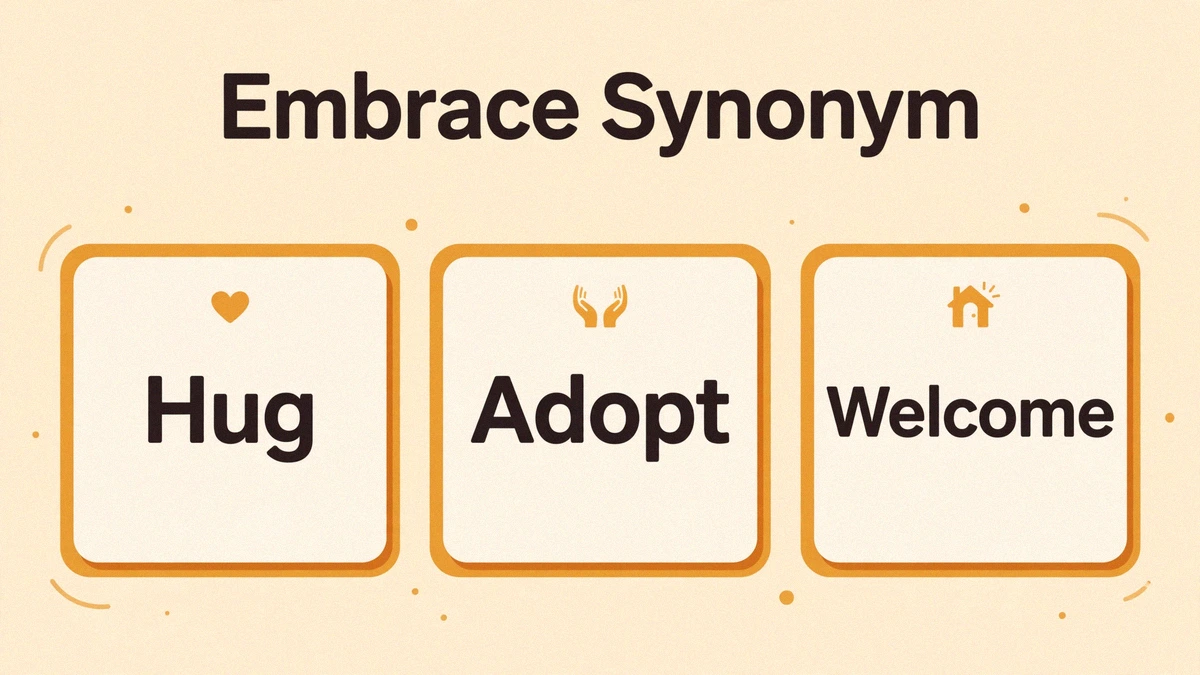
- adopt — to take something as your own: “She adopted the new routine.” The most neutral option; it says less about enthusiasm than embrace does.
- welcome — to receive something gladly: “They welcomed the change.” Close in warmth to embrace, and the best choice when the feeling is positive.
- espouse — to take up a cause or belief with strong attachment: “He espoused the cause of clean water.” Formal, and stronger than embrace — use it for beliefs and causes, not for casual changes.
- accept — to agree to take something: “She accepted the challenge.” Plainer than embrace, and it says nothing about enthusiasm — use it when the acceptance is reluctant or neutral.
- take up — to begin something new: “He took up gardening.” Good for hobbies, habits, and new practices.
- seize — to take eagerly: “She seized the opportunity.” Stronger and more urgent than embrace.
The Merriam-Webster thesaurus entry for “embrace” groups its 274 similar and opposite words by sense — to hug, to wrap, to adopt, to welcome, to include, to surround — which is exactly how this article is organised: pick the group first, then the word.
Synonyms for Including or Surrounding
When embrace means to contain or encircle, these words fit:
- include — to have as part of a whole: “The course includes history and art.” The plainest and safest replacement.
- encompass — to cover or contain completely: “The plan encompasses every department.” Slightly more formal than include.
- surround — to form a circle around: “Hills surround the village.” Use this when embrace is about place, not ideas.
- contain — to hold within: “The book contains twelve chapters.” Neutral and precise.
- comprise — to be made up of: “The team comprises ten players.” Formal; the whole comprises its parts.
Embrace vs Adopt vs Espouse
These three words overlap, but they are not identical:
| Word | Shade of meaning | Best example |
|---|---|---|
| embrace | accept gladly, with warmth | Embraced the new culture |
| adopt | take as your own, neutrally | Adopted a new policy |
| espouse | take up a cause with strong attachment | Espoused women’s rights |
The difference is feeling. “Embrace” implies a ready or happy acceptance. “Adopt” implies accepting something created by another, or foreign to your nature — you can adopt a policy you dislike. “Espouse” adds close attachment to a cause and a sharing of its fortunes — you espouse something you believe in deeply. If you want one safe synonym for most sentences about accepting ideas, use adopt; if you want to keep the warmth, use welcome.
Antonyms of Embrace
The opposite depends on the sense:
- For the hug sense: push away, shun, avoid — “She pushed him away.”
- For the acceptance sense: reject, refuse, resist, spurn — “He rejected the proposal.” “They resisted the change.”
- For the including sense: exclude, omit — “The course excludes maths.”
If someone refuses to embrace an idea, they reject it. If someone refuses to embrace a person, they push them away. The antonym, like the synonym, follows the sense.
How to Use “Embrace” in a Sentence
- “She embraced her brother when he came home.”
- “The company embraced remote working.”
- “He embraced the challenge with enthusiasm.”
- “The valley is embraced by green hills.”
- “It is time to embrace change, not fear it.”
- “They shared a long embrace at the airport.”
The pattern is simple: “embrace” takes a person (“embrace her son”) or a thing (“embrace the idea”) directly after it. With people, it usually means a hug; with ideas, changes, and opportunities, it means glad acceptance. Context does the work — and if the context is unclear, a synonym like “hug” or “welcome” makes the meaning certain.
Embrace in Writing
Word choice is a skill that shows up everywhere, not only in essays. A warm verb like “embrace” can make a message feel genuine, and the same care applies to other word lists: if you want more words for the thing being welcomed, the guide to life synonym covers forty alternatives for “life,” the list in shows synonym shows how a sharper verb can replace a tired one, and the compulsory definition guide explains another formal word the same careful way. “Embrace” earns its place the same way: it says “I welcome this” in a single warm word.
Frequently Asked Questions
What is the best synonym for embrace?
It depends on the meaning. For a hug, hug. For accepting an idea or change, adopt or welcome. For including something, include.
What is the opposite of embrace?
Reject or refuse for ideas; push away for people; exclude for things being included.
Is “embrace” the same as “hug”?
Almost, for the physical sense — a hug is a kind of embrace. But “embrace” also means to accept something gladly, and “hug” never means that. You can embrace an idea; you cannot hug one.
What is the difference between embrace and adopt?
Both mean taking something as your own, but “embrace” implies a ready or happy acceptance, while “adopt” is neutral — you can adopt a policy you dislike, but you embrace something you welcome.