
A shows synonym is a word you can use instead of “shows” when it has gone flat from overuse. “Shows” is one of the most repeated verbs in English writing — in essays, in reports, in everyday messages — and it is usually doing a job a sharper word could do better. The data shows a trend. The photo shows a dog. The report shows a problem. Three different meanings, one tired word. Below are 40 synonyms for “shows,” grouped by what you actually mean, with examples so you can pick the right one.
What Does “Shows” Mean?
“Shows” is the third-person singular of “show,” and it covers several different ideas: to display something so people can see it, to reveal something that was hidden, to prove a point with evidence, to guide someone somewhere, and to appear or come into view. A synonym is a word with the same or a very similar meaning — but no two synonyms are identical. Each one below carries its own shade of meaning, which is exactly why the groups matter: “demonstrates” proves something, “reveals” uncovers something hidden, and “exhibits” puts something on display. Pick the group first, then the word.
Synonyms for Shows That Mean “Displays”
Use these when something is put where people can see it:
- displays — “The shop displays fresh bread in the window.”
- exhibits — “The gallery exhibits her paintings this spring.”
- presents — “The teacher presents the project to the class.”
- unveils — “The company unveils its new design today.”
- showcases — “The festival showcases local musicians.”
- flaunts — “He flaunts his new car at every chance.” (use with care — flaunts suggests showing off)
- airs — “The channel airs the show every Friday.”
- screens — “The cinema screens the film at 7 p.m.”
- stages — “The theatre stages the play in June.”
- parades — “She parades her collection at the fair.” (parades suggests an ostentatious display)
Synonyms for Shows That Mean “Reveals”
Use these when something hidden becomes known:
- reveals — “The letter reveals how he really felt.”
- discloses — “The report discloses the full costs.”
- exposes — “The investigation exposes the mistake.”
- uncovers — “The dig uncovers an old Roman road.”
- betrays — “Her smile betrays her excitement.” (betrays means reveals unintentionally)
- manifests — “Stress manifests as headaches.”
- evinces — “His answer evinces real understanding.” (formal; use sparingly)
- conveys — “The photo conveys the mood of the day.”
- expresses — “Her face expresses pure joy.”
- illustrates — “The story illustrates the point perfectly.”
Synonyms for Shows That Mean “Proves”
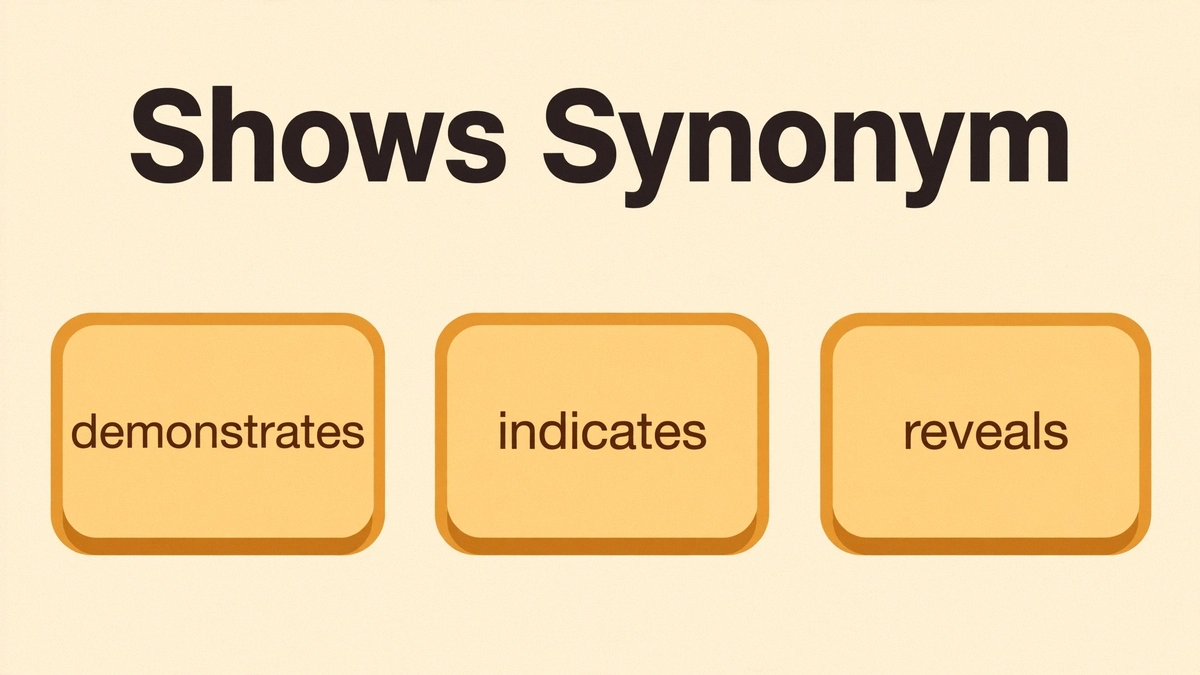
Use these when evidence supports a claim — the most common use in essays and reports:
- demonstrates — “The data demonstrates a clear rise in sales.”
- proves — “The test proves the theory works.”
- indicates — “The survey indicates that most people agree.”
- suggests — “The evidence suggests a link between the two.”
- confirms — “The results confirm our earlier findings.”
- establishes — “The study establishes a pattern over ten years.”
- signifies — “A fall in prices signifies weaker demand.”
- denotes — “The red line denotes the average.”
- attests — “His record attests to years of hard work.”
- exemplifies — “Her career exemplifies quiet dedication.”
The strength of the word should match the strength of your evidence. “Proves” claims certainty; “suggests” admits doubt. Merriam-Webster’s thesaurus lists 278 similar and opposite words for “shows” — you can browse the full list in the Merriam-Webster thesaurus entry for shows — but the ten above cover nearly every sentence an essay will ever need.
Synonyms for Shows That Mean “Guides”
Use these when a person shows someone the way or explains how something works:
- guides — “She guides visitors through the museum.”
- directs — “He directs new students to their classrooms.”
- leads — “The path leads you to the lake.”
- steers — “The teacher steers the discussion back on track.”
- escorts — “Security escorts guests to their seats.”
- ushers — “The usher ushers the audience inside.”
Synonyms for Shows That Mean “Appears”
Use these when something comes into view:
- appears — “A rainbow appears after the rain.”
- emerges — “The sun emerges from behind the clouds.”
- surfaces — “New details surface every week.”
- materializes — “A plan finally materializes after months of talk.”
“This Shows” — Better Ways to Say It in an Essay
“This shows” is the phrase teachers see most, and it is the easiest to improve. The best synonym for “this shows” depends on your evidence:
- “This demonstrates that…” — for strong proof
- “This indicates that…” — for a trend that is not yet certain
- “This suggests that…” — for a careful, qualified claim
- “This reveals that…” — for something previously hidden
- “This illustrates that…” — for an example that makes the point clear
If you are hunting for synonyms for “this shows” in an essay, keep the subject and change only the verb — the sentence structure stays the same, but the writing sounds sharper. The same trick works for emphasis: if you need an emphasizing synonym, try “underscores” or “highlights” (“The result underscores the need for change”), and the shorter form of that idea, an emphasize syn like “stresses” (“The report stresses the urgency”), does the same work in fewer words.
Essay writing rewards variety in small words too. Similarly, “likewise,” and “in the same way” all connect a new point to the last one. Another word for “overall” is “in general” or “on the whole” — and if you are collecting synonyms for “overall” in an essay, add “taken together” and “all in all” to the list. A due to synonym is “because of” or “owing to” (“The delay was owing to the weather”). Getting these small connectors right matters as much as the big verbs: a semicolon in the right place can join two related ideas just as cleanly as any synonym can replace a word.
Antonyms of Shows
Sometimes the opposite word is what you need. The antonym of “shows” is hides — and the same logic works for other strong verbs: just as an impact antonym would be a word like “lessens” or “weakens,” the opposite of revealing is concealing. Other antonyms of “shows” include conceals, obscures, and withholds. “The report hides the real costs” says the opposite of “the report shows the real costs,” and choosing between the two is a choice about what you believe, not just about style.
How to Choose the Right Synonym
- Name the meaning first. Displays, reveals, proves, guides, or appears? The group decides the word.
- Match the strength. “Proves” is stronger than “suggests.” Do not claim more than your evidence supports.
- Keep it natural. If a word sounds stiff in your sentence, it is the wrong word. “Evinces” belongs in formal writing, not in a text to a friend.
- Do not swap blindly. A thesaurus gives you options, not answers — read the sentence aloud with the new word and check it still means what you meant.
Word choice is a skill that shows up everywhere, not only in essays. A formal letter needs precise verbs just as much as a school essay does, and even a short note benefits from the right word: the parents writing thank you teacher messages from parents know that “your lessons inspired us” says more than “your lessons showed us.”
Frequently Asked Questions
What is the best synonym for shows?
It depends on the meaning. For evidence, use “demonstrates” or “indicates.” For revealing something hidden, use “reveals.” For display, use “exhibits” or “presents.” There is no single best synonym — the context decides.
What is another word for “this shows” in an essay?
“This demonstrates,” “this indicates,” “this suggests,” “this reveals,” and “this illustrates” are the most useful replacements. Choose by how strong your evidence is.
What is the opposite of shows?
“Hides” is the direct antonym. “Conceals,” “obscures,” and “withholds” are close alternatives.
Is “shows” a weak word?
Not always — sometimes it is exactly right. It becomes weak only when it is repeated so often that it stops saying anything specific. Replace it where a sharper word fits, and keep it where it is clear and honest.