
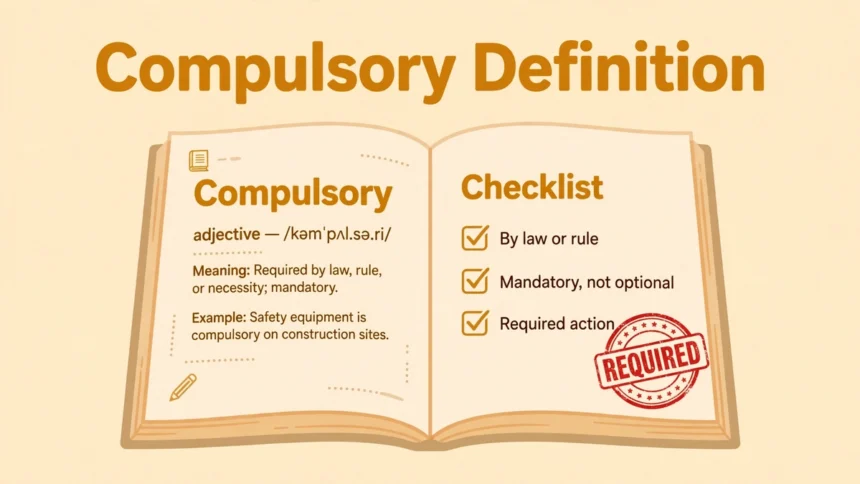
Compulsory definition: compulsory means required by a law or a rule — something you must do, not something you can choose. If school attendance is compulsory, you have to go. If wearing a seat belt is compulsory, you have to wear one. The word is short, formal, and useful exactly because it leaves no room for argument: compulsory means you do not get to decide.
What Does “Compulsory” Mean?
Compulsory is an adjective with two closely related senses:
- Required; mandatory; obligatory — something that must be done because of a law or a rule. “English is a compulsory subject at this level.” “Car insurance is compulsory.” “Attendance at the meeting is compulsory for all employees.”
- Using compulsion; compelling; constraining — something that forces action. “Compulsory measures to control rioting.”
The first sense is the one you will meet almost every time. As a noun, “compulsory” (plural “compulsories”) also names something that must be performed as part of a contest — in ice skating, for example, the compulsories are the set figures every skater must perform. The Wiktionary entry for “compulsory” lists both the adjective and the noun senses, with the same core idea running through them: something required, not chosen.
Pronunciation and Word Forms
Compulsory is pronounced /kəmˈpʌlsəri/ — “kum-PUL-suh-ree.” The stress falls on the second syllable, and the word comes from Medieval Latin compulsorius, from the Latin verb compellere — com- (“together”) + pellere (“to drive”) — literally “driven together,” or forced. The word entered English in the early 16th century, first as a noun for a legal mandate that had to be obeyed.
Useful forms to know:
- compulsory (adjective) — “a compulsory examination”
- compulsorily (adverb) — “pupils must compulsorily attend” (rare; “must attend” is more natural)
- compulsion (noun) — the force itself: “under compulsion”
- compulsories (noun, plural) — the required elements in a competition
Compulsory vs Mandatory vs Obligatory
These three words overlap, but they are not identical:
| Word | Shade of meaning | Best example |
|---|---|---|
| compulsory | required by law or rule | Compulsory education |
| mandatory | required by law or authority, often with a penalty | Mandatory seat belt laws |
| obligatory | required by duty, custom, or a rule | Obligatory attendance |
In everyday use they are close enough to swap in many sentences — “compulsory schooling” and “mandatory schooling” mean the same thing in practice. The difference is emphasis: “compulsory” points at the rule, “mandatory” points at the authority behind it, and “obligatory” points at the duty. If you want one safe synonym for most sentences, use mandatory.
Compulsory in Everyday Life
The word shows up in a few places again and again:
- Education — school attendance is compulsory in most countries, and some subjects are compulsory for all students. In England, compulsory education was introduced in 1870. Maths and English are compulsory for all students in many school systems. The Wikipedia article on compulsory education covers how different countries set the ages and rules.
- Driving — wearing a seat belt is compulsory in most countries, and car insurance is compulsory almost everywhere.
- Work — attendance at some meetings is compulsory for all employees, and safety equipment is compulsory on construction sites.
- Sport — in gymnastics and ice skating, competitors must perform compulsory elements alongside their freestyle routines.
- Public life — military service is compulsory for men in some countries, and jury duty is compulsory where it exists.
Synonyms and Antonyms of Compulsory
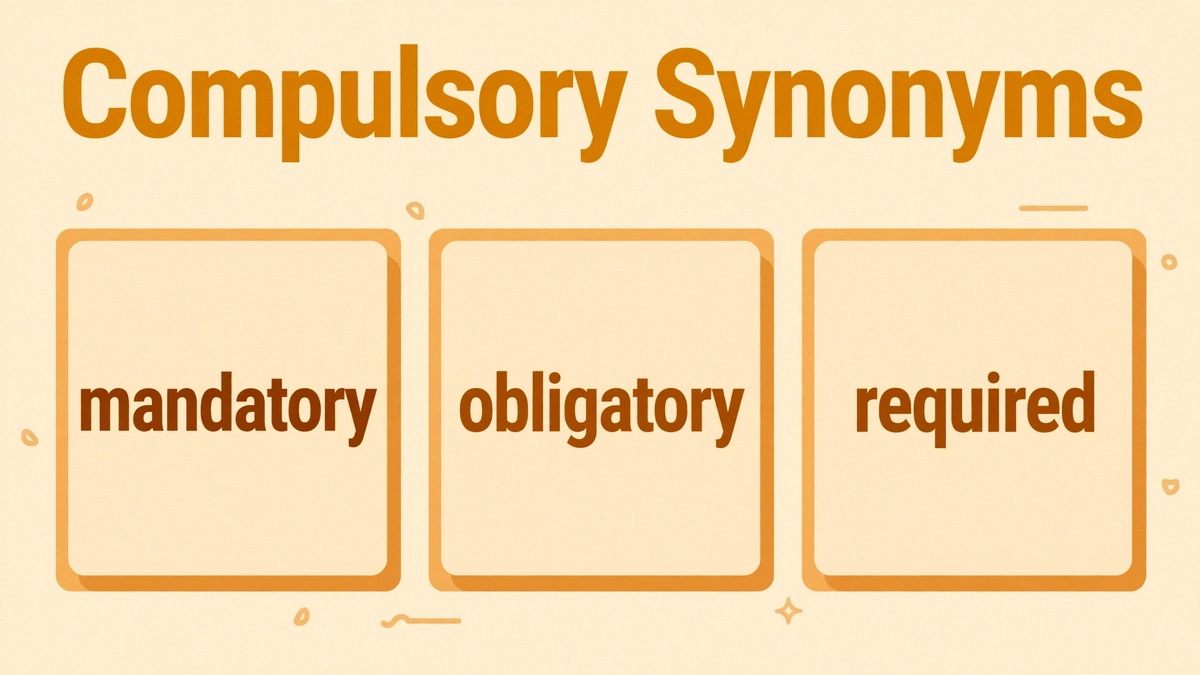
The closest synonyms, in order of usefulness:
- mandatory — the best all-round replacement
- obligatory — slightly more formal, duty-flavoured
- required — the plainest option
- binding — required by an agreement or contract
- imperative — urgent and required
The direct antonyms are voluntary and optional: “Attendance is voluntary” is the exact opposite of “Attendance is compulsory.” If you can choose, it is not compulsory.
Compulsory vs Compulsive: A Common Mix-Up
These two words look alike and share a Latin root, but they mean different things:
- Compulsory means required by a rule: “Compulsory schooling.”
- Compulsive means driven by an irresistible urge: “Compulsive shopping,” “compulsive behaviour.”
A compulsory action is imposed from outside, by a law or an authority. A compulsive action is driven from inside, by an urge the person cannot easily resist. Mixing them up changes the meaning completely — nobody wants to call a school rule “compulsive” or a habit “compulsory.”
How to Use “Compulsory” in a Sentence
- “Wearing a helmet is compulsory for all motorcyclists.”
- “It is compulsory for all students to take English.”
- “The training is compulsory, not optional.”
- “Is it compulsory for me to attend the class?”
- “The new rules made health checks compulsory for all staff.”
The pattern is simple: “compulsory” goes before the noun (“compulsory education”) or after “is” (“it is compulsory to…”). It is a formal word, so it fits official notices, school rules, and legal writing better than casual chat — but it is perfectly clear in everyday sentences too.
Compulsory in Writing
Word choice is a skill that shows up everywhere, not only in essays. A formal letter needs precise words just as much as a school essay does, and the same care applies to other confusable words: if you mix up “principal” and “principle,” the guide to principal vs principle sorts that pair out, and the word lists in shows synonym show how a sharper verb can replace a tired one. “Compulsory” earns its place the same way: it says “you must” in a single word, with no room for argument.
Frequently Asked Questions
What is the simple definition of compulsory?
Something that must be done because of a law or a rule. If it is compulsory, you do not get to choose.
What is the difference between compulsory and mandatory?
Very little in everyday use. “Compulsory” points at the rule, “mandatory” points at the authority behind it. They are interchangeable in most sentences.
What is the opposite of compulsory?
Voluntary or optional. If attendance is voluntary, nobody has to come; if it is compulsory, everybody has to come.
Is “compulsory” the same as “compulsive”?
No. Compulsory means required by a rule; compulsive means driven by an irresistible urge. They share a Latin root but describe opposite directions of force.