
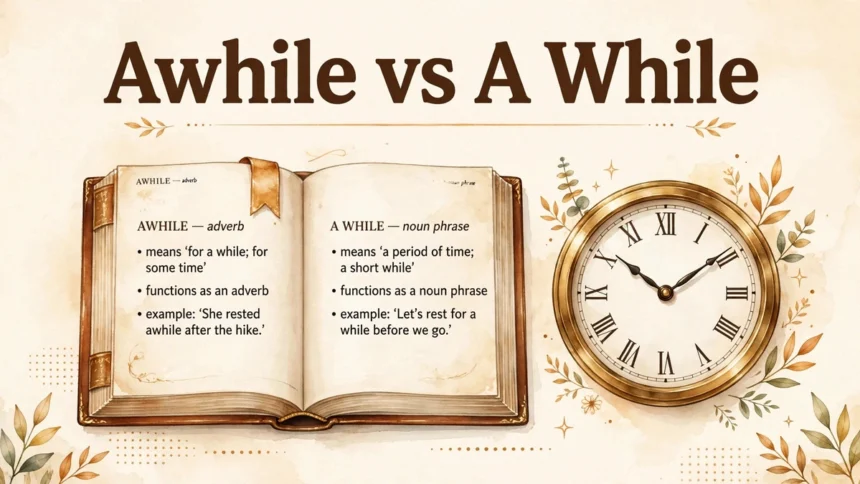
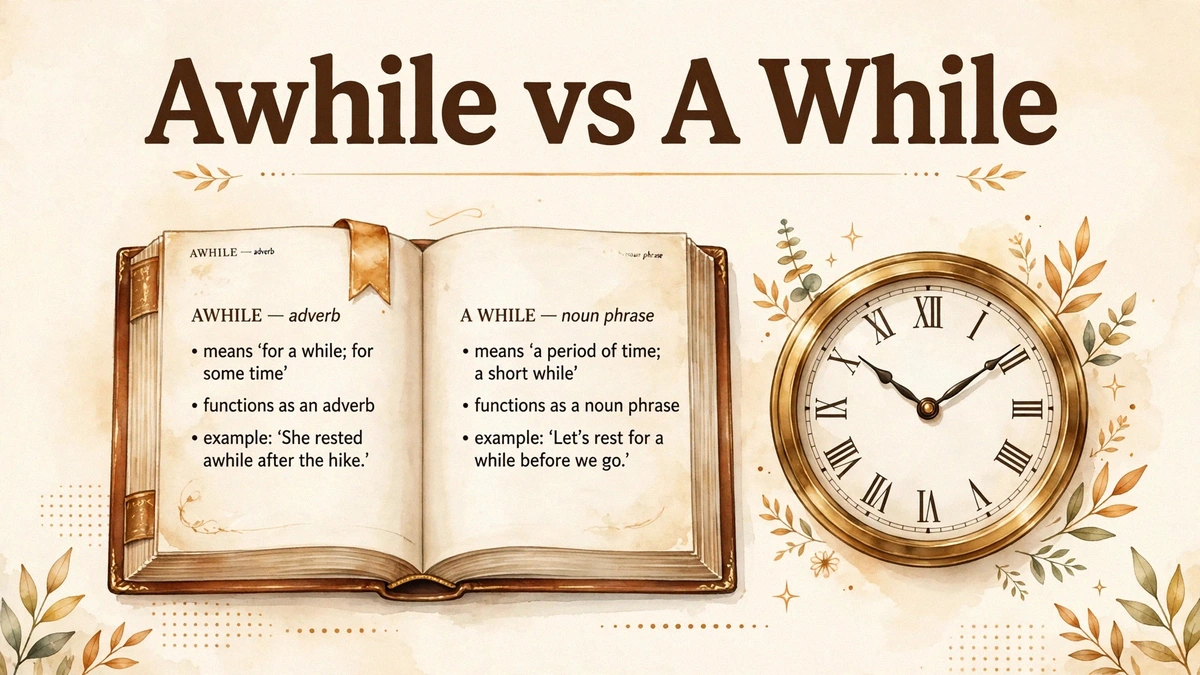
Awhile vs a while: awhile (one word) is an adverb meaning “for a short time,” and a while (two words) is a noun phrase meaning “a period of time.” They sound identical, they both talk about time, and the only visible difference is a single space — but that space changes the grammar. Use awhile right after a verb, and use a while after a preposition such as for, in, or after.
The Short Answer
| Form | What it is | When to use it | Example |
|---|---|---|---|
| awhile | Adverb — “for a short time” | Directly after a verb, with no preposition before it | “Stay awhile and rest.” |
| a while | Noun phrase — “a period of time” | After a preposition (for, in, after), or with ago and back | “Stay for a while and rest.” |
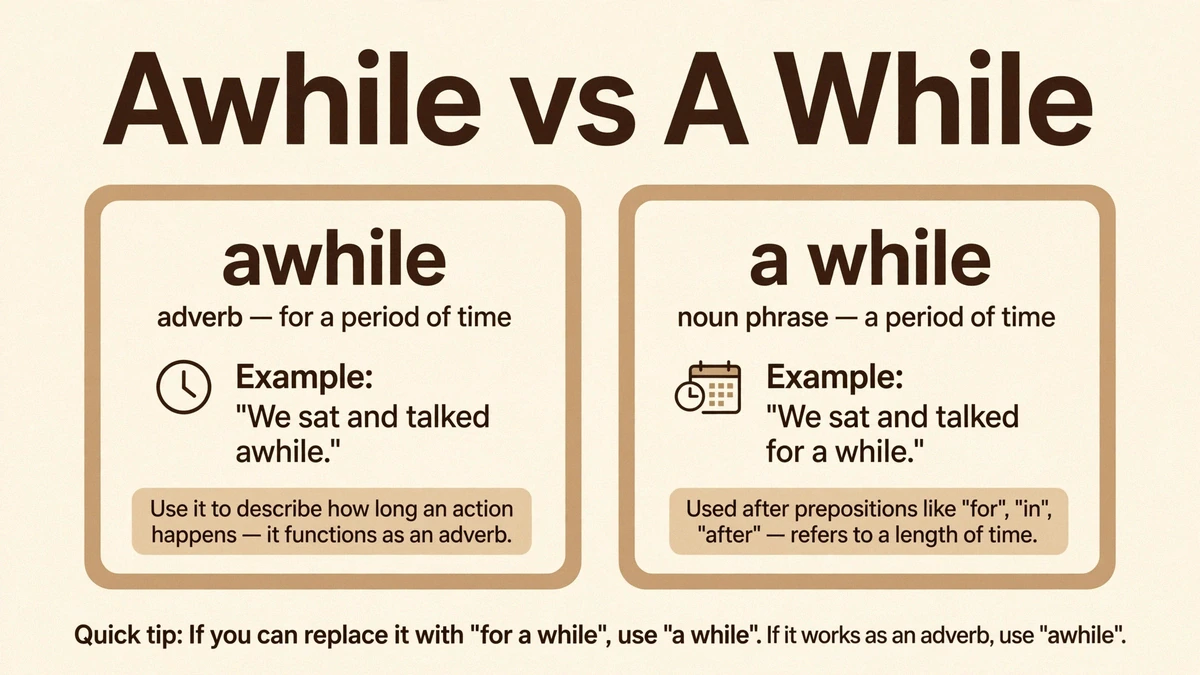
The quickest check is the “for” test: if you can put “for” in front of the expression, you need two words. “Wait for a while” works; “wait for awhile” does not, because “for” is a preposition and a preposition needs a noun after it, not an adverb.
What Does “Awhile” Mean?
Awhile is a single-word adverb. It modifies a verb and tells you how long the action lasts — it means “for a short time” or “for a period of time.” Because it is an adverb, it can never follow a preposition. The Wiktionary entry for “awhile” defines it as an adverb meaning “for some time; for a while,” and lists the same job in every example: it sits right after the verb it describes.
Use awhile with verbs such as wait, rest, sit, stay, and talk:
- “Please wait awhile before you call again.”
- “Rest awhile before you start the next task.”
- “Sit awhile and look at the map.”
- “We sat and talked awhile after dinner.”
- “Stay awhile and chat before you leave.”
In each sentence, awhile answers the question “how long?” about the verb. You can test it by swapping in another adverb: “wait quietly” works the same way “wait awhile” does, which is the sign that awhile is doing an adverb’s job.
What Does “A While” Mean?
A while is a two-word noun phrase: the article “a” plus the noun “while,” which means a period or length of time. Together they name a stretch of time, and because the phrase is a noun, it is the form that follows prepositions. The Wiktionary entry for “while” lists the noun sense as “a period of time,” which is exactly the meaning at work here.
Use a while after a preposition, and in the fixed expressions with ago and back:
- “We waited for a while outside the clinic.”
- “I will call you back in a while.”
- “After a while, the room became quieter.”
- “We met a while ago at a training course.”
- “I read that article a while back.”
- “The repair took a while.”
In the last example there is no preposition, but a while still works because it is the object naming how long the repair took — it is a noun phrase doing a noun’s job, not an adverb modifying a verb.
The “For” Test: One Rule That Settles Most Cases
When you are unsure whether to write a while or awhile, try the “for” test:
- Put “for” in front of the expression. If the sentence still makes sense, you need the two-word form: “wait for a while.”
- If “for” is already there, the choice is made. A preposition is always followed by the noun phrase: “for a while,” never “for awhile.”
- If the word sits directly after a verb with no preposition, awhile fits. “Wait awhile” means the same as “wait for a while,” with the “for” folded into the single word.
This one test settles the most common mistake in this pair. “For awhile” is always wrong in careful writing, because “for” needs a noun after it and awhile is an adverb.
Awhile vs A While: Side by Side
| awhile | a while | |
|---|---|---|
| Spelling | One word | Two words |
| Part of speech | Adverb | Noun phrase (article + noun) |
| Meaning | For a short time | A period of time |
| Follows a preposition? | Never | Yes — for, in, after, before |
| Follows a verb directly? | Yes | Sometimes (as an object) |
| Works with ago / back? | No | Yes — a while ago, a while back |
| Example | “Rest awhile.” | “Rest for a while.” |
Common Mistakes to Avoid
“For awhile” — wrong. The preposition “for” needs the noun phrase: “for a while.” This is the single most frequent error with this pair, and the “for” test catches it every time.
“Awhile ago” — wrong in careful writing. The established expression is “a while ago.” Some writers do use “awhile ago” informally, but “ago” works with the noun phrase, so “a while ago” is the safe choice in school, work, and edited writing.
“Once in awhile” — wrong. The fixed phrase is “once in a while.” “In” is a preposition, so it takes the two-word form.
“It’s been awhile” — wrong. The correct sentence is “It’s been a while.” Here “a while” is the noun phrase naming the period since something happened.
“After awhile” — wrong in careful writing. “After” is a preposition, so it takes “a while”: “after a while, the room became quieter.” The one-word spelling does appear informally, but it breaks the same rule as “for awhile.”
How Long Is “A While”?
Neither form names an exact length of time. “A while” usually means a short period, but short is relative: waiting a while for a kettle to boil is a few minutes, while waiting a while for a letter can be weeks. The length depends on what you are waiting for, not on the word itself. What the two forms share is vagueness about duration — what they differ in is grammar, not in how many minutes they mean.
Awhile vs A While in Writing
In careful writing — school essays, work emails, published articles — follow the structure rule every time: a while after a preposition or with ago and back, awhile directly after a verb. Readers usually understand either spelling in a quick text message, but in edited writing the wrong form reads as a mistake, and the right form signals that you know the grammar.
Getting small words right is a habit that carries across the whole sentence. The same care applies to other confusable pairs: the guide to to vs too sorts out another pair that sounds identical, and principal vs principle does the same for two words that differ by a single letter. Punctuation matters too — knowing when to use a semicolon instead of a comma keeps long sentences clear in the same way the right spelling keeps a short phrase clear. Awhile and a while earn their place in that list: one space, one rule, and no more guessing.
Examples: Awhile and A While in Sentences
Awhile (adverb, after a verb):
- “Wait awhile before you call again.”
- “She rested awhile after the hike.”
- “Let’s sit awhile and enjoy the view.”
- “He stayed awhile to finish the conversation.”
- “The dog slept awhile in the sun.”
A while (noun phrase, after a preposition or with ago/back):
- “We waited for a while outside the clinic.”
- “I haven’t seen her in a while.”
- “It took a while to finish the puzzle.”
- “We met a while ago at a training course.”
- “After a while, the noise stopped.”
Notice the pattern in every pair: where “for” appears, the two-word form follows; where the word stands alone after the verb, the one-word form does the job.
Frequently Asked Questions
What is the difference between awhile and a while?
Awhile is an adverb meaning “for a short time” and modifies a verb directly (“wait awhile”). A while is a noun phrase meaning “a period of time” and follows prepositions (“for a while”) or appears with ago and back (“a while ago”).
Is it “for awhile” or “for a while”?
Always “for a while.” “For” is a preposition, and a preposition is followed by the noun phrase a while. “For awhile” is incorrect in careful writing.
Is “a while ago” or “awhile ago” correct?
“A while ago” is correct. The fixed expression uses the two-word noun phrase, just like “a while back.”
Can awhile and a while be used interchangeably?
Not in careful writing. In informal messages readers usually understand either spelling, but the grammar is different: only a while can follow a preposition, and awhile only works directly after a verb. If you are unsure which to write, “a while” is the safer choice — it fits more sentence patterns than awhile does.