
To vs too is one of the most common mix-ups in English. The two words sound exactly the same, differ by a single letter, and do completely different jobs. To shows direction or starts an action; too means “also” or “more than enough.” Once you know the job each word does, the choice is easy — and there is a one-second test that settles it every time.
What Does “To” Mean?
To is a preposition, and it is also the little word that introduces an infinitive (the base form of a verb). It does two main jobs:
- Direction or destination — it points somewhere: “We drove to the station.” “Give the book to Ava.” “I walked to the park.”
- Infinitive marker — it comes before a verb to show purpose or intention: “I want to sleep.” “She hopes to visit soon.” “It is time to eat.”
To has other uses too — it can mark a recipient (“Send it to me”), a limit (“from nine to five”), or a comparison (“I prefer tea to coffee”) — but direction and the infinitive cover almost every sentence you will write. The Wiktionary entry for “to” lists these uses in full, and they all come back to the same idea: “to” points at something.
What Does “Too” Mean?
Too is an adverb, and it has two meanings:
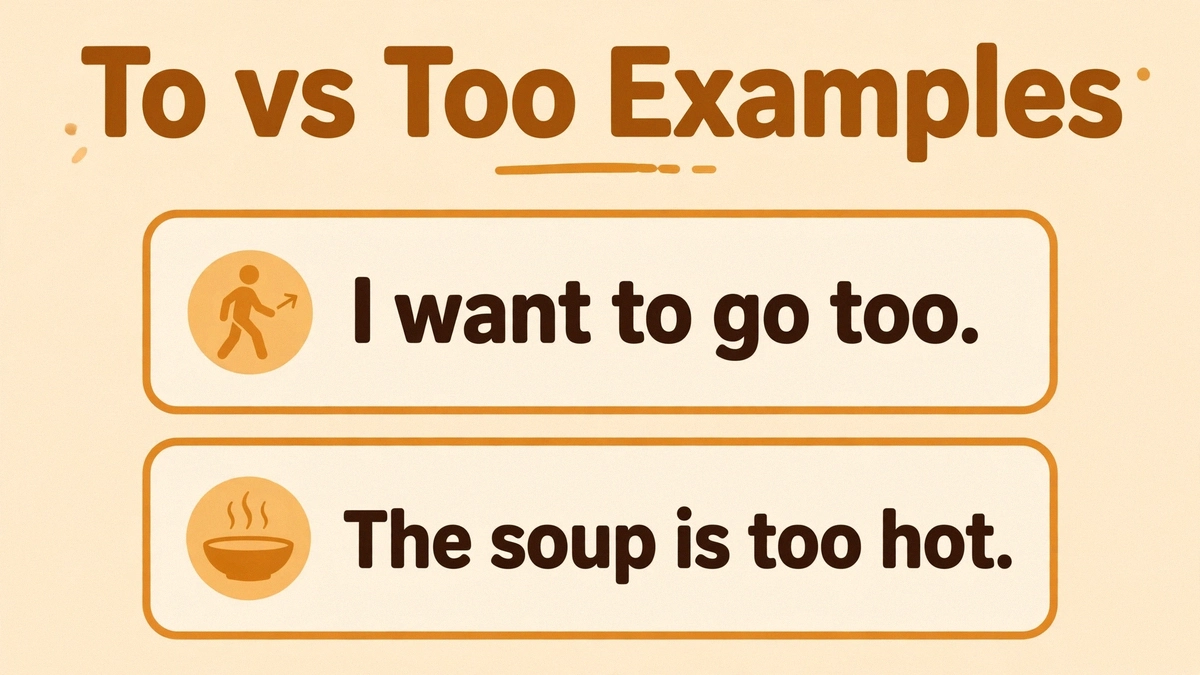
- Also, or in addition — “I want to go too.” “She likes dogs too.” It usually sits at or near the end of the sentence.
- More than enough, or excessively — “The soup is too hot.” “That bag is too heavy.” “It is too late.” Here it sits before an adjective or adverb and turns the volume up past the limit.
The Wiktionary entry for “too” gives both senses, and the test is simple: if you can swap in “also” or “very” and the sentence still makes sense, “too” is the right word.
To vs Too at a Glance
| Word | Part of speech | Meaning | Example |
|---|---|---|---|
| to | preposition | direction or destination | We drove to the station. |
| to | infinitive marker | introduces the base form of a verb | Mia hopes to visit soon. |
| too | adverb | also, in addition | I enjoy hiking too. |
| too | adverb | more than needed or suitable | The bag is too heavy. |
The Quick Test That Always Works
Stuck between to and too? Replace the word with “also” or “very”:
- “I want to go too.” → “I want to go also.” It works, so it is “too.”
- “The soup is too hot.” → “The soup is very hot.” It works, so it is “too.”
- “We drove to the station.” → “We drove also the station.” It fails, so it is “to.”
- “I want to sleep.” → “I want very sleep.” It fails, so it is “to.”
There is a memory trick too: “too” has an extra “o” because it means something extra — an extra person (“me too”) or an extra amount (“too much”). The extra letter is the clue.
Common Mistakes with To and Too
- “To late” or “too late”? It is too late — the lateness is more than you wanted. (“I checked for tickets, but we’re too late; they’re sold out.”)
- “Used to” or “used too”? It is used to — “I used to live here” talks about a past habit, and “to” is part of the phrase. “Used too” is never right.
- “To badly or too badly”? It is too badly — “I want it too badly” means the wanting is excessive. “To badly” is a mistake.
- “To much” or “too much”? It is too much — “much” is an amount, and “too” means more than enough. “Too much candy,” “too much noise,” “too much work.”
- “Me to” or “me too”? It is me too — you are adding yourself, so it is the “also” meaning.
What About “Two”?
“To,” “too,” and “two” are homophones — words that sound the same but mean different things. Two is simply the number 2: “I bought two cakes.” It never means direction or “also.” If your sentence is counting, it is “two.” If it is pointing or starting a verb, it is “to.” If it is “also” or “too much,” it is “too.”
Other Confusable Pairs Worth Knowing
Once you can tell to from too, the same habit helps with other pairs that trip people up. A while or awhile is a good next one: “a while” is a noun phrase meaning a period of time (“Stay a while”), while “awhile” is an adverb meaning “for a short time” (“Stay awhile”). The rule is the same as ever: check what the word is doing in the sentence, and the spelling follows.
To vs Too in Real Writing
The difference shows up everywhere, not only in school exercises. Getting it right matters most in writing that other people read carefully — a formal letter is no place for “to much,” and a semicolon in the wrong place can confuse a reader just as surely as a wrong “to.” The same care applies to other confusable words: if you mix up “principal” and “principle,” the guide to principal vs principle sorts that pair out the same way.
Frequently Asked Questions
Is it “to late” or “too late”?
Too late. The lateness is more than you wanted, so it is the “excessive” meaning of “too.”
How do I remember the difference between to and too?
Use the swap test: if “also” or “very” fits, use “too.” Or remember that “too” has an extra “o” because it means something extra.
Is “two” ever correct instead of “to” or “too”?
Only when you are counting. “Two” is the number 2. It never means direction or “also.”
Can “too” start a sentence?
Yes, in the “also” sense it can appear at the start in short replies: “Too bad.” “Too true.” In full sentences it usually sits at the end (“I like it too”) or before an adjective (“too hot”).