
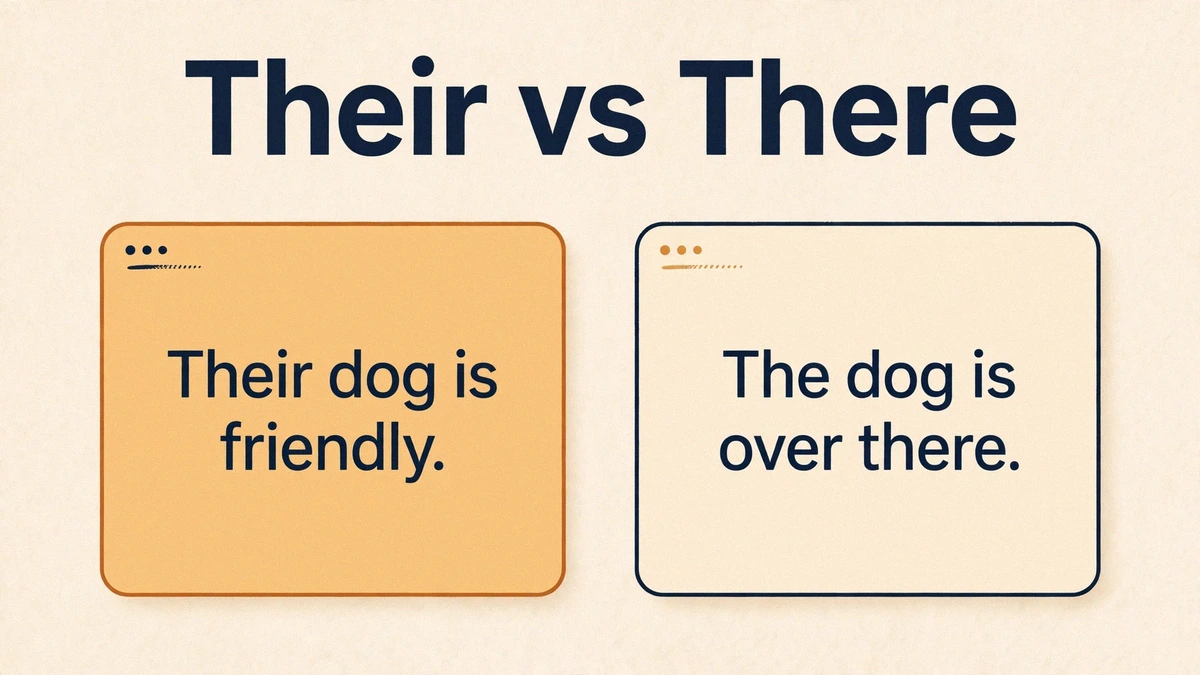
Their vs there: their shows that something belongs to a group of people, and there points to a place or to something that exists. “Their dog is friendly” means the dog belongs to them. “The dog is over there” means the dog is in that place. The two words sound exactly the same, which is why they are mixed up so often — but they do different jobs, and once you know the job, the choice is easy.
The Short Answer
| Word | What it does | Quick test |
|---|---|---|
| their | possessive adjective — shows belonging | Replace it with “his” or “her.” If the sentence still makes sense, use their. |
| there | adverb of place, or introduces something that exists | Replace it with “here.” If the sentence still makes sense, use there. |
| they’re | contraction of “they are” | Replace it with “they are.” If the sentence still makes sense, use they’re. |
Three words, three jobs, one sound. The rest of this guide works through each one with examples, then gives you the tests that settle any sentence in seconds.
What Does “Their” Mean?
Their is the possessive adjective that goes with “they.” It shows that something belongs to a group of people, animals, or things, and it always sits directly in front of a noun:
- “Their house is at the end of the street.”
- “The students forgot their books.”
- “The dogs wagged their tails.”
- “Is this their car or yours?”
Their never stands alone and never takes a verb straight after it. If the word after it is a noun — house, books, tails, car — their is the right choice. It is also used as a gender-neutral possessive for one person when their gender is unknown or not relevant: “Someone left their umbrella behind.” The Wiktionary entry for “their” lists it as the possessive form of “they,” used attributively before a noun.
What Does “There” Mean?
There has two main jobs, and both are about place or existence rather than belonging:
1. There as a place. There is an adverb meaning “in or at that place” — the opposite of “here.” In fact, there has “here” hidden inside it, which is the easiest way to remember it:
- “Put the keys over there.”
- “We have never been there.”
- “There it is, on the top shelf.”
2. There as existence. There also introduces the existence of something, most often in the fixed pattern “there is” / “there are”:
- “There is a problem with the printer.”
- “There are three apples left.”
- “There was a storm last night.”
In this second use, there is a dummy subject — it does not point to a place at all, it simply opens the sentence so the real subject can follow. The Wiktionary entry for “there” covers both the adverb of place and the existential use, along with the idioms built on it, such as “hang in there.”
They’re: The Third Word in the Trio
They’re is simply the contraction of “they are.” The apostrophe shows that the “a” of “are” has been dropped, just as in “we’re” (we are) or “you’re” (you are):
- “They’re coming to the party tonight.”
- “They’re the best team in the league.”
- “I think they’re ready.”
They’re is never followed by a noun the way their is, and it never points to a place the way there does. If you can swap in “they are” and the sentence still works, they’re is correct. This article’s focus is their vs there, but they’re belongs in the picture because it is the third member of the trio — and the one most often written when their is meant.
Their vs There vs They’re: Side by Side
| Word | Part of speech | Meaning | Example |
|---|---|---|---|
| their | possessive adjective | belonging to them | Their dog is friendly. |
| there | adverb / pronoun | that place; something exists | The dog is over there. / There is a dog. |
| they’re | contraction | they are | They’re walking the dog. |
One sentence can hold all three without any confusion once the jobs are clear: “They’re going over there to feed their dog.” Each word does its own job, and no other spelling would work in its place.
Three Quick Tests That Always Work
When you are unsure, run these tests in order:
- Can you say “they are”? If yes, write they’re. “They’re (they are) late.” If “they are” makes no sense, move on.
- Can you say “his” or “her”? If yes, write their. “Their (his) house is big.” If “his” or “her” makes no sense, move on.
- Otherwise, write there. “There is a problem.” “Put it over there.” Neither test worked, so there is the answer.
A second memory trick helps too: there contains here, a place word; their contains heir, someone who inherits and owns things; and they’re is the only one of the three with an apostrophe, the mark of a contraction.
The Most Common Mistakes (and the Fixes)
| Wrong | Right | Why |
|---|---|---|
| Their coming to the party. | They’re coming to the party. | “They are coming” works, so the contraction is needed. |
| Their is a problem. | There is a problem. | The sentence introduces something that exists — the fixed “there is” pattern. |
| They’re dog is very friendly. | Their dog is very friendly. | A noun (“dog”) follows directly, so the possessive adjective is needed. |
| Put the keys over their. | Put the keys over there. | A place is meant, so the adverb is needed. |
| There going to love it. | They’re going to love it. | “They are going” works, so the contraction is needed. |
The single most frequent error is using “there” where “their” or “they’re” belongs — unsurprising, since there is the most common of the three words. Running the two substitution tests catches it every time.
Theirs, There’s and the “Thier” Misspelling
Two lookalikes cause extra trouble:
- Theirs is a possessive pronoun, not an adjective. It replaces a noun instead of sitting in front of one: “That house is theirs.” It never takes a noun after it, and it has no apostrophe.
- There’s is the contraction of “there is”: “There’s someone at the door.” Despite looking like “theirs,” it means something completely different.
Then there is the spelling trap. If you have ever typed “their or thier” into a search box, you are not alone — “thier” is one of the most common misspellings of “their,” with the “i” and “e” swapped. The correct spelling is t-h-e-i-r: “their” follows the same “i before e” pattern as “their” itself — remember it as “t-h-e-i-r,” with the “i” coming first. There is no word “thier” in English, so any spellchecker flagging it is right.
More Confusable Words Worth Learning
Their vs there is not the only trio that trips writers up. English is full of words that sound alike but behave differently: the to vs too trio works the same way, with one word doing the job of a preposition, one meaning “also,” and one being the number two. And if you mix up “principal” and “principle,” the guide to principal vs principle sorts that pair out the same way — meaning first, then a quick test. Getting small words right is part of careful writing, just like knowing when to use a semicolon instead of a comma — each choice is small on its own, and together they decide whether a sentence reads cleanly.
Examples in Sentences
Their:
- “Their team won the match.”
- “The neighbours painted their fence blue.”
- “Everyone brought their own lunch.”
There:
- “There is a bus stop at the corner.”
- “We sat there for an hour.”
- “There are no tickets left.”
They’re:
- “They’re waiting outside.”
- “They’re the ones who called.”
- “I hope they’re feeling better.”
Frequently Asked Questions
What is the difference between their and there?
Their shows possession — something belongs to a group (“their house”). There points to a place (“over there”) or introduces something that exists (“there is a house”). They sound the same but do different jobs.
How do I remember which one to use?
Replace the word with “his” or “her” — if it fits, use their. Replace it with “here” — if it fits, use there. Replace it with “they are” — if it fits, use they’re. If none fits except the place or existence sense, it is there.
Is “they’re” the same as “their”?
No. They’re is a contraction of “they are” (“They’re coming”), while their is a possessive adjective that must come before a noun (“their car”). Swapping them changes the meaning of the sentence.
What does “thier” mean?
Nothing — “thier” is not a word. It is a common misspelling of “their” with the “i” and “e” swapped. The correct spelling is t-h-e-i-r.
Is it “there names” or “their names”?
Their names. The names belong to the people, so the possessive adjective “their” is needed: “What are their names?”