
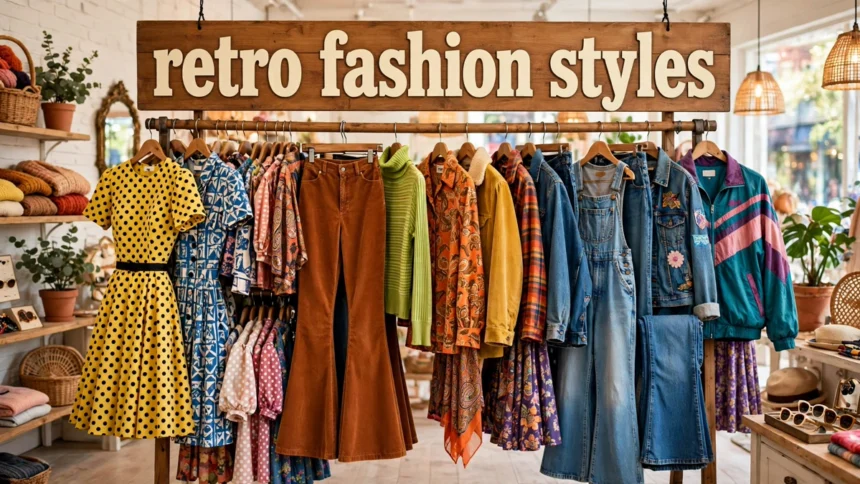
Walk into a shop and see a brand-new dress with a 1970s print, a fresh pair of wide-leg jeans nodding to the 1990s, or a newly stitched polka-dot skirt — and you are looking at retro fashion styles. “Retro” does not mean old. It means new clothing, deliberately designed to look like a past decade. Understanding that one distinction unlocks the whole subject, because almost every confusion about retro fashion comes from mixing it up with vintage.
Retro vs vintage vs antique
These three words describe different things, and shops mix them up freely:
- Retro: newly made clothing and accessories that imitate the styles of a previous era. A 1950s-style circle skirt sewn this year is retro. The word comes from the Latin prefix retro, meaning backwards or in past times, and it has been used in fashion since the 1970s.
- Vintage: genuine garments actually produced in the referenced period, typically between 20 and 100 years old. A dress sewn in 1962 and worn today is vintage.
- Antique: genuine garments at least 100 years old. These are museum pieces and collectors’ items more than everyday wear.
The practical difference is simple: retro is a design choice you can buy new, in your size, with modern fabrics and construction. Vintage is a hunt — one original item, in whatever condition and size it survived in. Both can look similar from across the room, but only one of them comes with a return policy.
Retro is also not a single look. Because it can target any decade, it functions as a method rather than a visual system: pick a reference era, borrow its silhouettes, colours, fabrics, and details, and make them new. That is why a shop can sell “retro” pieces from five different decades on the same rail without contradicting itself.
The 1950s: cinched waists and full skirts
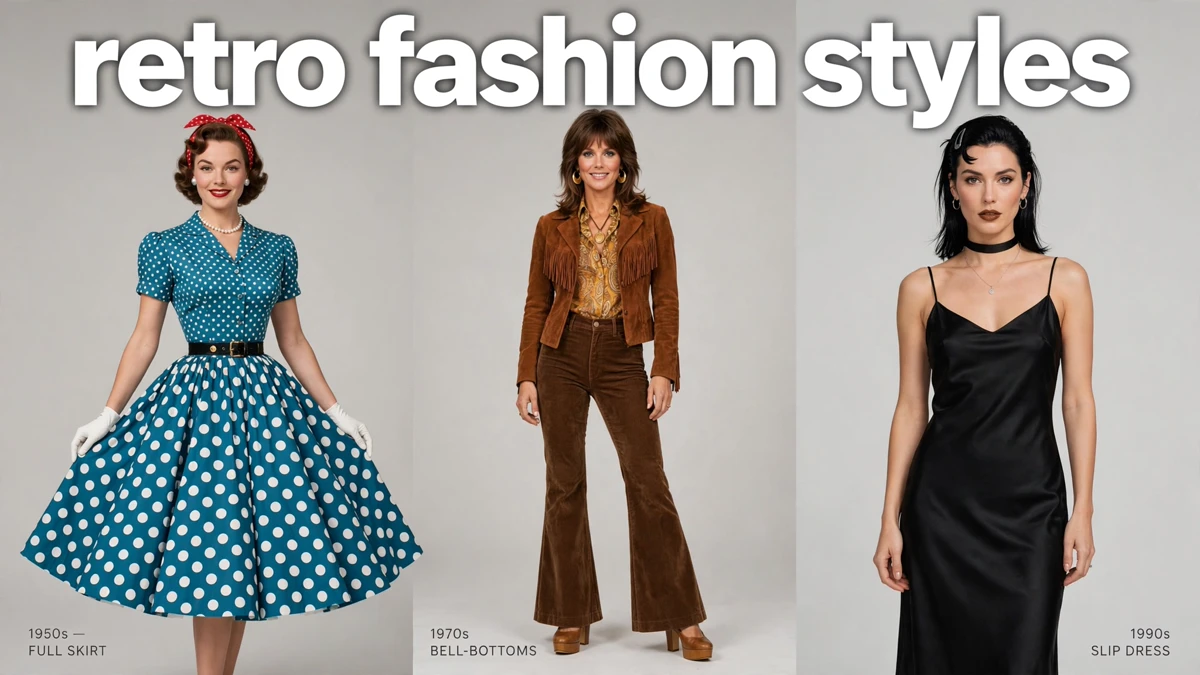
The 1950s retro look is defined by shape: nipped waists, full circle skirts with petticoats, fitted cardigans, and high-waisted wide-leg trousers for a sharper, tailored version. Polka dots, gingham, and small floral prints carry the era, along with pastel colours and, for evening, a more dramatic red or black. The mood is post-war optimism made wearable — neat, feminine, and deliberately put-together.
To wear it now without looking costumed, take one element rather than the whole outfit: a full skirt with a plain modern top, or a fitted cardigan with straight jeans. The silhouette does the work; the rest of the outfit can stay current.
The 1960s: mod shifts and bold geometry
The 1960s broke the 1950s shape. The signature retro pieces are A-line shift dresses, slim mod suits with narrow lapels, mini skirts, and bold geometric prints in high-contrast colours. Go-go boots complete the look, and the overall energy is youthful and graphic — the decade’s social upheaval expressed as clean lines and bright colour.
The modern way to wear 1960s retro is through the shift dress or a geometric print, kept to one statement piece. A full mod outfit, boots included, reads as a costume; a single shift dress with modern shoes reads as a deliberate style choice.
The 1970s: bell-bottoms, earth tones, and bohemian flow
The 1970s is the most borrowed decade in retro fashion, and the easiest to recognise: high-waisted bell-bottoms, wide lapels, elongated shirt collars, wrap dresses, maxi dresses, peasant blouses, and earthy tones — browns, oranges, mustard, and olive. Disco added its own branch: sequins, shiny fabrics, jumpsuits, and platform shoes.
Bell-bottoms are the gateway piece. A high-waisted flare with a fitted top gives the 1970s line without the full disco commitment, and earth tones pair easily with a modern wardrobe. If you want the decade’s spirit without its volume, a wrap dress in a 1970s print does the same job more quietly.
The 1980s: power shoulders and neon
The 1980s went loud: exaggerated padded shoulders, power suits, acid-wash denim, neon colours, and accessories worn in excess. The decade’s fashion was about visibility — being seen, and being seen as powerful. Oversized blazers, belted at the waist, and high-waisted tapered trousers are the pieces that survive best as retro today.
The 1980s is also the decade most likely to tip into costume, so restraint matters. One power shoulder — a blazer with strong shoulders over a simple top and straight trousers — gives the reference without the full 1980s volume. Neon works the same way: one neon accessory, not a neon outfit.
The 1990s and Y2K: minimalism, grunge, and logo mania
The 1990s retro wave splits in two. The early-to-mid 1990s brought minimalism and grunge: slip dresses, straight-leg or wide-leg high-waisted jeans, cropped cardigans, flannel shirts, and a muted palette. The late 1990s into the early 2000s — the Y2K look — swung the other way: low-rise jeans, baby tees, cargo pants, logo-heavy pieces, shiny fabrics, and a playful, tech-optimistic mood.
This is the retro wave most visible right now, partly because the people who wore it first time around are now buying it again, and partly because its pieces — slip dresses, wide-leg jeans, cropped cardigans — are easy to wear today. Denim is the through-line: from baggy 1990s jeans to 1970s wide-leg styles, denim carries more retro references than any other fabric, and its throwback forms are explored in what are jorts.
How to wear retro without looking costumed
The rule that separates stylish retro from fancy dress is commitment to one era’s proportions, not a mixture of decade cues. A 1950s skirt with 1980s shoulders and 1990s shoes is not retro — it is a jumble. Pick one reference decade, take its key proportion (the waist, the flare, the shoulder), and let the rest of the outfit stay modern.
Three practical tips follow from that rule:
- One statement piece. Let one retro item carry the reference — the flare, the print, the shoulder — and keep everything else simple and current.
- Modern fabric and fit. Retro made today has the advantage of modern stretch, construction, and sizing. Use it; a period-accurate fit that does not suit your body is not more authentic, it is just less comfortable.
- Match the occasion. A full retro look suits a themed event; a single retro piece suits everyday life. The same dress can do both jobs depending on what you pair it with.
That same “one statement piece” thinking applies to getting dressed in general — the simple, low-effort approach described in what to wear today works just as well when the statement piece happens to be retro.
Why retro keeps coming back
Retro fashion runs on a nostalgia cycle: every decade revives the styles of two or three decades before it, because the people who grew up with those styles reach the age where they buy, design, and set trends. The 1970s revived the 1950s, the 2010s revived the 1960s after the television series Mad Men premiered in 2007, and the 2020s revived the 1990s and Y2K. Retro style is, in this sense, less about the past than about the present’s relationship with it — a half-ironic, half-longing way of borrowing what worked before and making it new.
That cycle also explains why retro never really ends: as each generation’s youth becomes the next generation’s reference point, the range of decades available to borrow from keeps growing. Today’s retro rail already includes the early 2000s; tomorrow’s will include the 2010s.
The bottom line
Retro fashion styles are new clothes made to look like a past decade — not the original garments, which are vintage. Each decade offers a distinct signature, from 1950s waists to 1990s denim, and the way to wear any of them well is the same: commit to one era, let one piece carry the reference, and keep the rest of the outfit modern. And if you want a deeper dive into one decade’s look, the flapper dresses and drop waists of the 1920s are covered in 1920s women’s fashion trends.