
Past vs passed: past is never a verb, and passed is always a verb. “Past” talks about time gone by or a position beyond something — “the past,” “walked past the shop.” “Passed” is the past tense of the verb “pass” — “she passed the test,” “time passed slowly.” They sound exactly the same, which is why they get mixed up — but once you know which job each word does in a sentence, the choice is simple.
What Does “Past” Mean?
Past is a flexible word: it can be a noun, an adjective, an adverb, or a preposition — but it is never a verb. Its core idea is time gone by, or a position beyond a point.
- As a noun, past means an earlier time: “We can learn from the past.” “The past is behind us.”
- As an adjective, past describes something from an earlier time: “past experiences,” “a past president,” “in past years.”
- As a preposition, past means “beyond” or “after”: “We drove past the house.” “It is half past six.” “The office is two blocks past the station.”
- As an adverb, past works the same way but with no object after it: “Several weeks went past before we heard back.”
The Merriam-Webster dictionary entry for “past” lists all four of these uses, with examples like “past experience” and “two blocks past the intersection.” What is missing from that list: there is no verb sense. Past never does the work of an action word. The two words even share a history: Wikipedia’s article on the past notes that “past” was once a variant spelling of “passed,” the past participle of the Middle English verb “passen.” They split apart over time — and that split is exactly the difference this article explains.
What Does “Passed” Mean?
Passed is the past tense and past participle of the verb pass — always a verb, always an action that has already happened. The verb “pass” has many meanings:
- To move beyond something: “We passed the turning and had to go back.”
- To go by, of time: “Time passed slowly while we waited.”
- To succeed in a test or course: “He passed his driving test first time.”
- To hand something over, or to approve: “He passed me the salt.” “The new law was passed last year.”
- To decline something, or to die: “She passed up the chance to travel.” “Her grandfather passed away last winter.”
Because passed is a verb, it changes form: pass, passes, passing, passed — and that changeability is the key to telling the two words apart.
The Quick Rule
Ask one question: does the sentence need a verb here? If the word is doing an action — moving, succeeding, handing over, going by — you need the verb, so use passed. If it describes a time or a position beyond something, and the sentence already has its main verb, use past.
Two quick tests make this concrete:
- The tense-swap test. Try “pass,” “passes,” or “passing” in the word’s place. If the sentence still makes sense, you need passed: “She passes the test” works, so “She passed the test” is right.
- The by/beyond test. Try “by” or “beyond” instead. If the sentence still works, you need past: “We walked by the shop” works, so “We walked past the shop” is right.
Between them, these two tests settle almost every past vs passed question.
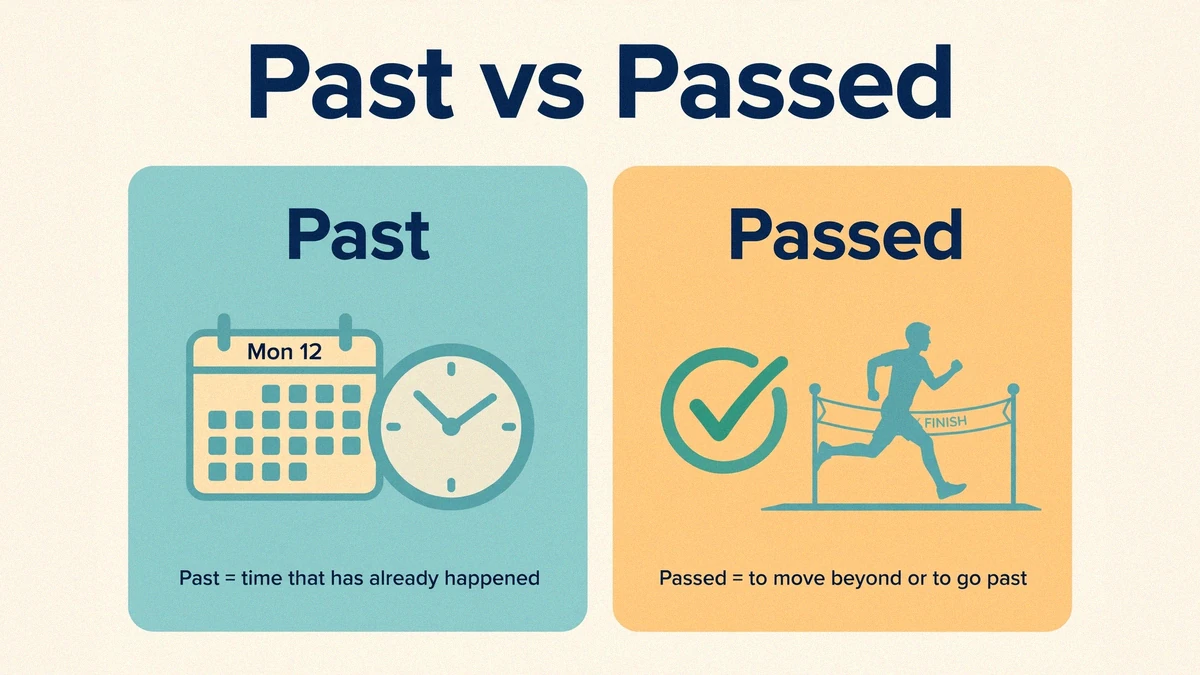
Past vs Passed: The Difference at a Glance
| Past | Passed | |
|---|---|---|
| Part of speech | Noun, adjective, adverb, or preposition — never a verb | Verb only (past tense / past participle of “pass”) |
| Core meaning | Time gone by; a position beyond something | An action that has already happened |
| Can it change tense? | No — “past” never changes form | Yes — pass, passes, passing, passed |
| Example | “We can learn from the past.” | “She passed her driving test.” |
| Example | “He walked past the gate.” | “Time passed quickly that summer.” |
The table shows the whole difference in one place: past describes time or position, passed describes an action.
Common Mistakes
Each pair shows the wrong version first, then the right one.
“Past away” vs “passed away”
- Wrong: “Her grandfather past away last year.”
- Right: “Her grandfather passed away last year.”
“Passed away” is the past tense of the verb phrase “pass away,” meaning to die. There is no verb in “past away,” so it cannot be right.
“Past the test” vs “passed the test”
- Wrong: “She past the test with top marks.”
- Right: “She passed the test with top marks.”
Passing a test is an action, so it needs the verb “passed.” “Past the test” is only correct with a different verb and meaning, as in “He walked past the test centre” — he went by the building, he did not take the test.
“Passed tense” vs “past tense”
- Wrong: “Write the sentence in the passed tense.”
- Right: “Write the sentence in the past tense.”
The tense is named for things that happened in the past, so it is the “past tense” — one of the most common mistakes, and one of the easiest to fix.
“Walked passed” vs “walked past”
- Wrong: “We walked passed the shop.”
- Right: “We walked past the shop.”
“Walked” is already the verb in this sentence, so the word after it must be the preposition “past,” meaning “beyond.” The same applies to “ran past,” “drove past,” and “went past.”
“In the passed” vs “in the past”
- Wrong: “That approach has not worked in the passed.”
- Right: “That approach has not worked in the past.”
“In the past” is a noun phrase meaning “in earlier times.” There is no action here, so there is no verb — and therefore no “passed.”
Example Sentences for “Past”
- “The past cannot be changed, but we can learn from it.”
- “In the past, this street was full of small shops.”
- “She has fond memories of past summers at the lake.”
- “We drove past the school on our way home.”
- “It is ten past four — we are already late.”
In every one of these, “past” either names a time, describes something from an earlier time, or means “beyond” — and in none of them is “past” the action of the sentence.
Example Sentences for “Passed”
- “She passed her driving test on the first try.”
- “Time passed so quickly that summer.”
- “We passed the old church and turned left.”
- “He passed the ball to his teammate.”
- “My grandmother passed away peacefully in her sleep.”
Every “passed” here is an action — succeeding, moving, handing over, dying, going by. If you can put “pass,” “passes,” or “passing” in the same spot, “passed” is the right choice.
How to Remember: A Memory Trick
The simplest trick is hidden in the spelling: “passed” contains the verb “pass.” If you can see “pass” inside the word, it is the verb form — use it when something was passed, handed over, or got through. “Past” is the shorter word, for time that is already gone.
A second trick works for the trickiest pair: “passed away” has two words that both end in “-ed” sounds. If you write “past away,” the sentence has no verb at all.
Past vs Passed in Writing
Getting this pair right matters in everyday writing — emails, essays, job applications, and messages. A “passed tense” in a cover letter or “past the exam” on a CV is the kind of small error a reader notices. The good news: learn the verb test once, and it works every time.
Word pairs like this one come up constantly in English. The same check sorts out their vs there — possession against place — and to vs too, where one small word changes the meaning. The guide to principal vs principle explains another pair that sounds the same but means something different.
Frequently Asked Questions
What is the difference between past and passed?
“Past” refers to time that has already happened, or to a position beyond something, and it is never a verb. “Passed” is the past tense of the verb “pass,” and it always describes an action that has already happened.
Is it “passed away” or “past away”?
“Passed away” is correct: it is the past tense of the verb phrase “pass away,” meaning to die. “Past away” has no verb in it, so it cannot be right.
Is it “passed the test” or “past the test”?
“Passed the test” is correct — passing is an action, so it needs the verb “passed.” “Past the test” only works with a different verb, as in “He walked past the test centre.”
Is it “past tense” or “passed tense”?
“Past tense” is correct: the tense is named for earlier time. “Passed tense” is a common mistake.
Can “past” ever be a verb?
No. “Past” can be a noun, an adjective, an adverb, or a preposition, but it is never a verb. If the sentence needs a verb, the word is “passed.”