
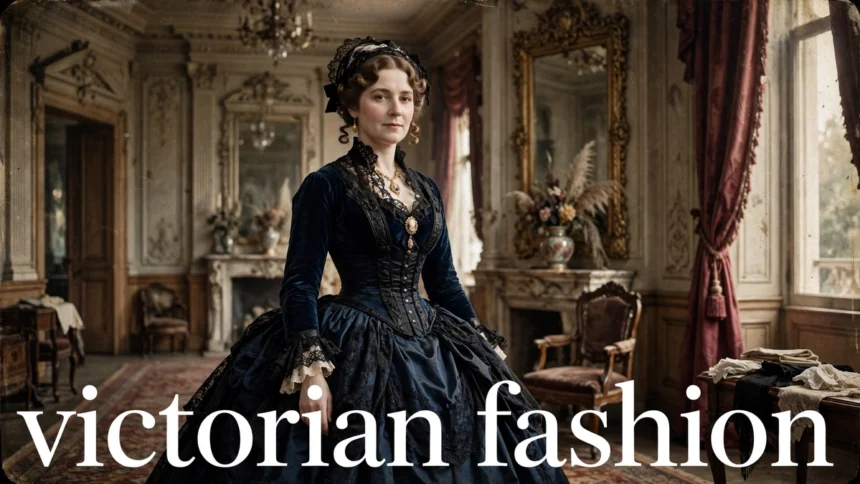
Victorian fashion takes its name from Queen Victoria, who reigned from 1837 to 1901, and it grew out of the 1830s silhouette of bell-shaped skirts, full sleeves, and a near-natural waist. It is not one look but a sequence of them, shaped by industry, empire, and strict ideas about modesty and status. So if you are learning victorian fashion for the first time, follow the decades: the volume moves, and it tells you the date. Victorian fashion covers the fashions and trends of British culture through the Victorian era, roughly from the 1830s through the 1890s.
The three things that changed everything
Three developments changed how Victorian clothes were made, coloured, and designed. First, the sewing machine: in use from the mid-1850s and general by the mid-1860s, it drove the mass production of clothes and expanded ready-to-wear, so fashionable shapes reached the middle classes faster than ever before. Second, synthetic dyes: after William Henry Perkin patented aniline purple, later called mauve, in 1856, vivid, contrasting colours spread through fashion by the mid-to-late 1860s — black was no longer the only serious colour. Third, Parisian couture: Charles Frederick Worth, an Englishman in Paris, opened his own house in 1858 and is often called the father of haute couture, setting the model of the named designer dressing wealthy clients.
Together, these three explain why Victorian fashion looks both handmade and industrial: hand-finished dresses, machine-made in growing numbers, in colours chemistry had just invented.
Women’s fashion, decade by decade
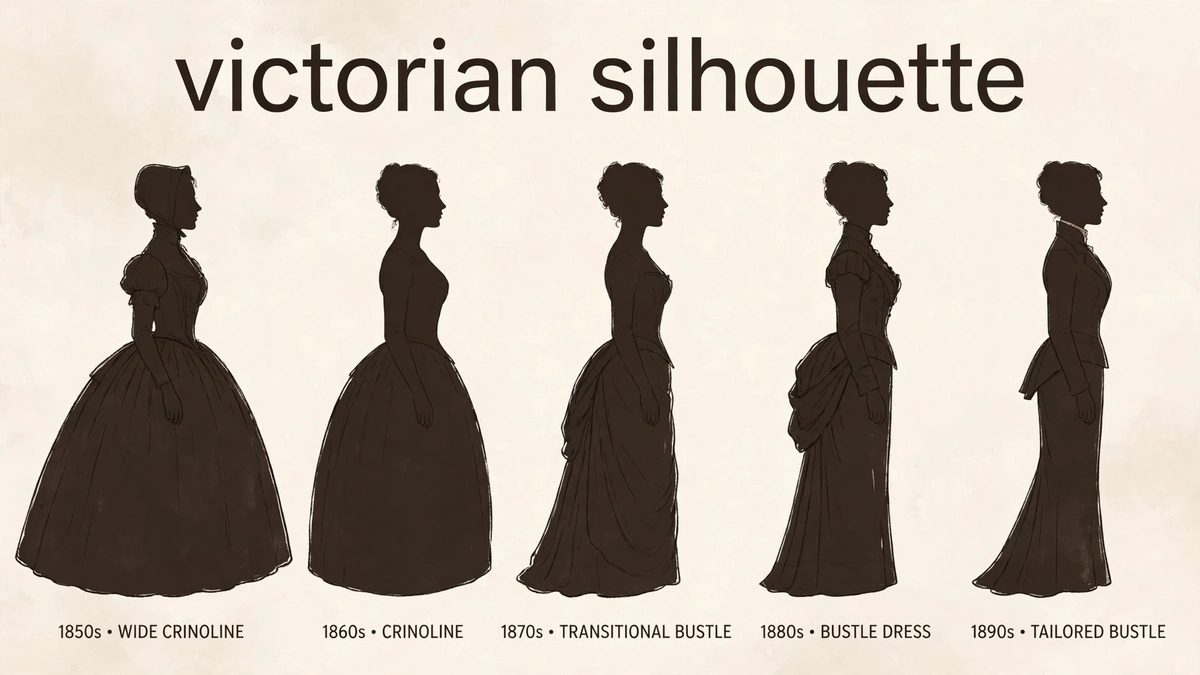
The defining pieces of women’s Victorian fashion are the structures under the dress: the corset, the cage crinoline, and the bustle, worn with a fitted bodice. The corset — or stays — shaped the bust, waist, and hips, and it was worn under almost every fashionable dress of the period.
- 1830s–1840s (early Victorian): Bell-shaped skirts over layers of petticoats, full sleeves, and a small waist. Dresses often had a bertha neckline, a wide, deep collar draping over the shoulders, with a chemisette adding modesty to a low-cut bodice.
- 1850s–1860s (mid-Victorian): The cage crinoline, a steel framework from 1856, replaced layers of petticoats and pushed skirts to their widest — volume all around the hem. By the late 1860s the fullness began to move to the back.
- 1870s–1880s (late Victorian): The bustle took over, adding volume behind the body — first in the early 1870s, then again from about 1883 until it faded by 1892. Trains, fitted bodices, and elaborate trimmings of lace, ribbon, and embroidery completed the look.
- 1890s: Volume moved to the upper sleeves — the leg-of-mutton sleeve — with a slimmer skirt and a tailored, shirtwaist look for the new working woman, including the bicycle costume for the cycling craze.
Accessories marked status throughout: bonnets and later hats, gloves, shawls, fans, and jewellery, with mourning dress — strict black, then greys and mauves in stages — as its own elaborate code after a death in the family.
Men’s fashion: from frock coat to lounge suit
Men’s Victorian fashion moved more quietly but just as clearly. Daywear began with the frock coat, a knee-length coat worn with a waistcoat and trousers, and moved toward the morning coat and then the looser lounge (sack) suit, which by the end of the century was becoming the modern suit. The silk top hat, pocket watch, and carefully tied cravat or necktie completed the respectable outfit, and a gentleman’s clothes signalled his occupation and class as plainly as a woman’s dress signalled hers.
Evening wear followed its own rules — the dinner jacket’s ancestor appeared late in the century — and working men’s clothes, by contrast, were built for labour: sturdy wool, corduroy, and aprons, with flat caps rather than top hats.
What Victorian fashion meant
Victorian clothing was never just decoration. It signalled modesty and decorum, especially for women, whose long skirts, high necklines, and gloves followed strict social standards; it signalled status, with luxurious fabrics — velvet, silk, lace, taffeta — and intricate handwork marking wealth; and it signalled the era’s industrial change, as ready-to-wear, fashion magazines, and department stores let the masses take part in high fashion for the first time.
That is also why Victorian fashion still matters: its tailoring underpins the modern suit, its couture model underpins modern fashion houses, and its silhouettes — crinoline, bustle, leg-of-mutton sleeve — remain the shorthand every costume drama reaches for. The same decade-by-decade logic helps with other fashion histories too: the single-decade focus of 1920s women’s fashion trends shows what changed when hemlines rose and corsets fell away, while what are retro fashion styles traces how later decades revived and remixed earlier looks. And for the everyday side of getting dressed, what to wear today is the practical counterpart to this history.
How to spot Victorian fashion today
If you want to recognise Victorian fashion in a museum, a film, or a vintage shop, use three checks. First, find the volume: bell skirt means early, full crinoline means around 1860, bustle means 1870s–1880s, big upper sleeves mean 1890s. Second, look at the waist: a fitted bodice over a corset, with a small waist, is the Victorian signature across all decades. Third, check the details: lace, embroidery, buttons, and trimmings piled on structured fabric, in deep, muted tones — burgundy, dark green, navy, black — with the brighter aniline colours appearing after the mid-1860s.
A final caution: the corset’s reputation needs care. Tight-lacing to extreme thinness was a minority practice, much discussed at the time; most women wore corsets as structured support, much like a modern bra — uncomfortable by today’s standards, but not the torture device of popular myth.
The bottom line
Victorian fashion, from 1837 to 1901, moved from bell skirts over petticoats to the steel cage crinoline, then to the bustle, then to leg-of-mutton sleeves — driven by the sewing machine, synthetic dyes, and the rise of couture, and worn as a visible code of modesty, status, and class. Learn the silhouette, and you can date almost any Victorian outfit at a glance.