
If you have ever paused mid-sentence wondering whether to write affect or effect, you are not alone. The two words sound almost identical and appear in the same kinds of sentences, which is why affect vs effect is one of the most searched grammar questions in English.
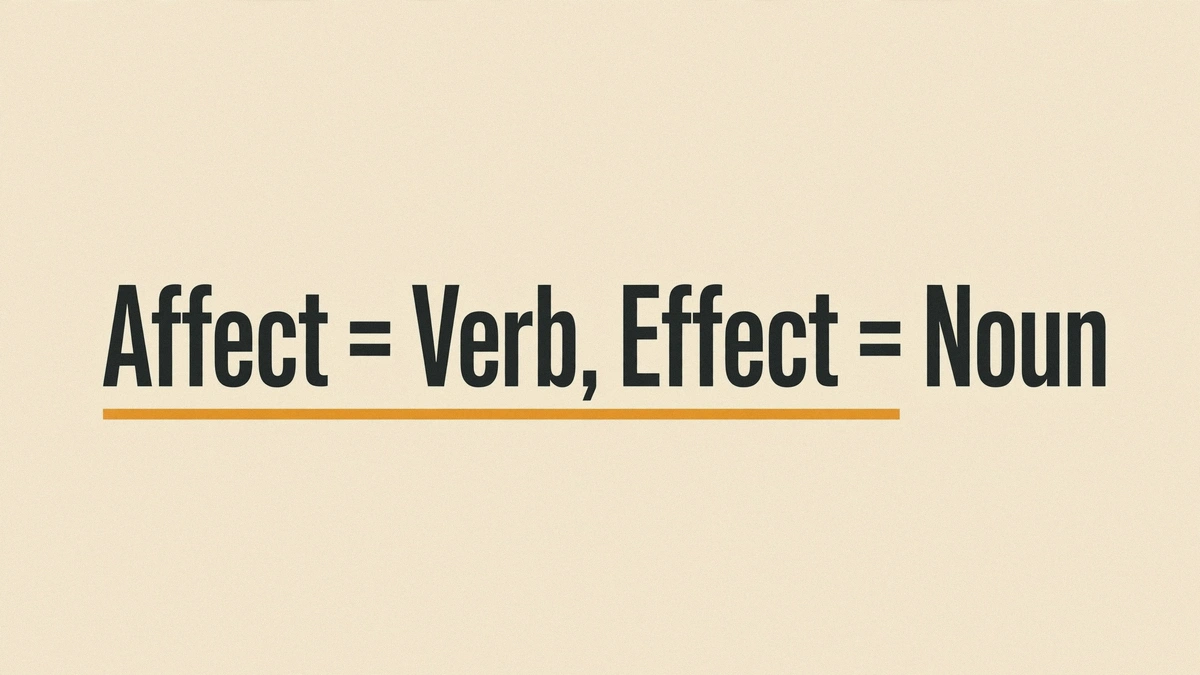
The short answer is simple: affect is usually a verb meaning to influence, and effect is usually a noun meaning a result. Rain affects the garden. The effect of the rain is wet soil and faster growth. One word does something; the other names what happened because of it.
The Core Rule in One Sentence
Think of cause and result. Affect is the action — the cause doing something. Effect is the result — the thing left behind after the action.
- The cold weather affected our travel plans. (The weather did something to the plans.)
- The cold weather had a serious effect on our travel plans. (The serious change is the result.)
Ask what job the word does in your sentence. If you need an action word, you need affect; if you need a thing, you need effect. The news affected her mood; it had a happy effect on her.
How to Use Affect
Affect is most often a verb meaning to influence, change, or have an impact on someone or something. It is followed by the person or thing being influenced.
- Lack of sleep affects concentration.
- The new tax rules will affect small businesses.
- The delay affected customer satisfaction.
Affect can also mean to move someone emotionally: the film affected her so much that she cried. And in a rarer sense it means to pretend — he affected a British accent during the play.
How to Use Effect
Effect is most often a noun meaning a result, consequence, or outcome. It names what happened because of a cause, and it often follows words like the, an, or side.
- One effect of regular exercise is better sleep.
- The medicine took effect within twenty minutes.
- The storm had a devastating effect on the town.
A quick check: if you can replace the word with result and the sentence still makes sense, effect is correct. “The result of the storm was devastating” works, so “the effect of the storm” is right. If influence fits instead, you need affect.
Effect also appears in fixed phrases — in effect, take effect, to that effect — where it is always a noun: the new rules come into effect on Monday.
Affect vs Effect: Comparison Table
| Affect | Effect | |
|---|---|---|
| Usual part of speech | Verb | Noun |
| Meaning | To influence or change something | A result or consequence |
| Ask yourself | Is it an action? | Is it a thing or result? |
| Replace with | Influence | Result |
| Example | The rain affected the match. | The rain had an effect on the match. |
The Exceptions You Need to Know
Both words also have a less common second job — exactly where careful writers get caught.
Effect as a verb: to bring about
Effect can be a verb meaning to bring about, cause, or accomplish something, usually with a noun like change or improvements as its object. The question of affect change or effect change comes down to this: if you mean to influence a change that already exists, use affect; if you mean to bring about the change, use effect.
- The new committee hopes to effect change in the company. (Bring about change.)
- The new policy will effect major improvements. (Bring the improvements into being.)
Compare that with the ordinary verb affect, where the thing being influenced already exists: the new policy will affect working hours. As a rule of thumb, effect as a verb is followed by the thing being created, while affect as a verb is followed by the thing being influenced.
Affect as a noun: emotion in psychology
Affect can also be a noun, but only in psychology, where it means a person’s observable emotional state — feelings shown through facial expressions, tone, and gestures. It is pronounced AF-fect, unlike the verb (uh-FECT). Merriam-Webster defines it as the observable manifestations of an experienced emotion, as in a patient showing a flat affect. Unless you write about psychology, you will rarely need it.
Affective vs effective: a related pair
A similar mix-up involves the adjectives. Affective vs effective is a different question: affective relates to feelings or emotions (mainly a psychology term), while effective means producing the intended result. The reverse order, effective vs affective, is the same pair — if you mean “it works,” the word is effective, as in “an effective method.”
Memory Tricks That Actually Work
A is for action. Affect starts with A, and it is an action word — a verb. When you need an action, pick the A word.
Cause and effect. Cause ends with E, and effect begins with E — a cause leads to an effect.
The article test. If the word follows a, an, or the, it is almost always the noun effect: “an effect,” “the effect.” Verbs do not follow articles.
The substitution test. Swap in influence and result. “The weather will influence our plans” works, so affect is right; “the weather had a result on our plans” works, so effect is right.
Common Mistakes and How to Fix Them
Most errors come from writing the word that sounds right rather than the word that does the right job.
- Wrong: The new law will have a big affect on prices. Right: a big effect on prices. (“A big result” fits, so the noun is needed.)
- Wrong: Lack of sleep can effect your mood. Right: Lack of sleep can affect your mood. (Sleep influences mood.)
- Wrong: We studied the affects of the new timetable. Right: the effects of the new timetable. (The results are things, so the noun plural effects is correct.)
English is full of sound-alike pairs that behave the same way, and the same habit of checking the word’s job in the sentence sorts out principal vs principle, their vs there, and past vs passed — in each pair, the spelling follows the meaning, not the sound.
Quick Self-Test
Cover the answers, fill in each blank with affect or effect, then check yourself.
- The rainy weather will ___ our picnic plans.
- One ___ of the new timetable is a shorter lunch break.
- The charity hopes to ___ real change in the community.
- The medicine had a strong ___ on her headache.
Answers: 1. affect 2. effect 3. effect (bring about change) 4. effect. Question 3 catches almost everyone the first time.
Frequently Asked Questions
Is affect always a verb?
Almost always. In everyday writing, affect is a verb meaning to influence; the exceptions are the psychology noun and the rarer verb sense meaning to pretend.
Is effect always a noun?
Usually. Effect is a noun meaning a result in most sentences, but it is also a verb meaning to bring about, as in “to effect change.” Cambridge’s grammar guide draws the same line: affect is the verb for causing a change, effect the noun for the result.
Can affect and effect appear in the same sentence?
Yes. “The new policy will affect student attendance, which will have a significant effect on overall grades.”
The Rule to Remember
Affect is the action; effect is the result. When you are unsure, ask what job the word does, try the influence/result swap, and remember that a cause leads to an effect. Learn the two exceptions, and you will choose correctly every time.