
Another word for but is usually however — but the best replacement depends on what you mean. “But” is one of the most used words in English: it joins two ideas that contrast, it introduces an exception, and it can even mean “only.” When you use it in every sentence, your writing starts to sound flat and repetitive. The fix is not to stop showing contrast — it is to pick the word that fits the sentence.
Below are 25 alternatives, grouped by meaning: words for contrast, words that start a contrasting clause, and words for exception. Every one comes with a plain meaning and an example sentence, so you can see exactly how it works before you use it.
What Does “But” Mean?
But is a conjunction — a joining word. Its main job is to connect two ideas that contrast with each other: “I like tea, but I prefer coffee.” It can also introduce an exception (“Everyone came but John”) and, in a more formal or old-fashioned sense, mean “only” (“We have but one day left”). The Wiktionary entry for “but” lists all of these senses, along with its use as a preposition (“all but one”) and an adverb (“but recently”).
Because “but” does so many jobs, no single replacement covers all of them. A synonym for but that works for contrast will not work for an exception, and the other way round. That is why this list is grouped by meaning — pick from the group that matches your sentence.
25 Better Words to Use Instead of “But”
Words for Contrast
These are the closest direct swaps. They join two contrasting ideas in the same way “but” does.
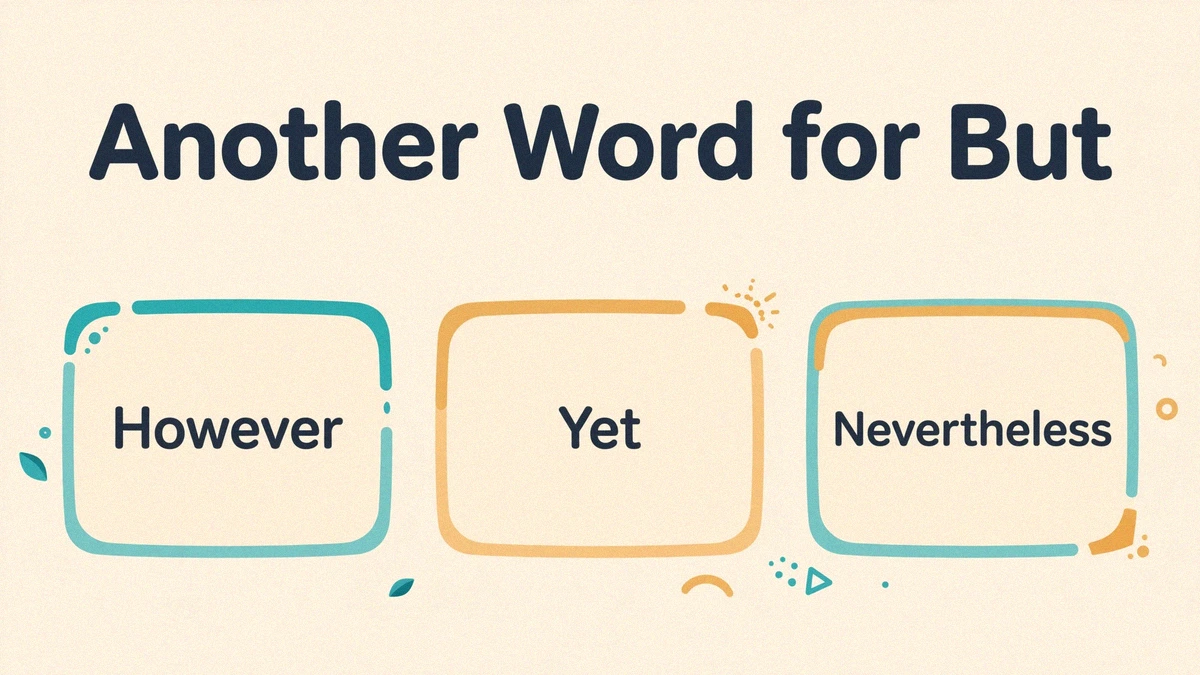
- However — the most common formal replacement. It often starts a new sentence. “The task was difficult. However, she finished it on time.”
- Yet — short, slightly more elegant than “but,” and good for a surprising contrast. “The house looked old, yet it was solid and well built.”
- Nevertheless — formal, meaning “in spite of that.” “The weather was bad. Nevertheless, the event went ahead.”
- Nonetheless — almost identical to “nevertheless.” “Running a marathon is exhausting. Nonetheless, millions of people do it every year.”
- Still — natural and conversational; shows something is true despite the opposite fact. “She knew it was unwise to go out in the storm. Still, she went.”
- Even so — means “despite that.” “It was a beautiful spring day. Even so, she preferred to stay indoors.”
- On the other hand — introduces the opposite side of an argument. “City life is exciting. On the other hand, it is noisy and expensive.”
- Conversely — formal; introduces the exact opposite. “I love her cooking. Conversely, I cannot stand her singing.”
- In contrast — used when comparing two people, things, or situations. “The first film was slow and quiet. In contrast, the sequel was loud and fast.”
- Whereas — formal; shows a strong contrast between two facts. “She loves winter, whereas I prefer summer.”
- While — shows contrast between two facts in one sentence. “While I agree with you, I see the problem differently.”
Words That Start a Contrasting Clause
These words sit at the front of a clause and set up the contrast before the main point arrives.
- Although — the most useful of this group; slightly formal. “Although it was raining, we went for a walk.”
- Though — the informal twin of “although,” and it can also sit at the end of a sentence. “It was raining. We went out, though.”
- Even though — a stronger form of “although.” “Even though she was exhausted, she kept working.”
- Despite — followed by a noun or an -ing form, not a full clause. “Despite the rain, we went for a walk.”
- In spite of — means the same as “despite.” “In spite of her illness, she wrote wonderful stories.”
- Despite this — starts a new sentence and points back at what was just said. “I prepared thoroughly for the exam. Despite this, I failed.”
- Having said that — conversational; softens a change of direction. “I will never drink again. Having said that, pass me a glass of water.”
- That said — the shorter version of “having said that.” “The plan is risky. That said, it is our best option.”
Words for Exception
Here “but” does not show contrast — it carves out the one thing that is not included. These replacements only work in that sense.
- Except — means “apart from” or “excluding.” “Everyone came except John.”
- Except for — the same idea, usually before a noun phrase. “It was a lovely day except for the strong wind.”
- Apart from — “Apart from the cost, the holiday was perfect.”
- Other than — “I told no one other than my sister.”
- Save for — slightly formal or literary. “The house was empty, save for one old chair.”
- Barring — formal; means “except for.” “Barring rain, we will play on Saturday.”
Which Alternative Should You Use?
The choice depends on two things: how formal your writing is, and where the word sits in the sentence.
| Situation | Best choices |
|---|---|
| Formal writing and essays | however, nevertheless, nonetheless, although, whereas, in contrast |
| Everyday writing and speech | yet, still, though, even so, that said |
| Starting a new sentence | however, nevertheless, nonetheless, still, even so, despite this |
| Starting a clause in the same sentence | although, though, even though, whereas, while |
| Meaning “except” | except, except for, apart from, other than |
A common mistake is swapping in “however” without changing the punctuation. “But” joins two clauses with a comma (“I like tea, but I prefer coffee”), while “however” usually needs a full stop or a semicolon before it: “I like tea. However, I prefer coffee.” The guide to when to use a semicolon instead of a comma explains exactly when that semicolon belongs there.
But vs However
“But” and “however” are the most confused pair on this list, so it is worth getting them straight:
- But is a conjunction. It joins two clauses inside one sentence: “It was late, but we kept studying.”
- However is an adverb. It usually starts a new sentence or a new clause: “It was late. However, we kept studying.”
They mean the same thing, but they are built differently. If you replace “but” with “however” and keep the comma, the sentence breaks. Change the punctuation too, and the swap works every time.
But Synonyms in Everyday Writing
You do not need to replace every “but” — it is a perfectly good word, and using it once or twice is natural. The problem is only repetition. A good rule is one “but” per paragraph at most; after that, reach for a different word from the list above.
The same habit improves other tired words too. The word lists in shows synonym show how a sharper verb can replace “shows,” and life synonym does the same for “life” — forty stronger options with examples, in the same grouped style as this list. Once you start swapping one overused word, the rest follow naturally. The Wikipedia article on “but” covers the word’s grammar in more depth, including its history as a conjunction, preposition, and adverb.
Frequently Asked Questions
What is the best synonym for but?
However. It is the most common and most versatile replacement, and it works in formal and everyday writing alike. For a shorter, more natural option, use “yet” or “still.”
What is a different word for but in formal writing?
Nevertheless, nonetheless, although, whereas, and in contrast are the strongest formal choices. They are the ones examiners and editors expect to see in essays and reports.
Can “yet” replace “but” in every sentence?
Almost, but not quite. “Yet” works wherever “but” shows a surprising contrast (“The house looked old, yet it was solid”). It does not work for exceptions — you cannot say “Everyone came yet John.” Use “except” there instead.
What are the synonyms of but that mean “except”?
Except, except for, apart from, other than, save for, and barring. These are the only ones on the list that carry the “not included” meaning of “but.”
Is “however” always a good replacement for “but”?
In meaning, yes; in punctuation, no — not without a change. “But” joins clauses with a comma, while “however” usually needs a full stop or a semicolon before it. Swap the punctuation as well as the word.