
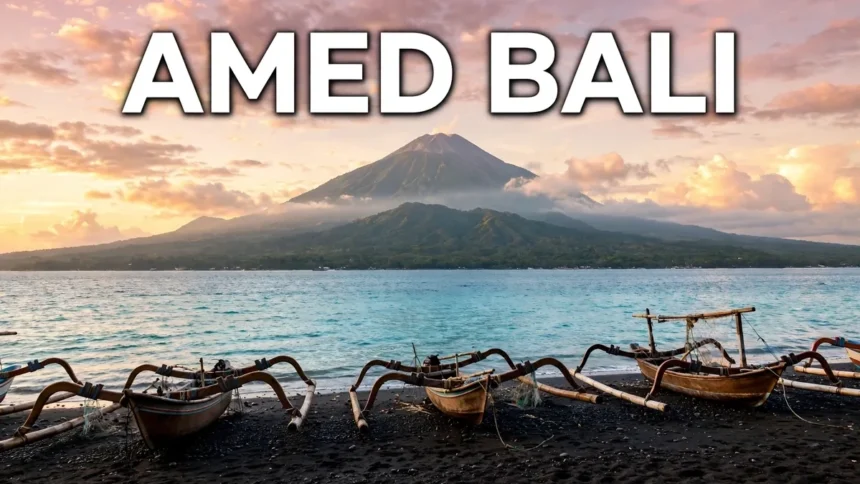
Amed, Bali is not one town. It is a quiet, roughly 14-kilometre string of fishing villages along the north-east coast of Bali, in Karangasem Regency — Amed itself, then Jemeluk, Bunutan, Lipah, Lehan, Selang, Banyuning and Aas, running east along the shore. There are no beach clubs here, no traffic jams of scooters, and no nightlife strip. What there is: black-sand bays where the coral reef starts a few strokes from the beach, wooden jukung outrigger boats lined up at dawn, salt fields drying in the sun, and the 3,031-metre cone of Mount Agung rising out of the sea on clear mornings. If you want slow days built around the water, Amed is the right corner of Bali. If you want shopping, surf and parties, it is not — and that is exactly the point.
Where Amed is, and what to expect
Amed sits on the far eastern tip of Bali, facing the Lombok Strait, with Mount Agung about 17 kilometres to the west. The beaches are black volcanic sand and pebbles, not white sand — better for getting into the water than for lying on it. Each bay has its own character: Amed village is the working fishing beach, Jemeluk is the busiest bay with the most dive shops and cafés, Lipah is quieter with soft black sand, and the bays further east — Selang, Banyuning, Aas — get steadily more remote and scenic. Fishing and salt-making still shape daily life here; tourism arrived late, with the coast road only sealed in 2000, and the place still runs on village time. Evenings are low-key: dinner at a family warung, fresh fish grilled over coconut husks, and an early night, because the best of Amed happens at dawn.
Getting there: allow half a day
Amed is one of the furthest corners of Bali from the airport, and the journey is part of why it stays quiet. From Ngurah Rai International Airport it is roughly 95 to 100 kilometres, and the drive takes about 2.5 to 3.5 hours depending on traffic — the first half through Denpasar and Sanur, the second half along the scenic east coast. From Ubud, Bali it is about 72 kilometres and 2 to 2.5 hours, climbing through rice fields and over the Bukit Jambul viewpoint before dropping down to the sea. There is no direct public transport, and ride-hailing apps such as Grab and Gojek are unreliable on this coast, so for a first trip book a private car with a driver or a shared shuttle in advance. A private airport transfer typically runs in the region of IDR 500,000 to 750,000 (roughly $35–50) per car, and a full-day private driver from Ubud is often around $50–55 — but treat every price in this guide as a range reported by Bali travel guides in 2026 and check it before you travel, as prices change. Once in Amed, get around by scooter if you are a confident rider, or by local driver; the coast road climbs steeply over headlands, has few streetlights, and is best avoided on a scooter after dark.
How many days, and when to go
Two nights gives you a taste — one day in the water and one slow beach day. Three to four nights is the sweet spot: enough for the Liberty wreck, Jemeluk Bay, a day trip inland, and a morning doing nothing at all. More than four nights suits divers taking a course or travellers who genuinely want to slow down. The best window is the dry season, April to October, when the seas are calmest and visibility is at its best — dive guides report visibility of 15 to 30 metres at Tulamben in those months. July and August are the busiest, though “busy” in Amed still means quiet by south Bali standards. In the wet season, November to March, rain tends to come in short afternoon bursts, mornings stay clear, and prices drop; visibility on the wreck dips to around 10 to 15 metres. Water temperature sits around 26 to 30°C all year, so you will not need a thick wetsuit.
Snorkelling and diving: the reason to come
Amed is first and foremost a water destination, and its great advantage is that you can walk in from the beach. The reef starts a few metres from the shore, and the volcanic slope drops quickly into deeper water, so snorkellers, divers and freedivers all share the same bays.
Jemeluk Bay is the classic first stop. It is a sheltered crescent bay with a shallow coral garden that drops into a wall about 40 metres offshore, and a small underwater temple and statue garden at 2 to 12 metres that has become one of Amed’s most photographed spots. Go early — the water is glassy before 10 AM and the current picks up in the afternoon — and go at high tide, when the coral is safely submerged. Snorkel gear rental from the beach typically runs IDR 50,000 to 100,000 for the day.
Lipah Beach is the quieter alternative, with soft black sand, shallow coral gardens and easy entry — the best pick for families and beginners. Just offshore at Banyuning lies the Japanese wreck, a small wartime shipwreck in about 2 to 12 metres of water, shallow enough to snorkel over on a calm day. The Amed Pyramids, a pyramid-shaped artificial reef off Amed village, is a reliable place to spot turtles.
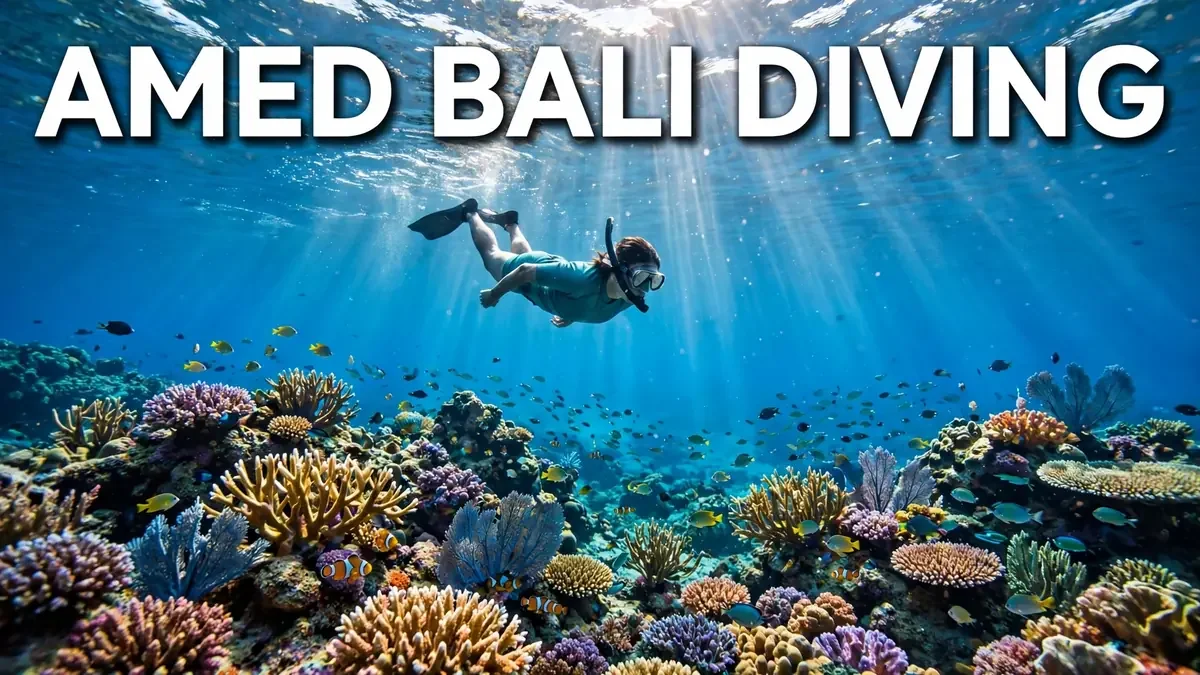
The USAT Liberty wreck at Tulamben is the headline dive, about 15 kilometres and 20 to 30 minutes north of Jemeluk. The Liberty was a 120-metre US Army cargo ship torpedoed by a Japanese submarine in the Lombok Strait on 11 January 1942; it was beached at Tulamben to save its cargo, then slid off the beach into the sea during the tremors of Mount Agung’s 1963 eruption. It now lies on a black-sand slope just offshore, between about 5 and 30 metres deep, encrusted in coral and patrolled by schooling jacks and bumphead parrotfish — one of the most accessible wreck dives in the world, with the shallow end friendly to newer divers and strong snorkellers. Two-tank shore dives from Amed-based operators are commonly quoted around $75–100 including gear, guide and transport. Amed has also become a freediving hub: calm mornings and deep water close to shore make it a natural place for a beginner course, typically a two-day Level 1 course.
Beyond the water: sunrises, salt and the volcano
Amed’s beaches face east, so sunrise is the daily event. At around 5:30 AM the jukung boats push out, and several fishermen run two-hour sunrise trips along the coast with a snorkel stop — arrange it at your guesthouse the evening before and agree the price in advance. Back on land, watch for the salt fields around Purwakerti, where seawater is still evaporated by hand in the dry months, and take the short climb to the Jemeluk viewpoint for the classic view back across the bay to Mount Agung. In the evening the light reverses: the sun sets behind the volcano, the bays turn pink and gold, and the cliff road between Jemeluk and Lipah is the place to watch it. Cloud builds through the day, so dawn is when you get the postcard — by 10 AM Agung is often hidden.
Day trips: east Bali in a day
Amed makes a good base because east Bali’s best-known sights sit within about an hour’s drive. Tirta Gangga, about 30 to 40 minutes inland, is a royal water palace built in 1946 by the last king of Karangasem, with lily ponds, stepping stones across the water and koi-filled pools — go at opening, around 7 AM, for soft light and fewer people, and allow an hour. Pura Lempuyang, the “Gates of Heaven” temple, is roughly another 30 minutes beyond Tirta Gangga; its split gate frames Mount Agung on clear days, but the photo queue can be long, so arrive at dawn. Taman Ujung, a second former royal water palace near the coast, is a quieter stop for a late morning. Pair Lempuyang and Tirta Gangga in a single day with a driver, and keep the afternoon free for a swim back in Amed. Fast boats also run from Amed across to the Gili Islands, so if you want to extend the trip, Gili Air, Indonesia is an easy next stop — another slow, car-free island built around the same kind of shore snorkelling.
Where to stay and eat
Pick your bay, not your star rating: almost everything in Amed is small and family-run. Jemeluk puts you closest to the best snorkelling and the most cafés, and suits most first-timers. Lipah is quieter at night and a good mid-range choice. Amed village and Bunutan have the most budget homestays, often a short walk from the sea. The further east you go, the more remote and scenic it gets — and the fewer places there are to eat, so plan dinner around your guesthouse out there. Do not come for fine dining; come for fresh fish. Most warungs are built around whatever the morning boats landed — mahi-mahi, tuna, snapper, squid — grilled with sambal matah and rice, typically IDR 50,000 to 120,000 per main at a warung. Vegetarian options are limited, but every warung can usually do nasi campur, gado-gado or tempeh with sambal. Book ahead in July and August; outside peak season you can often arrive and choose.
A simple 3-day plan
Day 1 — Arrive and settle in. Transfer from the airport or Ubud, stopping at Tirta Gangga on the way if you come from Ubud. Swim at Lipah in the late afternoon, watch the sunset from the cliff road, and eat at a warung in Jemeluk.
Day 2 — In the water. Snorkel Jemeluk Bay early, then the Japanese wreck or the Pyramids in the afternoon. If you dive, make this your Liberty wreck day at Tulamben — dawn dives are the calmest, and bumphead parrotfish are often around at sunrise.
Day 3 — Inland and slow. Dawn at Lempuyang for the gate photo, Tirta Gangga mid-morning, lunch on the coast, and a last unhurried afternoon: salt fields, a jukung sunset trip, or simply coffee and a book while the boats come in. Leave Amed at least six hours before a flight home — the drive is long and Bali traffic is unpredictable.
Practical tips for a first trip
Bring cash: ATMs exist in Amed village and Jemeluk, but they are few and can run out, and many warungs and dive shops are cash-only. Pack reef-safe sunscreen, water shoes for the pebbly entries, and a light layer for cool mornings on a scooter. Snorkel at high tide and in the morning, when the water is calmest. Do not stand on coral — it is fragile, and the reef here is the whole reason the place is worth visiting. If you hire a scooter, wear a helmet and skip riding after dark. And keep one day empty: Amed rewards doing nothing more than almost anywhere else in Bali.
The bottom line
Amed, Bali is the quiet end of the island — black-sand bays, shore snorkelling a few steps from your room, a world-famous wreck twenty minutes up the road, and Mount Agung watching over it all at dawn. Come for two to four nights, base yourself in Jemeluk or Lipah, get in the water every morning, and let the afternoons take care of themselves. If this kind of slow island trip appeals to you, Palawan Island, Philippines is another first-trip guide on this site in the same spirit — lagoons and island-hopping instead of volcanoes and wrecks, but the same unhurried pace.