
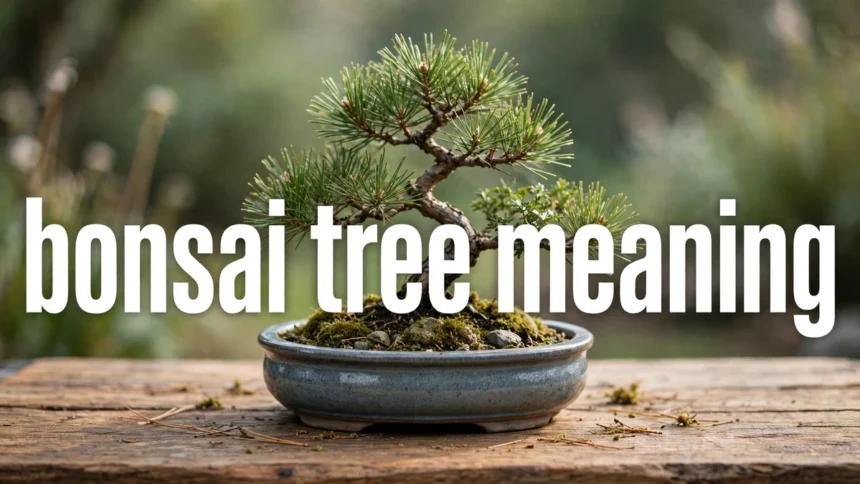
What is the bonsai tree meaning? At its simplest: patience, harmony, and balance — the idea that beauty and strength emerge slowly, through consistent care over time. Bonsai is not a species of tree. It is an art form, nearly two thousand years old, in which an ordinary tree is grown in a shallow pot and shaped, pruned, and tended for decades until it becomes a miniature landscape. The meaning lives in that process as much as in the tree itself.
What the word “bonsai” actually means
The word bonsai (盆栽) is Japanese, but it comes from the older Chinese penzai, and both phrases translate roughly the same way: bon (or pen) means “tray” or “shallow pot,” and sai means “planted.” So bonsai literally means “tray planting” or “planted in a shallow pot.” It is the technique that gives the word its meaning — not the species, not the style. A pine, a maple, or a juniper can all be bonsai; what makes them bonsai is that they are grown and shaped in a pot, kept small on purpose, until they read as a whole landscape in miniature.
The art began in China as penjing — tray landscapes — around 700 AD, where it was practiced by elites as a symbol of wealth and status. It traveled to Japan with Zen Buddhist monks during the Heian period (794–1185), where Zen principles transformed it from a landscape replica into the single-tree art form we know today. What was once a mark of riches became a practice of contemplation.
Patience: the first meaning
The first and most obvious meaning of bonsai is patience. A bonsai is not bought finished; it is grown. A tree that is thirty years old carries more meaning than one that is three, because those decades show in its bark, its trunk, and its shape. Watering, pruning, wiring, and repotting are small acts repeated over years, and the tree answers slowly. That is the point: bonsai teaches that worthwhile things take time, and that daily care matters more than any single dramatic gesture.
This is why bonsai is so often described as a moving meditation. The care rituals — daily watering, weekly pruning, seasonal repotting — demand presence. You cannot rush a tree, and you cannot tend one while distracted. The patience bonsai requires is the patience it symbolizes.
Harmony and balance
Bonsai also symbolizes harmony and balance between people and nature. A bonsai is shaped by human hands, but the artist does not impose a form on the tree — they read the trunk’s natural lean, the way the branches catch light, and the species’ own growth habit, and they bring out what is already there. In a finished bonsai, everything comes together: shape, growth, and space, with nothing overpowering the rest.
The same idea runs through the Zen philosophy that grew up alongside bonsai in Japan. The Japanese aesthetic of wabi-sabi — finding beauty in imperfection and impermanence — is central to the art. A bonsai’s asymmetrical branches, weathered bark, and intentional scars are not flaws; they are evidence of a life lived. A perfectly symmetrical, flawless tree would actually be considered a poor bonsai, because it would show no time, no weather, and no story.
What different bonsai species symbolize
Across Chinese and Japanese traditions, specific species carry their own meanings, and those associations have carried into modern Western gift culture — so the species you choose changes the message:
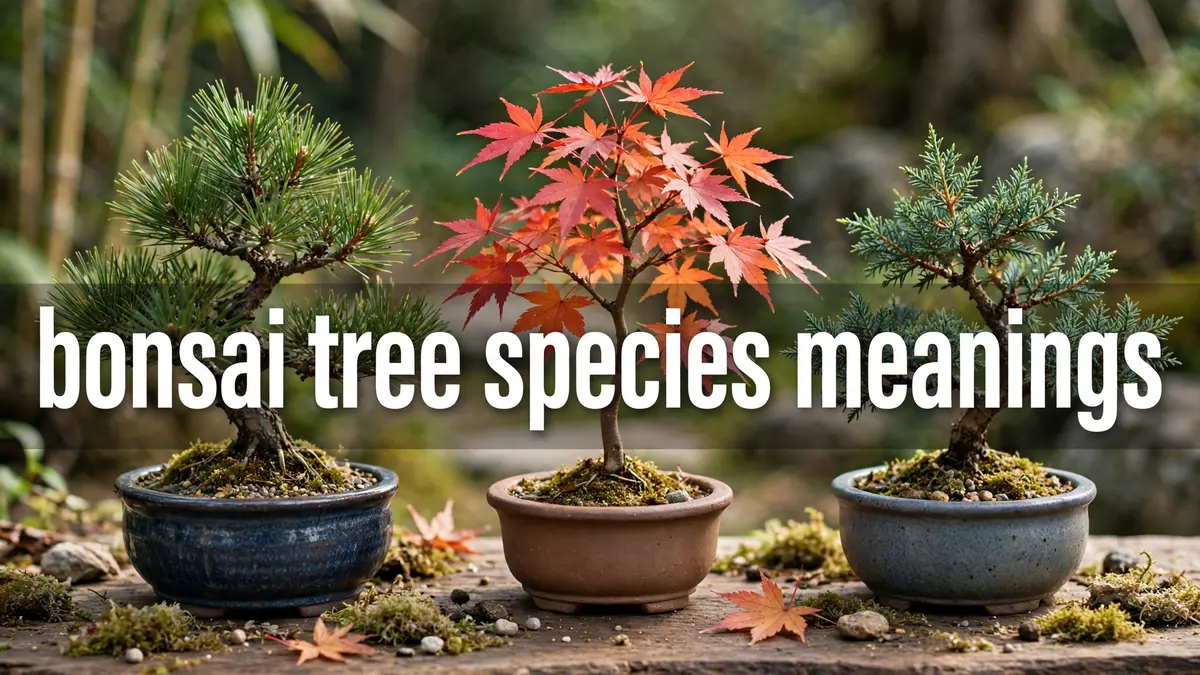
- Pine: longevity, endurance, and wisdom. The pine survives harsh winters and lives for centuries; it stands for perseverance and steady character.
- Juniper: protection, cleansing, and resilience. Junipers were traditionally planted near temples and homes to ward off negative energy.
- Japanese maple: peace, balance, and beauty in change. Its dramatic seasonal color shift is read as accepting transformation.
- Cherry blossom: the impermanence of life. Its brief, brilliant bloom is a reminder that beauty is fleeting.
- Chinese elm: harmony, inner strength, and wisdom — a calm, steady presence.
- Jade (money tree): prosperity and good fortune. The jade bonsai is the classic good-luck gift.
- Ficus: health, fertility, and love — a warm wish for a new home or a new beginning.
The shape matters too. A slanting bonsai, trained to lean to one side as if bent by wind, signifies patience, strength, and perseverance. A cascading bonsai, its trunk trailing downward, symbolizes harmony and patience. A semi-cascade balances the two and stands for balance in life. And the formal upright, straight and symmetrical, stands for harmony, simplicity, and health.
What a bonsai means as a gift
A bonsai is a thoughtful gift precisely because it is not a finished object — it is a responsibility and a promise. The traditional occasions each suit a different species: a jade bonsai for good luck, a ficus for a new home, a Chinese elm for sympathy or peace, a rose apple for a wedding, a Japanese pepper tree for a get-well wish. The message is always the same underneath: I am giving you something that will grow with you, and that asks you to slow down and pay attention.
That is also why a bonsai suits a housewarming, a birthday, or a retirement better than a bouquet. A bouquet fades in a week. A bonsai, cared for, can outlive the person who gave it — the oldest bonsai in the world, at the Crespi Bonsai Museum in Milan, is over a thousand years old. A gift that old is less a present than a legacy.
The bottom line
Bonsai means patience, harmony, and balance — a miniature tree shaped over decades into a landscape in a pot, carrying Zen ideas about imperfection, time, and the meeting of human hands and natural form. Whether you grow one, receive one, or simply admire one, its message is the same: slow down, pay attention, and let something beautiful take its time. Trees and their meanings are a thread that runs through this site — the horse, the star, and the gladiolus — and the bonsai belongs beside them, as the slowest and quietest symbol of all.