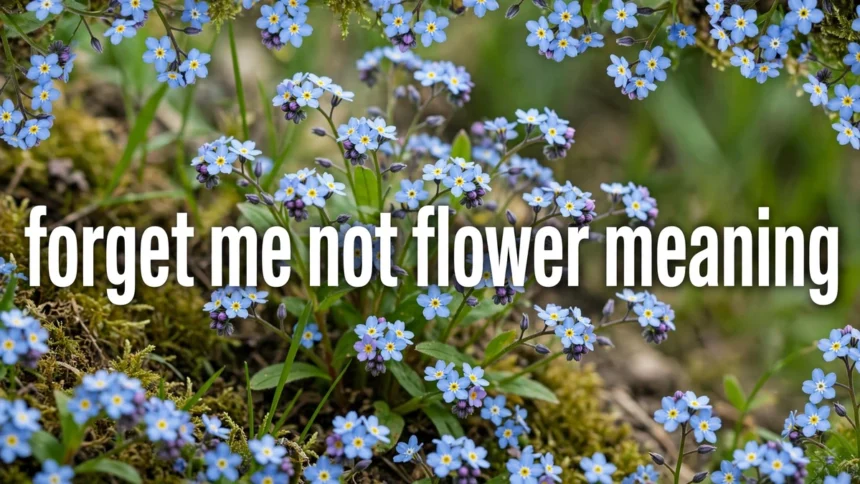
What is the forget me not flower meaning? In a sentence: true love, remembrance, and the plea “do not forget me.” The forget-me-not is a small five-petalled flower, usually sky blue with a yellow center, and its name is unusual in the plant world — it is not a description of how the flower looks, but an emotional appeal, repeated in translation across dozens of languages. That directness is why the flower has carried the same message for centuries: remember me; I will remember you.
The legend behind the name
The name traces to a medieval German legend, retold across European cultures. A knight walked beside a river with his beloved and spotted small blue flowers on the far bank. He waded across to pick them for her, but the current was stronger than he expected. As he was swept away, he threw the bouquet to her and cried out “Vergiss mein nicht!” — forget me not. The story is a legend, not history, but it explains the flower perfectly: a gift given at a parting, carrying the hope that the giver would not be forgotten.
The botanical name tells a quieter story. Forget-me-nots belong to the genus Myosotis, from the Greek for “mouse ear,” referring to the shape of their small, soft leaves. The most widespread garden species is Myosotis sylvatica, the woodland forget-me-not, with the water forget-me-not, M. scorpioides, growing along streams and ponds. The plants are small annuals or biennials of the borage family, and they self-seed so readily that one packet can fill a shaded garden corner for years.
Remembrance and faithful love
In the Victorian language of flowers — floriography — the forget-me-not was the preeminent symbol of faithful love and enduring memory. The Old Farmer’s Almanac’s chart of Victorian flower meanings gives it two meanings: “true love memories” and “do not forget me.” Victorians pressed the flowers into letters, embroidered them on keepsakes, and painted them onto porcelain, giving them at partings to say what words could not: I will remember you; remember me.
That meaning has never really faded. Forget-me-nots are still given at memorials, weddings, and anniversaries, and worn at remembrance events — a flower that honors grief without making it heavier, and that speaks of a connection meant to last beyond distance and time. To give someone a forget-me-not is to make a promise: you will not be forgotten.
What each forget-me-not color means
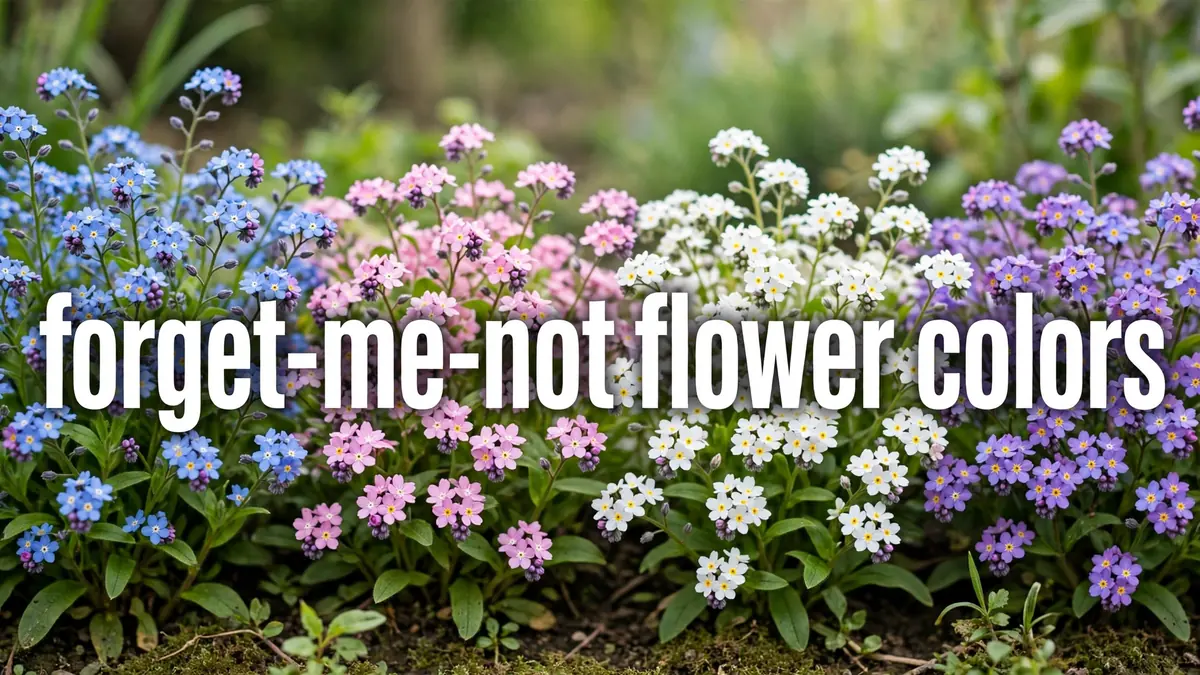
Not all forget-me-nots are blue, and each color carries its own nuance:
- Blue (the classic): true love, deep remembrance, and fidelity — the full weight of the flower’s traditional meaning.
- Pink: gentle affection, kindness, and a softer form of devotion.
- White: purity, innocence, and peaceful remembrance — often chosen for memorials.
- Purple: dignity, quiet strength, and remembrance with grace.
Blue is the color most people picture, and it carries the classic meaning. The other colors let the same message be tuned to the occasion.
Forget-me-nots around the world
The flower’s meaning travels well, with local shades in each culture. In Europe, it has long stood for romance, loyalty, and mourning — a flower of medieval love stories and Victorian keepsakes. In parts of East Asia, forget-me-not symbolism extends into the spiritual realm, representing devotion that transcends death and the honoring of ancestors. In North America, the flower has found a powerful modern role: it is the emblem of dementia and Alzheimer’s awareness, adopted by the Alzheimer’s Society in the United Kingdom and similar organizations worldwide — a fitting choice, since the forget-me-not is literally the flower of memory, and dementia is the disease of memory’s loss.
Alaska made the connection official long ago: the forget-me-not has been the state flower since 1949, a full decade before Alaska became a state in 1959, symbolizing the territory’s lasting connection to those who serve.
When to give forget-me-nots
The flower fits occasions where memory and devotion are the point. Give them at a memorial or funeral, where they say “remembered, always” better than any card. Give them at a wedding or anniversary, where they promise faithful love. Give them at a farewell — a friend moving away, a loved one leaving for a long trip — where “do not forget me” is exactly the message. And give them simply as a “thinking of you” gesture, the way the Victorians did, when someone is going through a hard season and needs to know they are held in mind.
A practical note for gardeners: forget-me-nots are easy to grow from seed in cool, moist, partly shaded soil, and they bloom in early to mid spring. They self-seed aggressively, so plant them where you are happy to see them return year after year — a fitting habit for a flower whose whole meaning is coming back.
The bottom line
Forget-me-nots mean true love, remembrance, and faithful devotion — a small blue flower named not for how it looks but for what it asks: do not forget me. From a knight’s last words on a riverbank to a Victorian keepsake to a modern symbol of memory itself, the message has stayed the same for centuries. Flowers carry meanings that outlast their blooms, and the forget-me-not belongs beside the other meanings on this site — the gladiolus, with its strength of character, the colour grey, with its quiet balance, and the star, whose light has long guided travelers home — as one of the clearest symbols we have.