
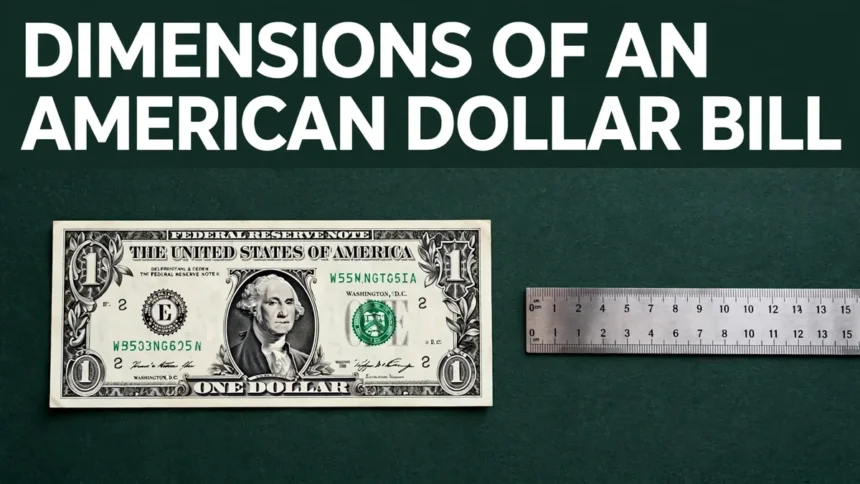
So what are the dimensions of an American dollar bill? A US one-dollar bill measures 6.14 inches long by 2.61 inches wide — 156 by 66.3 millimetres in metric — and it is just 0.0043 inches thick and weighs about 1 gram. Those four numbers are the whole answer, and they apply to every US paper bill in your wallet, not just the one-dollar note.
The exact dimensions, in every unit
The size is set by the Bureau of Engraving and Printing, the federal agency that prints all US paper currency, and every freshly printed note is made to the same specification. The United States one-dollar bill is listed at 6.14 inches wide by 2.61 inches high, weighing approximately 1 gram:
| Measurement | Inches | Metric |
|---|---|---|
| Length | 6.14 in | 156 mm / 15.6 cm |
| Width | 2.61 in | 66.3 mm / 6.6 cm |
| Thickness | 0.0043 in | 0.109 mm |
| Weight | 0.035 oz | About 1 g |
A worn bill may measure a fraction less at the edges after years of folding and handling, but a new note matches these figures. The bill is not really paper at all: it is a blend of 75% cotton and 25% linen, which is why it survives an accidental trip through the washing machine far better than an ordinary sheet of paper would.
Is every US bill the same size?
Yes. A $1 bill and a $100 bill are exactly the same physical size — 6.14 × 2.61 inches — and so is every denomination in between: $2, $5, $10, $20, and $50. Only the portrait, the colours, and the security features change. That is unusual: in most countries, higher-value notes are larger than lower-value ones, so you can tell them apart by size alone.
The thickness adds up fast when bills stack. One hundred bills stand about 0.43 inches tall — just over a centimetre — and a million one-dollar bills stacked would reach roughly 358 feet high. Since each bill weighs about a gram, there are roughly 454 notes in a pound, so a pound of one-dollar bills is worth about $454.
How a dollar bill compares with other banknotes
The US is one of the few countries that keeps every denomination the same size. Elsewhere, notes grow with their value:
- Euro €5 note: 120 × 62 mm — shorter and slightly narrower than a US bill.
- Euro €10 note: 127 × 67 mm — still shorter than a US bill, but a touch wider.
- UK £5 note: 125 × 65 mm — the Bank of England’s polymer fiver is smaller than a US dollar bill in both directions, and unlike US notes, British notes get bigger as the value rises.
So an American dollar bill is on the long side by world standards: longer than a €5 or €10 note and longer than a British fiver, though the euro’s largest notes are bigger still.
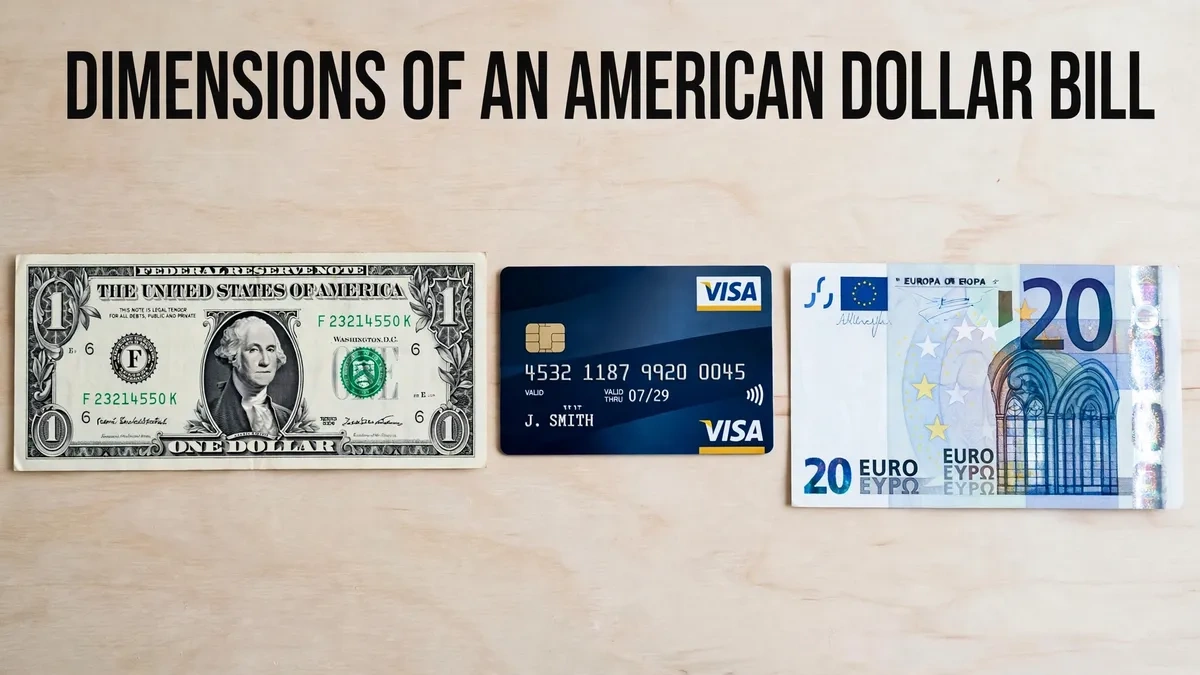
How a dollar bill compares with everyday objects
Because the size never changes, a dollar bill works as a handy pocket ruler:
- Credit card: 3.375 × 2.125 inches. A dollar bill is nearly twice as long as a credit card, and a little wider. Two credit cards laid end to end are still shorter than one bill.
- Folded in half: fold a bill in half lengthwise and you get about 3 inches — a quick way to estimate small lengths.
- Two bills end to end: 12.28 inches, just over a foot.
- Letter paper: a standard US letter sheet is 8.5 × 11 inches, so a dollar bill is about two-thirds as long as the page is tall.
The same habit of measuring with a familiar standard shows up all over the house. Card sizes are a useful reference too — Pokemon card dimensions follow their own strict standard — and once you know the size of one common object, you can estimate plenty of others without reaching for a tape measure.
Why the size has stayed the same since 1929
American bills have not always been this size. Before 1929, US notes were much larger — about 7.42 × 3.125 inches — and people nicknamed them “horse blanket” currency because they barely folded into a pocket. In 1929 the Treasury shrank every denomination to the current 6.14 × 2.61 inch format, mainly to cut production costs and make notes easier to handle, print, and store.
Nearly a century later, the size is still fixed for a practical reason: every machine that handles cash is built around it. ATMs, vending machines, and bank currency counters all expect one exact rectangle, so a $5 bill feeds through exactly like a $100 bill. Changing the size now would mean rebuilding or replacing that equipment across the whole country — which is why the standard has survived every redesign of the artwork, portraits, and security features printed on the notes.
There is one real drawback to the fixed size: you cannot tell US bills apart by touch alone, which is harder for people with low vision than in countries where each denomination is a different size. It is a trade-off the US has kept, and there is no sign of it changing.
The bottom line
A US dollar bill measures 6.14 × 2.61 inches (156 × 66.3 mm), is 0.0043 inches thick, and weighs about 1 gram — the same for every denomination, and unchanged since 1929. It is longer than a credit card, longer than a €5 note or a British fiver, and thin enough that a hundred bills stack to less than half an inch. Next time you need a rough measurement and there is no ruler nearby, the bill in your wallet will do: fold it in half for three inches, or lay two end to end for a foot. Measuring by a known standard is a habit that pays off elsewhere too, from figuring out how to measure a cord of firewood to working out how much seed a lawn needs with a grass seed calculator.