
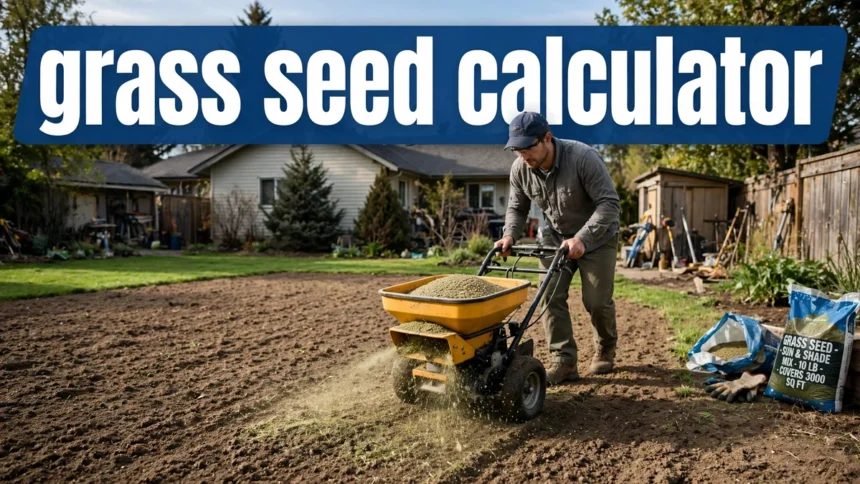
Buy too little grass seed and your new lawn comes up patchy. Buy far too much and the seedlings crowd each other, compete for light and water, and end up thin and disease-prone. A grass seed calculator exists to avoid both mistakes: it multiplies your lawn’s area by the sowing rate on the seed bag and tells you the weight of seed — and the number of bags — to buy. The maths is simple, and this guide walks through it step by step.
The formula
For a rectangular lawn, the calculation has three steps:
- Measure the area. Length × width gives square feet (or square metres).
- Multiply by the sowing rate. Seed needed = area ÷ 1,000 × rate in pounds per 1,000 square feet. In metric: seed in kilograms = area in square metres × rate in grams per square metre ÷ 1,000.
- Round up to whole bags. Divide the total weight by the bag size and round up — a part-bag is no use, and leftover seed is handy for patching.
For irregular lawns, split the shape into rectangles, work out each one, and add them together. For curves, measure generously and add about 10% for waste and uneven spreading.
Sowing rates: new lawn vs overseeding
The rate depends on the job, and this is where most people go wrong. A new lawn on bare soil needs the full rate because you are building the entire grass cover from nothing. Overseeding — sowing into an existing lawn to thicken it — needs roughly half the rate, because the existing grass already covers most of the ground.
Typical rates, always subordinate to the rate printed on your own seed bag:
- Cool-season grasses (ryegrass, fescue, bluegrass), new lawn: about 5–7 lb per 1,000 sq ft (25–35 g/m²).
- Cool-season grasses, overseeding: about half that, 2.5–3.5 lb per 1,000 sq ft (12–18 g/m²).
- Warm-season grasses (bermuda, zoysia), new lawn: about 1–2 lb per 1,000 sq ft for small-seeded types, up to 3–5 lb for larger-seeded mixes (15–25 g/m²).
- Tall fescue (turf-type), new lawn: about 6–8 lb per 1,000 sq ft (30–40 g/m²).
Seed size explains much of the difference: tiny bentgrass seed needs only 8–10 g/m², while large ryegrass seed needs far more weight to deliver the same number of seeds. That is why the bag rate, not a universal number, is the final authority.
Worked examples
Example 1 — new lawn, 5,000 sq ft, cool-season mix at 6 lb per 1,000 sq ft: 5,000 ÷ 1,000 × 6 = 30 lb. At 10 lb bags, that is 3 bags. Add 10% for waste and you are at 33 lb — still 4 bags if you round up, or 3 bags plus a small bag for patching.
Example 2 — overseeding the same lawn at 3 lb per 1,000 sq ft: 5,000 ÷ 1,000 × 3 = 15 lb. Two 10 lb bags cover it, with 5 lb left for patch repairs.
Example 3 — new lawn, 100 m², at 30 g/m²: 100 × 30 = 3,000 g, or 3 kg. Overseeding the same lawn at 15 g/m² needs 1.5 kg.
Example 4 — one acre at 6 lb per 1,000 sq ft: One acre is 43,560 sq ft, so 43.56 × 6 = about 261 lb.
How much does one bag cover?
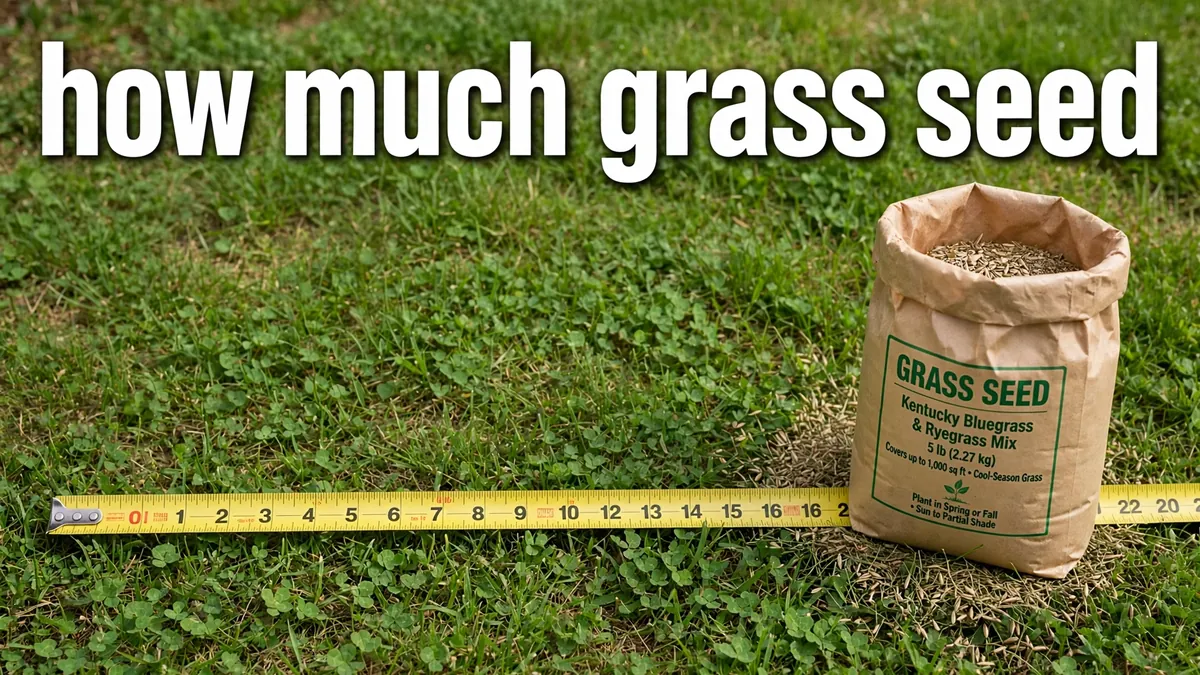
Coverage per bag = bag weight ÷ rate × 1,000. At 6 lb per 1,000 sq ft, a 50 lb bag covers about 8,333 sq ft, and a 10 lb bag covers about 1,667 sq ft. At the overseeding rate of 3 lb per 1,000 sq ft, the same bags cover roughly double. This is the number worth checking in the shop: two bags that look similar can cover very different areas if their recommended rates differ.
Mistakes a calculator cannot fix
A calculator gives you a weight, not a lawn. Four mistakes still ruin results:
- Sowing far above the label rate. More seed is not better. Overcrowded seedlings compete and weaken, leaving a thin lawn that is more prone to disease.
- Ignoring the bag rate. Online rates are general guidance. Species and cultivars vary, and the rate printed on your packet outranks any article, including this one.
- Sowing at the wrong time. Seed needs warm enough soil to germinate — roughly 8°C and rising for cool-season grasses — and consistent moisture for the first weeks. A perfect calculation sown into cold, dry soil still fails.
- Skipping soil preparation. Seed needs contact with soil, not thatch or bare compacted ground. Rake, loosen the top layer, and water gently and often until germination.
New lawn, overseeding, or patch repair?
The job changes the rate, so name it before you calculate. A new lawn on bare soil takes the full rate. Overseeding a thin lawn takes about half. Patch repair takes the full rate but only over the patch area — measure the patch, not the whole lawn. Renovation, where most of the old lawn is gone, sits between overseeding and a new lawn: use the full rate on the bare areas and the overseeding rate where grass survives.
The same measuring habit pays off elsewhere around the house: knowing an area and a rate, then buying to the calculation, is the same thinking behind sizing anything from firewood to a garden bed, as the firewood cord calculator shows for stacked wood. And a lawn is a long game, like growing anything from seed — the patience it takes is the same patience described in how to grow coffee beans at home, even if the plant is very different. City and town yards also differ more than people expect in size and shape, a contrast explored in town vs city — measure your own yard, not your neighbour’s.
The bottom line
A grass seed calculator is just area × rate, rounded up to whole bags: measure the lawn, use the rate on your bag, halve it for overseeding, add about 10% for waste, and buy to the result. Get the rate right and the timing right, and the seed does the rest.