
Firewood is one of the few things still sold by a unit most buyers cannot picture — and sellers know it. A firewood cord calculator is simply the arithmetic that turns a stack’s measurements into cords, so you can check what was delivered against what was quoted before you pay. The whole method rests on one number, and once you know it, the rest is multiplication and one division.
The one number: 128 cubic feet
A full cord is 128 cubic feet of wood that is “ranked and well stowed” — neatly stacked in rows, not thrown in a heap. The classic shape is a stack 4 feet high, 8 feet long, and 4 feet deep (4 × 8 × 4 = 128), but any shape that multiplies to 128 cubic feet is a cord. That definition, used in the United States and Canada and set out in NIST Handbook 130, is why a cord is a measure of stacked volume, including the air gaps between pieces, rather than a count of logs or a weight. The cord as a unit exists precisely because firewood pieces vary in size, so volume is the fair way to compare loads.
The formula
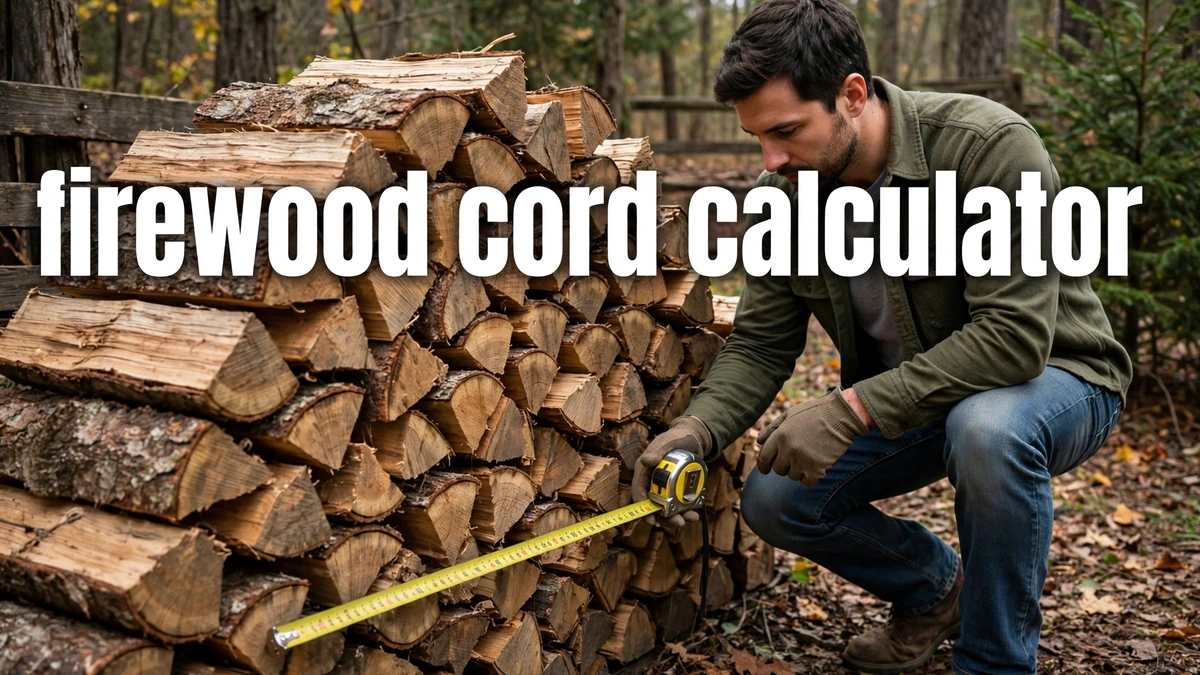
Measure three things, all in feet: the stack’s length, its height, and its depth (the length of the logs, if the stack is one log deep). Then:
Cubic feet = length × height × depth
Cords = cubic feet ÷ 128
That is the entire calculator. If your logs are measured in inches, divide by 12 first: 16-inch logs are 1.33 feet deep, 12-inch logs are 1 foot, 24-inch logs are 2 feet.
Worked examples
- The classic stack: 8 feet long × 4 feet high × 4 feet deep = 128 cubic feet ÷ 128 = 1 cord.
- A longer stack: 12 feet long × 4 feet high × 4 feet deep = 192 cubic feet ÷ 128 = 1.5 cords.
- A taller, shorter stack: 10 feet long × 5 feet high × 4 feet deep = 200 cubic feet ÷ 128 = 1.56 cords (round to 1.6 for practical purposes).
- A single row of 16-inch logs: 8 feet long × 4 feet high × 1.33 feet deep = 42.7 cubic feet ÷ 128 = 0.33 cords — this is a face cord, not a full cord (see below).
- A single row of 24-inch logs: 8 feet long × 4 feet high × 2 feet deep = 64 cubic feet ÷ 128 = 0.5 cords.
If your stack is uneven, measure the height at several points and use the average, and measure the length along the ground rather than along a sloping top. A stack that sags in the middle or tapers at the ends is smaller than its maximum dimensions suggest, and averaging is the honest way to handle it.
Full cord vs face cord vs rick
This is where most confusion — and most short deliveries — happen. A full cord (sometimes called a bush cord) is 128 cubic feet. A face cord is a stack with the same face — 4 feet high and 8 feet long — but only one log deep. Its volume depends entirely on log length:
| Log length | Face cord volume | Share of a full cord |
|---|---|---|
| 12 inches | 32 cubic feet | 0.25 cords |
| 16 inches | 42.7 cubic feet | 0.33 cords |
| 18 inches | 48 cubic feet | 0.375 cords |
| 24 inches | 64 cubic feet | 0.5 cords |
A rick is the same idea as a face cord, but the term is informal and its depth varies by region and seller — never assume a rick equals a particular fraction without asking the log length. The rule to remember: if a quote says “cord” but only gives two dimensions (4 × 8 feet), it is describing a face, not a volume. Ask for the third dimension before agreeing a price.
Checking a delivery and comparing prices
Use the formula before the truck leaves, or at least before you pay in full. Measure the stack once it is stacked — not while it is still in the truck, where loose wood takes up more space — and compare the result with the quoted amount. A shortfall of a few percent can be stacking variation; a shortfall of a third usually means a face cord was sold as a full cord.
To compare prices fairly, convert every quote to a price per full cord:
Price per cord = quoted price ÷ cords delivered
For example, $240 for 0.8 cords works out to $300 per full cord ($240 ÷ 0.8 = $300). A cheaper headline price for a smaller amount is often the more expensive deal once converted, which is why the per-cord figure — not the per-load figure — is the number to compare. Also note what the price includes: delivery, stacking, and whether the wood is seasoned (dried) or green (freshly cut). Green wood is heavier, harder to burn, and needs months of drying, so a low price for green wood is not comparable with a price for seasoned wood.
Stacked, loose, and metric measures
A cord counts stacked volume. The same wood thrown loosely into a truck measures larger — roughly a third more volume for the same wood, because of the extra air — so a loose load that looks like a cord is not one. Some jurisdictions give loose-volume equivalents for this reason, but the safe check is always the same: restack (or measure the stack after delivery) and apply the formula.
The solid wood inside a cord is less than 128 cubic feet, typically around 80 to 90 cubic feet depending on how straight and tightly the pieces are split and stacked. That gap is normal — it is the air between pieces, and it is already included in the definition.
In metric terms, a full cord is about 3.62 cubic metres. Wood sold by the cubic metre is often sold by the stere (1 cubic metre), which is about 0.28 cords. To convert, divide cubic metres by 3.62 to get cords, or multiply cords by 3.62 to get cubic metres.
How much wood do you actually need?
That depends on how you heat, how cold your winters are, and how large your home is — so any single number would be a guess, and this guide will not invent one. What the calculator does give you is a way to plan: measure what you used last winter (or what a full season’s stack measures), convert it to cords, and order that amount, with a small buffer for a colder-than-usual season. Home energy planning works the same way for other fuels — the sizing logic in how many batteries for daily 80 kWh starts from daily use and works up to a total, just as firewood planning starts from a season’s stack and works up to cords.
Storage matters as much as quantity. Stack wood off the ground, with air flow around it and a cover on top but open sides, so it can finish drying. Wood stored against a house wall or under a sealed tarp stays damp, and damp wood burns poorly and deposits more soot. A rural property with space for a proper stack has an advantage here — one of the practical trade-offs between town and country living described in town vs city — but even a small yard can hold a face cord or two if it is stacked neatly.
And season matters for buying, too: wood bought in autumn, when everyone else is buying, is often greener and pricier than wood bought in spring and left to dry through summer. If you can store it, buying ahead is the cheapest version of the same calculator result.
The bottom line
A firewood cord calculator is one formula: length × height × depth in feet, divided by 128. A full cord is 128 cubic feet; a face cord is a 4-by-8-foot face one log deep, and only a fraction of a cord. Measure the stack, convert every quote to a price per full cord, and never accept a two-dimensional quote as a cord. With that, you can check any delivery in minutes — and, over a winter, save yourself the most common firewood overcharge there is. A warm house in autumn pairs well with a warm drink, and the seasonal drinks in fall coffee drinks are a good reward for a stack well measured.