
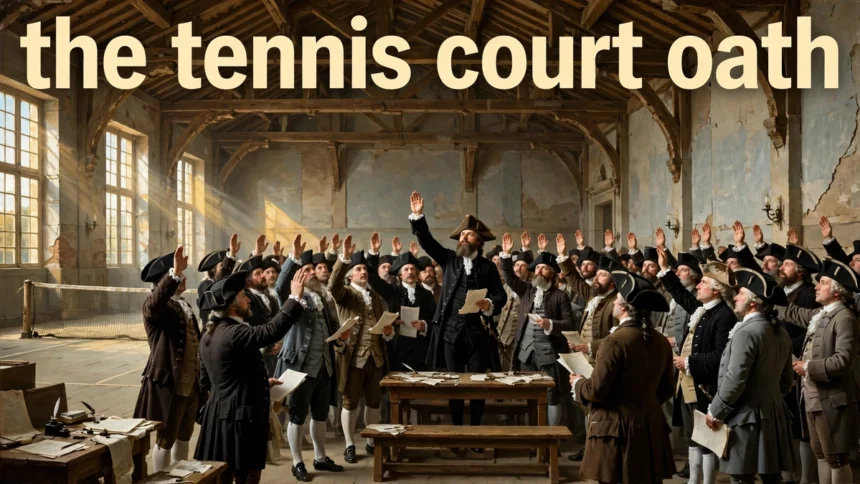
On the morning of 20 June 1789, the deputies of France’s Third Estate arrived at their meeting hall at Versailles and found the doors locked and guarded by soldiers. Rather than go home, they walked to a nearby indoor tennis court — a long hall built for jeu de paume, the ancestor of modern tennis — and there they swore an oath that changed France. So what was the oath of the tennis court? In one sentence: a vow never to separate, and to reassemble wherever necessary, until France had a constitution established on solid foundations.
France in crisis
France in 1789 was effectively bankrupt. Years of war spending, a regressive tax system that exempted the clergy and nobility, and a series of poor harvests had pushed the kingdom to the edge. King Louis XVI, unable to raise revenue without the consent of the privileged orders, summoned the Estates-General — an assembly of the three orders of French society that had not met since 1614.
The three Estates were the clergy (First Estate), the nobility (Second Estate), and everyone else (Third Estate) — roughly 98% of the population, from wealthy merchants to peasants. The fight that followed was about voting: the First and Second Estates wanted votes counted by order, which would let them outvote the Third Estate two to one. The Third Estate demanded voting by head, counting each deputy individually, which would give it — the largest delegation — real power.
From Third Estate to National Assembly
On 17 June 1789, the Third Estate took the decisive step: it declared itself the National Assembly, claiming to speak for the French nation rather than for one order among three. A few clergy and nobles joined it. The king’s government, alarmed, closed the Assembly’s usual meeting hall, the Salle des Menus-Plaisirs, officially for renovations to prepare for a royal session. The deputies read it as intimidation — an attempt to lock them out of existence.
On 20 June, finding the hall locked and guarded, the deputies followed the suggestion of Joseph-Ignace Guillotin and gathered in the nearby Salle du Jeu de Paume, the royal tennis court built in 1686 near the palace. There, on the proposal of Jean-Joseph Mounier, they took the oath. Jean-Sylvain Bailly, an astronomer who presided over the Assembly, was the first to sign. Of the 577 deputies present, 576 took the oath; the single exception was Joseph Martin-Dauch, who said he would only execute decisions made by the monarch.
What the oath actually said
The oath, in the version recorded from the Assembly’s proceedings, was: “We swear never to separate and to meet wherever circumstances require until the kingdom’s Constitution is established and grounded on solid foundations.” Its French name is the Serment du Jeu de Paume — the Oath of the Real Tennis Room.
Three things about that wording matter. First, it was a promise of persistence, not a programme: it did not demand a republic or the king’s removal, only a constitution. Second, it claimed authority from the nation rather than the crown: the deputies, not the king, would decide when their work was done. Third, it was collective and public — hundreds of men swearing together, in a room, where breaking the vow would be visible to everyone present.
Why it mattered
The oath was the first moment French citizens formally stood in opposition to Louis XVI as a body. The king first tried to annul it, then, faced with the Assembly’s refusal to back down and with some clergy and nobles joining it, conceded: on 27 June he ordered the remaining deputies of the First and Second Estates to join the National Assembly. The lock-out had backfired completely.
What followed came fast. The storming of the Bastille on 14 July, the abolition of feudal privileges in August, and the Declaration of the Rights of Man and of the Citizen on 26 August all flowed from the Assembly’s survival — and the Assembly survived because of the oath. The promise itself was fulfilled two years later by the Constitution of 1791, which created a constitutional monarchy and ended absolute rule in France’s first revolutionary phase.
The oath also drew on an older model: it was foreshadowed by the 1776 American Declaration of Independence, especially its preamble’s claim that legitimate government derives from the consent of the governed. The deputies were putting Enlightenment ideas about popular sovereignty into action — sovereignty comes from the people, not from the crown.
What happened to the room — and the oath-takers
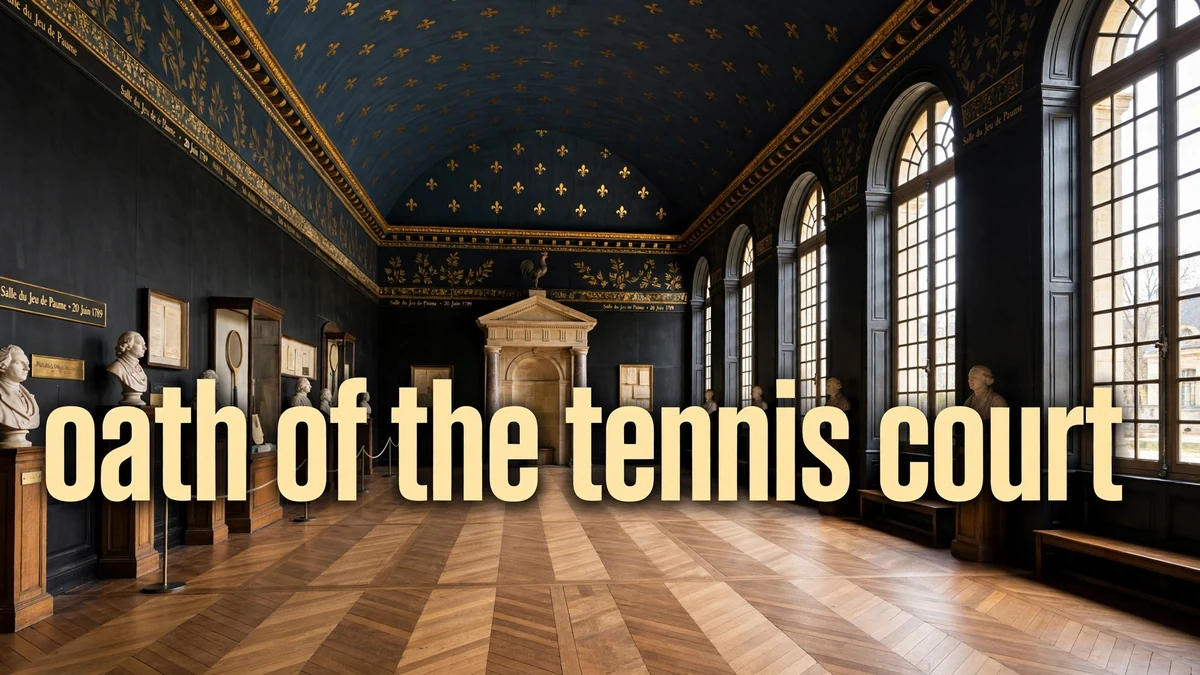
The tennis court itself still stands at Versailles. It has served as a museum of the French Revolution since 1883, and visitors can stand in the room where the deputies swore. Jacques-Louis David’s famous depiction of the event, commissioned by the National Assembly in 1790, was never finished — a fitting image for a revolution that outran its own plans.
The oath-takers’ later fates were mixed, and often grim. Bailly became the first mayor of Paris after the Bastille fell, but was guillotined in November 1793. The constitution the deputies wrote did not last: within a year France was at war, Louis was arrested after a failed escape attempt, and the Revolution consumed many of its own founders. But the principle articulated in that tennis court — that a nation’s representatives, not its king, hold the authority to make a constitution — survived the Terror and the chaos that followed, and it remains the reason the oath is remembered as a founding act of French democracy.
An oath, after all, is a promise made in public, and its power comes from the witnesses as much as the words — a dynamic familiar from any game built on trust and bluff, like two truths and a lie ideas, where a statement only matters because the group hears it together. And promises kept or broken are a theme that runs through old texts as well as new history, from short bible verses to the travel writing of best places to visit in panama, where a place’s history is part of why it is worth visiting.
The bottom line
The Oath of the Tennis Court was the 20 June 1789 vow by France’s Third Estate deputies, locked out of their hall at Versailles, not to disband until France had a written constitution. It was not a battle and it demanded no republic — but it was the moment the Revolution became irreversible, because a king who could lock a door discovered he could not lock out a nation.