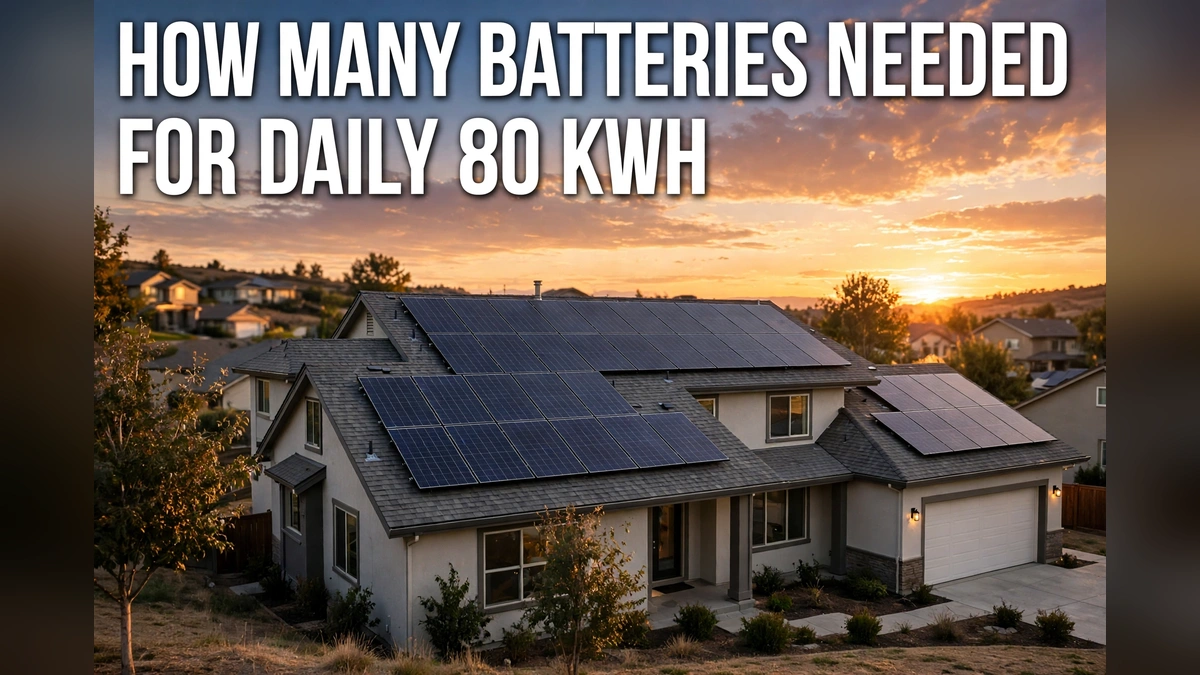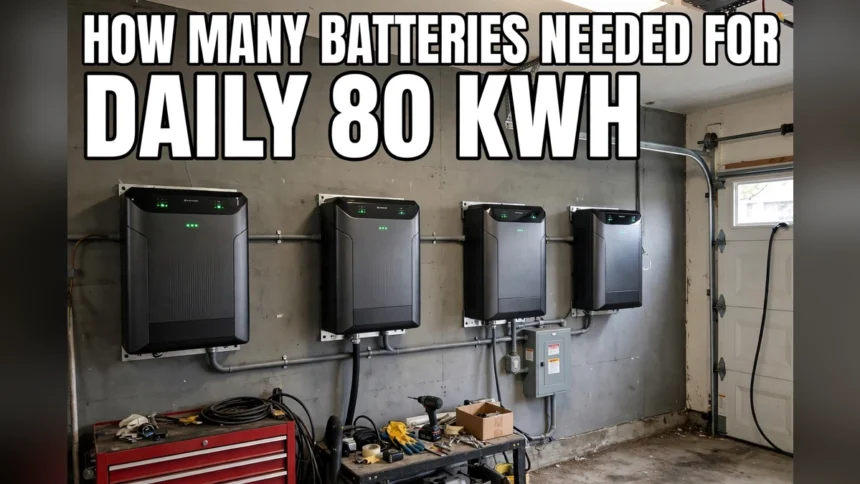
First, some context: 80 kWh a day is a lot. Industry guides cite a US average household use of roughly 29–30 kWh a day, so 80 kWh suggests a large home, electric heating or cooling, an EV charger, or several of those at once. That matters because the answer to how many batteries needed for daily 80 kwh is not one number — it depends on how much of that 80 kWh you want the batteries to cover, and on the size of each battery you buy.
The sizing math
Start with usable energy, not the number on the box. A battery’s rated capacity is not all available: manufacturers limit depth of discharge to protect lifespan, and the inverter loses some energy converting stored power back to household electricity — the same basics that define home energy storage systems generally. Using common planning assumptions of 90% depth of discharge and 90% inverter efficiency, the rated capacity you need is:
Rated capacity = daily energy to cover ÷ (0.90 × 0.90)
For a full day of 80 kWh from batteries alone, that is 80 ÷ 0.81 = about 99 kWh, so roughly 100 kWh of rated capacity. Your own numbers will differ if your battery’s usable capacity or your inverter’s efficiency differ — always use the usable capacity from the product’s spec sheet, not a generic assumption, before you buy.
Battery counts for a full 80 kWh day
Divide the roughly 100 kWh of rated capacity by the size of the unit you are considering, and round up:
| Battery size (rated) | Units for ~100 kWh | Total rated capacity |
|---|---|---|
| 5 kWh | 20 | 100 kWh |
| 10 kWh | 10 | 100 kWh |
| 13.5 kWh | 8 | 108 kWh |
Eight 13.5 kWh units is the closest common answer, and it is a very large system — most homes that want whole-home backup install far fewer units, because they are not trying to cover a full 80 kWh day from batteries alone.
The overnight-only option
Here is where most households save money. Your solar panels cover part of the day directly, so batteries usually only need to carry the home from late afternoon to the next morning. Sizing guides commonly suggest total battery capacity around half of daily use as a cost-effective starting point. For 80 kWh, that is about 40 kWh of usable energy, or roughly 50 kWh rated (40 ÷ 0.81). That works out to about 4 units at 13.5 kWh, 5 units at 10 kWh, or 10 units at 5 kWh — roughly half the full-day system. The trade-off is honest: on a cloudy stretch or a very heavy-use day, an overnight-sized bank will run out, while a full-day bank keeps going. Choose based on whether you want backup for a night, or independence for a full day.
What else changes the count
Three things move the answer more than anything else. First, your real load: check your electricity bill and divide monthly kWh by 30 for your daily average, and check whether a few heavy days, not the average, are what you actually need to cover. Second, your goal: backup for essentials only (lights, fridge, heating controls, medical equipment) needs far less than whole-home backup. Third, your solar: a system that refills the batteries daily needs less stored energy than one that must ride through several sunless days. Treat the counts above as worked estimates with stated assumptions, not as a quote — a solar installer sizes the final system from your bills, your roof, and the products you choose. Home systems also age like any other household system: the same habit of checking before assuming applies to why a washer stops draining — look at the actual unit, not the generic advice. And once the system is in, it becomes part of the daily routine, like learning how to grow coffee beans at home or getting how much ground coffee per cup right: small, regular habits beat one big guess.