
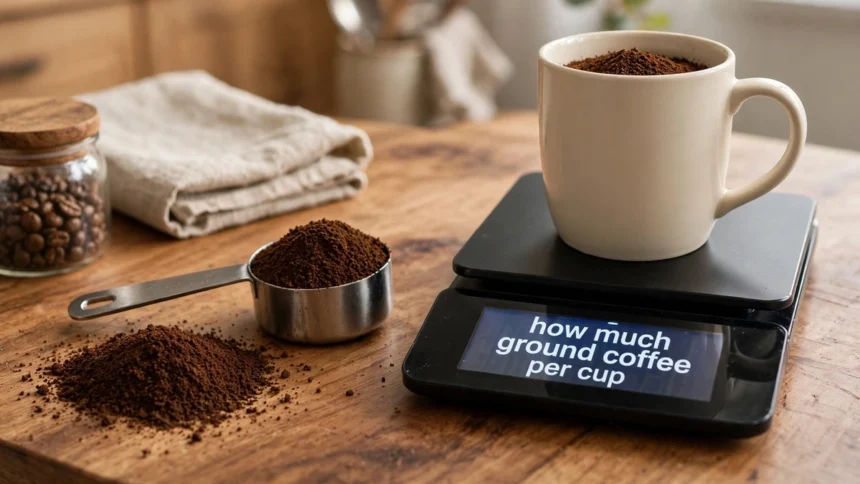
The short answer: start with about 2 level tablespoons of ground coffee per cup, roughly 10 to 15 grams depending on cup size. For a standard 8-ounce mug, aim for the higher end of that range; for a smaller coffee-maker cup, aim for the lower end. That starting point gives most people a balanced cup, and you can adjust it up or down to suit your taste.
Once you know how much ground coffee per cup means for your mug, your brewer, and your taste, the guesswork — and most weak or bitter mornings — disappears.
Why “a cup” is confusing
In everyday language, a cup is the mug you drink from, usually 8 to 12 ounces. On a coffee maker, a “cup” is usually much smaller, often 5 to 6 ounces. So a machine that makes 12 cups does not make 12 full mugs; it makes 12 of its own small cups, closer to 60 to 72 ounces in total.
That is why two people can follow the same recipe and get different results: one measures for an 8-ounce mug, the other for a 6-ounce machine cup, and both call it “one cup.” Check your own cup first: fill it, pour it into a measuring jug, and note the ounces.
How much ground coffee per cup, by cup size
These are starting points, not exact doses, because grind size and bean density change how much a tablespoon actually weighs. Use them to get close, then adjust by taste.
| Cup size | Ground coffee (weight) | Ground coffee (spoons) |
|---|---|---|
| 6 oz coffee-maker cup | 10–11 grams | 2 level tablespoons |
| 8 oz mug | 13–15 grams | About 2.5 tablespoons |
| 12 oz large mug | About 22 grams | About 3.5–4 tablespoons |
For a full pot, work from the ounces of water you are actually brewing, not an imagined number of mugs. Planning portions in advance helps any shared morning run smoothly — a lesson also visible in a big thank-you to everyone who supported a pet food drive, where getting the amounts right meant everyone was looked after.
The ratio behind the numbers
The most useful way to think about coffee is as a ratio of coffee to water by weight. The Specialty Coffee Association’s Golden Cup standard is 55 grams of coffee per litre of water, with a tolerance of about 10 percent either way — roughly 1 part coffee to 18 parts water, or about 1:18.
Many home brewers find 1:18 a touch light, so a good everyday starting ratio is 1:16: one gram of coffee for every 16 grams (or millilitres) of water. Since one millilitre of water weighs one gram, the maths is easy. For 250 millilitres of water, about an 8-ounce mug, divide 250 by 16 to get about 15 grams of coffee — matching the table above.
Treat 1:16 as your home base. If coffee tastes weak or watery, move towards a stronger ratio such as 1:15, adding a little more coffee for the same water. If it tastes too strong or harsh, move towards 1:17 or 1:18, using a little less. Change only the coffee amount at first, so you can tell what actually made the difference.
Adjusting by brew method
Different brewers extract coffee differently, so the same ratio does not taste identical in every method:
| Brew method | Starting ratio | Notes |
|---|---|---|
| Drip machine and pour-over | 1:16 | A balanced starting point for most everyday coffee. |
| French press | About 1:15 | Slightly stronger, suiting the fuller body and longer steep. |
| Cold brew concentrate | Stronger than drip | Brew concentrated, then dilute with water or milk to taste. |
For drip and pour-over, 1:16 keeps the cup clean and balanced. Coffee preparation explains how grind, water, and contact time shape the result — a finer grind or longer brew extracts more from the same coffee.
For French press, 1:15 suits the fuller, steeped result. Press gently, and do not leave coffee sitting on the grounds, which turns bitter.
Cold brew is normally brewed as a concentrate, using considerably more coffee relative to water than a hot method, then diluted before drinking. Dilute a small glass first, then adjust the whole batch.
On a hot day, a cold drink is welcome for everyone in the house, dogs included — frozen pupsicles for dogs on a hot day are the canine equivalent of planning a refreshing treat in advance.
Weight versus volume: why a scale wins
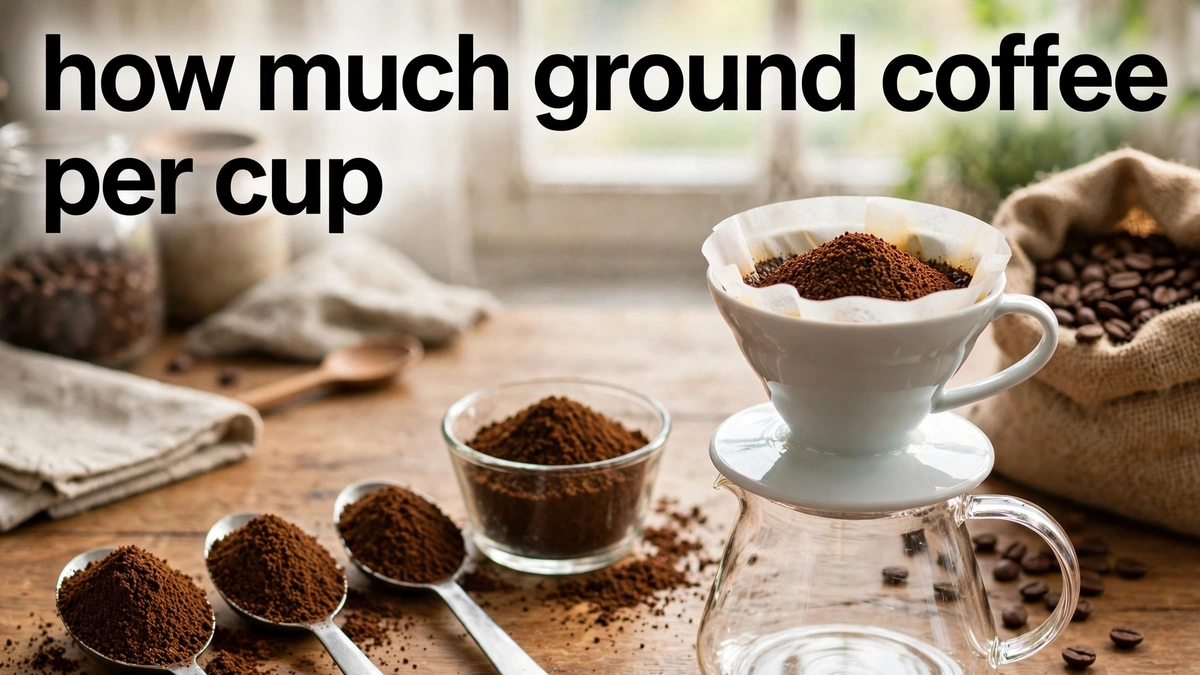
Tablespoons are convenient and fine for getting started, but they are not precise. A level tablespoon of finely ground coffee weighs more than a level tablespoon of coarsely ground coffee, because fine particles pack together more tightly, and different beans differ in density. So the same “two tablespoons” can weigh noticeably different amounts if the grind or bean changes.
A small gram scale removes that variation and lets you repeat a good cup exactly. Without one, use level tablespoons and keep the same spoon and grind.
Scoops are worse, because they are not a standard size: some hold about one tablespoon, others about two. To put it plainly: tablespoon measures are starting points, not exact doses, because grind and density vary.
How to adjust to taste
Adjust in small steps over a few days, changing only one thing at a time:
- Weak or watery: add a little more coffee for the same water, moving from 1:16 towards 1:15. First check you measured the water correctly and did not count a 6-ounce machine cup as an 8-ounce mug.
- Too strong or harsh: use a little less coffee, moving towards 1:17 or 1:18, and check the coffee did not sit on the grounds too long.
- Bitter but not strong: this may be over-extraction, not too much coffee. A slightly coarser grind or shorter brew time may help more than changing the dose.
- Sour or thin: this may be under-extraction. A slightly finer grind or longer contact time may help, as may making sure the water is hot enough.
- Inconsistent day to day: switch to weighing the coffee. Volume measures drift when grind, bean, or spoon changes.
Taste is personal: the ratio is a starting point, your palate makes the final call.
If you carry coffee to work, measure your travel mug the same way you measured your home mug, so the recipe travels with the container it actually travels in — the same kind of advance planning behind take your dog to work day.
A simple routine that works
- Find out how many ounces your mug or pot really holds.
- Start at 1:16 — about 2 level tablespoons, or 13 to 15 grams, for an 8-ounce mug.
- Use level tablespoons without a scale; weigh the coffee if you have one.
- Brew, taste, and change only the coffee amount first, in small steps.
- Once strength is right, fine-tune grind or brew time only if a specific flavour problem remains.
At home the fundamentals stay the same: the right amount of coffee, the right amount of water, and a method that suits both. Start with 2 tablespoons per cup, weigh it when you can, and adjust from there.