
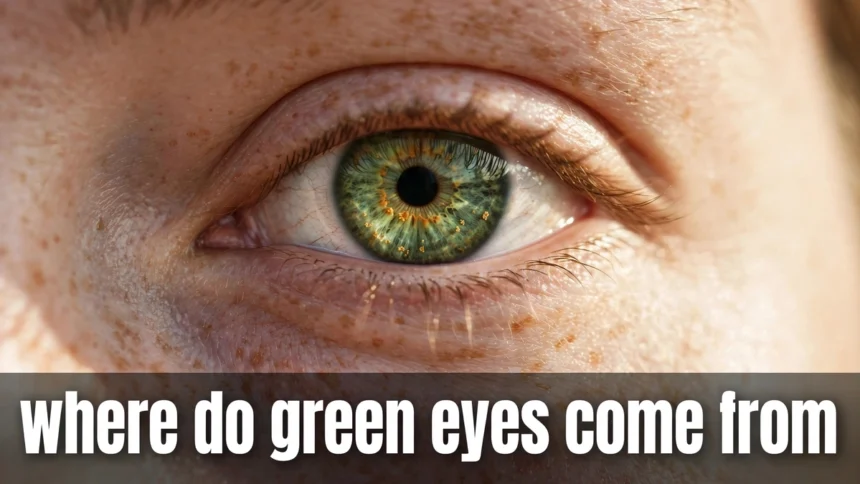
Green eyes are the rarest eye colour most people will ever meet — about 2% of the world’s population has them, against roughly 79% with brown eyes and 8–10% with blue. The obvious question is why they are so uncommon, and the answer has two parts: genetics and optics. So where do green eyes come from? From a specific, hard-to-hit balance of pigment in the iris, shaped by several genes and by the way light scatters through the eye’s tissue.
There is no green pigment
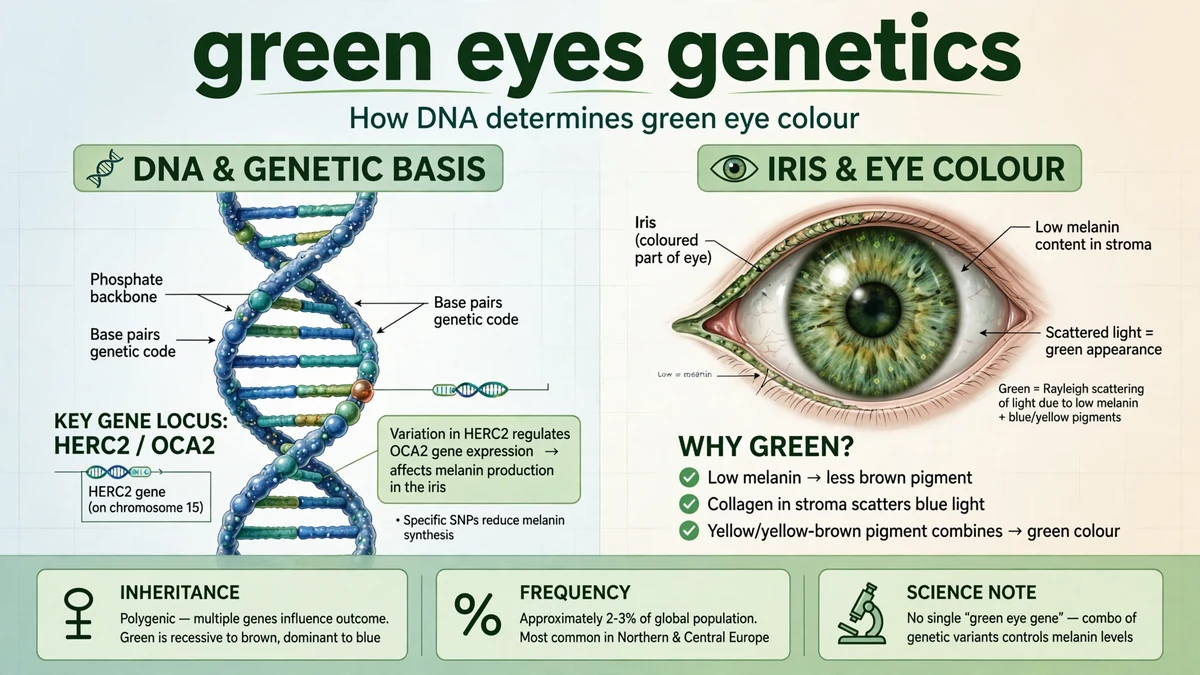
The first surprise: no human iris contains green pigment. Brown eyes look brown because the iris contains a lot of the dark pigment eumelanin. Blue eyes look blue because the iris contains very little melanin, and light scattering in the iris tissue — similar to why the sky looks blue — returns blue wavelengths to the viewer. Green eyes sit in between, and their colour is a combination effect: a modest amount of yellowish pigment (pheomelanin, the same pigment family behind red hair and freckles) in the front layer of the iris, overlying light scattered blue by the iris stroma. Yellow over scattered blue reads as green.
That is also why green eyes can seem to change shade in different light. The pigment does not change; the light does. In warm indoor light the yellow tones dominate and the eyes look hazel-green; in daylight the scattered blue comes forward and they look greener or greyer. Eye colour is partly structural, not just chemical.
The genes: HERC2, OCA2, and the rest
Eye colour is polygenic — shaped by many genes, not a single dominant-or-recessive switch. The old schoolbook version (brown dominant, blue recessive) is an oversimplification that modern genetics has replaced. Two neighbouring genes on chromosome 15 do most of the heavy lifting:
- OCA2 provides instructions for the P protein, which helps melanocytes produce and distribute melanin. Variants that reduce P protein activity mean less melanin in the iris.
- HERC2 sits next to OCA2 and acts as a regulatory switch for it. A well-studied variant in HERC2, rs12913832, can dial OCA2 expression down, reducing melanin further and contributing to lighter eyes.
If HERC2 and OCA2 were the whole story, eyes would come out brown or blue and nothing in between. Green exists because other genes modify the outcome — genes affecting pheomelanin production, melanosome structure, and pigment distribution push the result into the middle ground. Green eyes require a subtle combination: enough melanin reduction to lighten the iris, plus enough pheomelanin to warm the scattered blue into green. That combination is simply rarer than the combinations that produce brown or blue, which is why green is the least common colour.
Why green eyes run in families — but unpredictably
Because eye colour involves many genes, family patterns surprise people. Two brown-eyed parents can have a green-eyed child, because each parent can carry lighter-eye variants that neither expresses. Two blue-eyed parents can have a brown-eyed child for the same reason — the child’s combination, not either parent’s colour alone, decides the outcome. There is no single “green-eye gene” a parent either passes on or does not.
What does run in families is ancestry. Green eyes cluster most heavily in Northern and Central Europe, with Ireland and Scotland the most frequently noted hotspots, and they appear at lower rates in populations with Celtic and Germanic ancestry more broadly. The leading explanation is history: until roughly 10,000 years ago, practically all humans had brown eyes, and lighter colours arose from mutations that spread as populations migrated, concentrated by genetic drift and founder effects in smaller, more isolated groups.
Green vs hazel: a common confusion
Green and hazel are often mixed up, and the distinction is worth making. Hazel eyes show a blend — typically brown or gold near the pupil shifting to green at the edge — and their appearance changes more dramatically with light and clothing. Green eyes are more uniformly green across the iris. Both sit in the same middle ground of melanin and scattering, which is why the boundary between them is a spectrum rather than a sharp line, and why two observers can disagree about the same pair of eyes.
Can eye colour change?
In adults, essentially no. Babies are often born with blue or grey eyes because their melanocytes have not yet produced full melanin; the colour typically settles within the first year as melanin production ramps up. After that, iris colour is stable for life, apart from subtle shifts with lighting, pupil size, and age-related changes in the iris tissue. Claims that diet, mood, or eye drops change eye colour have no support in the genetics literature — and any product promising to change eye colour should be treated with scepticism, since the iris is delicate and its pigment system is not adjustable from outside.
That stability is part of what makes eye colour a useful ancestry clue, though only a rough one: it says something about the populations your ancestors came from, not about your personality, health, or character. And appearance runs in families in dogs as surely as in people — a Boston Terrier’s dark, round eyes are part of the breed’s look, as any reader of why a Boston Terrier will recognise, even if the genetics behind a dog’s eyes differ from a human’s. Small natural wonders are worth noticing wherever they appear, whether in a person’s eyes, in a garden visitor like the one in what a ladybug landing on you means, or on a walk like our trip to San Francisco.
The bottom line
Green eyes come from a rare genetic recipe: reduced eumelanin plus pheomelanin, shaped mainly by the HERC2–OCA2 region on chromosome 15 and modified by several other genes, with light scattering in the iris turning that pigment mix green. No green pigment exists, no single gene decides it, and its rarity — about 2% of people — is exactly what you would expect from a balance that is harder to hit than brown or blue.