
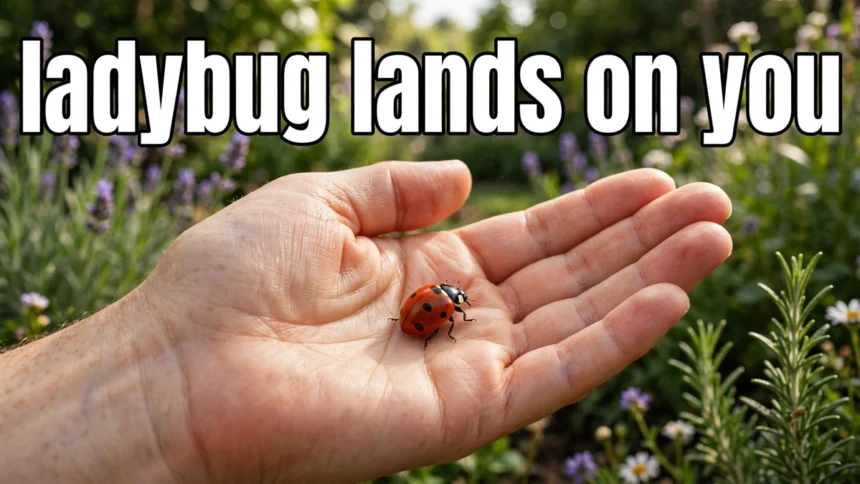
A tiny red beetle lands on your hand, pauses, and takes off again — and for a second, it feels like more than an accident. That feeling is old: in folklore across many cultures, a ladybug lands on you as a sign of good luck. The traditions behind that idea are charming, and the real insect behind them is worth knowing too.
The short answer: good luck, in almost every tradition
The most consistent meaning, across Europe, Asia, and the Americas, is good fortune. Many traditions add the same practical advice: do not brush the ladybug off. Let it walk off or fly away on its own, and the luck stays with you. Some sayings go further — make a wish while it sits on you, and when it flies away it carries the wish with it.
Two other meanings show up again and again:
- Love and relationships. In several traditions, a ladybug landing on you signals new love, a deepening relationship, or — in one old saying — that the direction it flies points toward a future partner.
- Protection. The name itself points here: in medieval Europe, ladybugs were called “the beetles of Our Lady,” after the Virgin Mary, and their red wing covers were said to represent her cloak. A ladybug on you was read as a sign of being watched over.
None of this is a fact about the future. It is folklore — a set of stories people have told about a welcome insect for centuries. That distinction matters, and it is also the reason the folklore lasted: ladybugs really do help people, which gave the stories a root in everyday life.
Why farmers loved ladybugs first
Before ladybugs meant luck, they meant a saved harvest. Ladybugs eat aphids and other soft-bodied pests that destroy crops, and a single ladybug can eat a large number of aphids in its lifetime. Medieval European farmers, facing crops overrun with aphids, prayed for help — and when ladybugs arrived and cleared the pests, the beetles were credited with the rescue. That practical gratitude hardened into symbolism: the helpful insect became the lucky insect, and the lucky insect became the protected one. In many traditions, killing a ladybug is said to bring bad luck — a belief that, whatever its origin, happens to protect a genuinely useful garden insect.
This is also why ladybugs appear on lucky charms, greeting cards, and children’s toys far more than any other beetle. The symbol travelled from the field into the culture, and it stuck because the insect itself is harmless to people, brightly coloured, and easy to like.
Counting the spots
The best-known ladybug saying involves counting. In one version, the number of spots on the ladybug’s back tells you how many lucky months lie ahead. In another, the spots count the months until you meet your true love. In a third, more spots mean a bigger windfall.
Here the folklore runs into the real insect. Spots do not measure luck — they vary by species. The seven-spot ladybug, Coccinella septempunctata, has seven spots, which is why the number seven shows up in old sayings about the insect’s seven joys and seven sorrows. Other species have two spots, or none at all, or so many that counting is pointless. The saying is fun to repeat when one lands on you; it is not a calendar.
What different cultures say
The core theme — luck and positive change — stays remarkably consistent, while the details vary:
- Western Europe: incoming good luck; spots count lucky days or months ahead.
- Russia and Eastern Europe: the ladybug is called “God’s little cow,” and its appearance signals divine protection.
- Asian folklore: a link to love and romantic luck; a ladybug landing on you may fly toward your true love.
- Native American traditions: a symbol of renewal and the cycles of nature — a call to trust the process.
- France: a belief that when a ladybug flies away, it carries your ailments away with it.
- Belgium: a ladybug crawling across a young woman’s hand was once said to predict how soon she would marry.
Some folk traditions also assign meanings to where the insect lands: the hand for creative success or a new project, the head for clarity or an important decision, the shoulder for being watched over. These associations vary by source and are best treated as storytelling, not guidance.

What a ladybug actually is
Ladybugs are not bugs in the strict sense — they are beetles, members of the family Coccinellidae. They are found on every continent except Antarctica, and most species are predators of aphids, scale insects, and mites, which is why gardeners welcome them. Their bright red or orange colour with black spots is a warning to predators: many ladybugs taste bad and can release a bitter fluid from their leg joints when threatened. That warning colouring is part of why they feel safe to handle — they are advertising, in insect terms, that they are not worth eating.
A ladybug landing on you, in plain terms, usually means it was flying nearby and your hand was a convenient perch — often near plants, in warm weather, when ladybugs are active. Some species gather in large groups in autumn to overwinter, which is why you may see many at once in certain seasons. None of this makes the moment less pleasant; it just means the luck, if you want it, is in how you choose to take the moment.
What to do when one lands on you
The folklore and the practical advice agree for once: leave it alone. Let it walk off or fly away on its own. If you need to move it, let it walk onto a leaf or a piece of paper rather than grabbing it, and put it outside near plants rather than indoors, where it will struggle to find food. Do not keep it in a jar — a ladybug’s value, practical and symbolic alike, is in being free to do its work in the garden.
And if you are out walking the dog when one lands on you, it is one more small outdoor surprise to notice — the same kind of everyday moment that makes a walk worth writing about, whether the walk ends at a beach like the one in our trip to San Francisco or just around the block with a Boston Terrier who notices every bug before you do, as any reader of why a Boston Terrier will recognise. Even a swim can bring its own small encounters, as Gus swims showed long ago.
The bottom line
A ladybug landing on you means good luck in folklore, love or protection in several traditions, and — in reality — that a helpful little beetle mistook your hand for a good place to rest. The folklore is worth enjoying, the insect is worth protecting, and the best response is the simplest one: let it fly away, and take the good mood with you.