
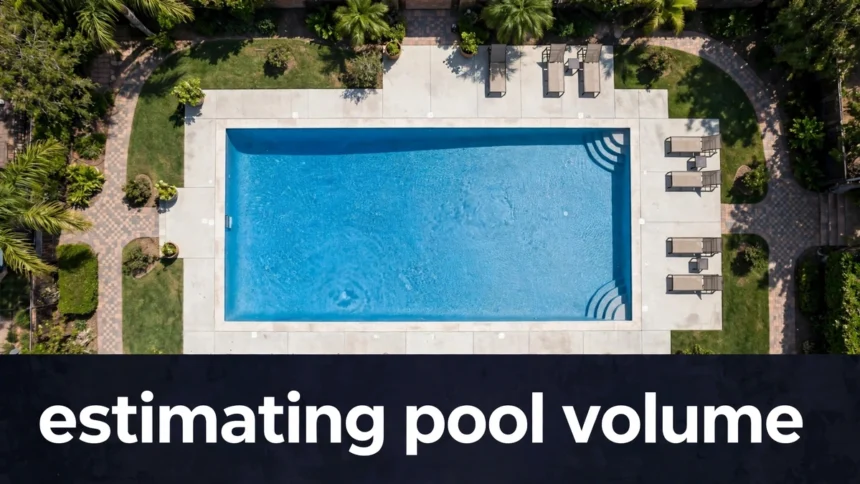
Estimating pool volume is the first job in pool care, because every chemical dose — chlorine, shock, salt, stabiliser — is calculated per gallon. Get the volume wrong and every dose is wrong by the same percentage. The good news is that the maths is simple: for every shape, pool volume in gallons is the surface area in square feet, multiplied by the average depth in feet, multiplied by 7.48 — the number of US gallons in one cubic foot. What changes with shape is only how you work out the surface area.
Step 1: find the average depth
Most pools are not one depth throughout, so do not use the deep end alone. Measure the depth at the shallow end and the depth at the deep end, add them together, and divide by two:
Average depth = (shallow end depth + deep end depth) ÷ 2
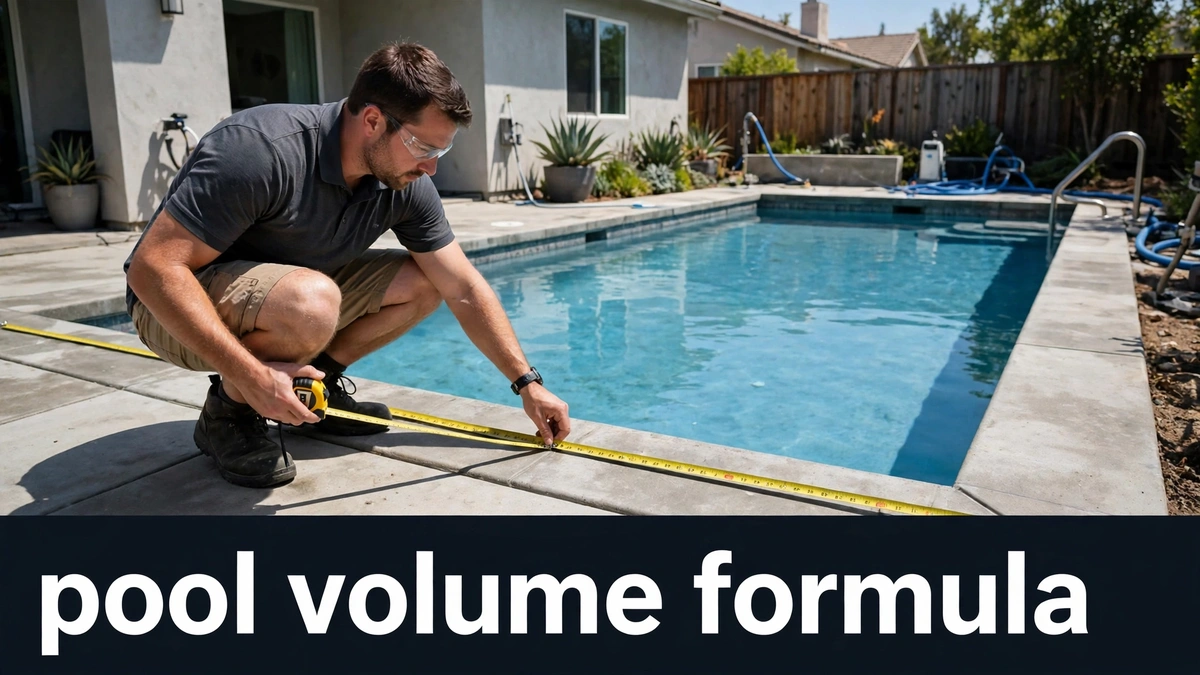
A pool with a 3-foot shallow end and an 8-foot deep end has an average depth of (3 + 8) ÷ 2 = 5.5 feet. A flat-floored pool just uses its one depth. This single number moves the answer more than anything else, so measure it properly rather than guessing — wading in with a tape is worth ten minutes of estimating from the side.
Step 2: formulas by shape
Rectangular pools. Surface area is length × width, so:
Volume = length × width × average depth × 7.48
Worked example: a 32 × 16 foot pool with a 5.5-foot average depth holds 32 × 16 × 5.5 × 7.48 = 21,064 gallons.
Round pools. Measure the diameter, halve it for the radius, and use π × radius² for the area:
Volume = π × radius² × average depth × 7.48
Worked example: an 18-foot diameter above-ground pool has a 9-foot radius, so its surface area is 3.1416 × 81 = 254.5 square feet. At a 4-foot average depth it holds 254.5 × 4 × 7.48 = 7,614 gallons.
Oval pools. Treat the oval as a true ellipse: π × half the length × half the width:
Volume = π × (length ÷ 2) × (width ÷ 2) × average depth × 7.48
Worked example: a 30 × 15 foot oval at a 5-foot average depth holds 3.1416 × 15 × 7.5 × 5 × 7.48 = 13,218 gallons.
Irregular, kidney, and freeform pools. There is no clean formula, so use one of two approaches. The quick method multiplies the bounding rectangle by a shape factor — 0.75 is the common shortcut, assuming the curves remove about a quarter of the rectangle’s area — then by average depth and 7.48. The more accurate method splits the pool into simple shapes (rectangles, circles, semicircles), calculates each section separately, and adds them together; this typically lands within 5 to 10 percent of the true volume. For exact volume, a flow meter on the fill hose, measuring gallons from empty to full, is the only method that gives a precise number — and your water meter reading before and after a fill does the same job, since one CCF (hundred cubic feet) equals 748 gallons.
Step 3: use the number
Once you have gallons, everything else follows. Chlorine and shock doses are labelled per 10,000 gallons, so divide your volume by 10,000 and multiply by the labelled dose. Salt systems are sized by gallons, and pump flow requirements follow from volume too: dividing gallons by 12 hours, then by 60, gives the gallons per minute needed for a full turnover in 12 hours. Keep the volume written down where you keep your chemicals — it is the one number you will reach for all season.
Common mistakes to avoid
- Using the deep end as the depth. This overstates the volume badly; always average shallow and deep ends.
- Forgetting the 7.48 conversion. Length × width × depth gives cubic feet, not gallons. Without the conversion your dose will be roughly seven times too small.
- Measuring the waterline instead of the pool. Measure the pool’s own dimensions, not the water surface after rain or splashing has changed it.
- Trusting a shortcut for dosing. The 0.75 rectangle shortcut is fine for a rough estimate, but for chemical dosing on an irregular pool, the section method or a meter reading is worth the extra effort — shortcut errors of 15 to 20 percent become dosing errors of the same size.
Why estimates still beat guesses
An estimate within 10 percent is enormously better than a guess, and most rectangular, round, and oval pools can be estimated within a few percent with a tape measure and the formulas above. The one case where estimating struggles is a freeform pool with shelves, benches, and a spa spilling into it — features add or subtract volume from the base calculation, so treat any figure for such a pool as approximate and round chemical doses conservatively. And if you are out walking the dog while the pool pump hums away at home, it is one more small, unhurried household job worth doing properly — the same kind of practical measuring this site has covered before, from working out how much material a job needs, as in soil yard calculator, to seeding a lawn, as in grass seed calculator, to stacking winter fuel, as in firewood cord calculator — and a swimming pool is simply the next thing in the garden worth measuring right.
The bottom line
Estimating pool volume is three steps: surface area, times average depth, times 7.48. Measure the shallow and deep ends and average them, pick the formula for your shape, and write the gallon figure down. Every chemical decision you make afterwards starts from that one number, so it is worth the ten minutes with a tape measure.