
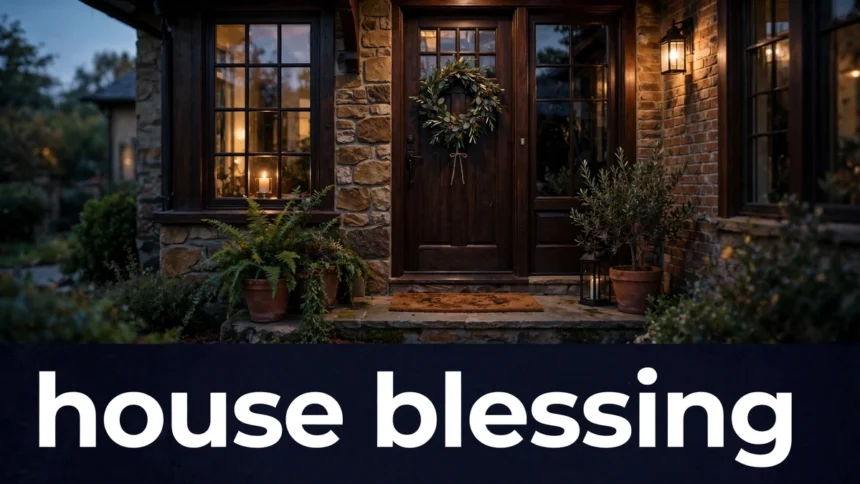
A house blessing is a short ceremony where you speak peace, protection, and intention over a home — most often when moving in, but also after an illness, a separation, a break-in, or simply a hard season that a household wants to mark and move past. It can be led by a priest or minister, shared with family, or done quietly alone, and it belongs to no single faith: many religions have a form of it, and plenty of people do it with no religion at all, calling it an intention-setting or a home dedication instead. What it always is, at heart, is a walk through the rooms you live in, saying out loud what you want each one to be for.
What a house blessing is — and is not
A house blessing is a dedication, not a repair. It does not fix a house, remove anything from it, or promise a good year, and it is not an exorcism: nothing is being driven out, and no room will give you a verdict on the house’s history. What it does is mark a threshold. Moving house is one of life’s biggest disruptions, and a short ceremony gives that disruption a shape — a beginning, said out loud, in the rooms where life will actually happen.
That is also why it works without any particular belief. The essential act is attention: walking slowly through your own home, room by room, and naming what each room is for. Everything else — the candle, the water, the words — is scaffolding around that single act.
How traditions around the world do it
House blessings take different forms in different traditions, and knowing a few helps you choose what fits your own home:
- Christian traditions. In Roman Catholicism, Orthodoxy, Lutheranism, Anglicanism, and Methodism, a house blessing is usually performed by a pastor who walks through every room with the occupants, praying for them and sprinkling holy water; blessed salt and incense may also be used. Many families have their homes blessed at Epiphany, on January 6, often starting with the custom of chalking the door — writing the year and the initials C, M, and B, for the traditional names of the Magi and for the Latin blessing Christus mansionem benedicat, “May Christ bless this house,” above the front door.
- Hindu tradition. A house blessing is conducted before the people move in — after construction is finished for a new house, or after purchase but before moving in for a bought one — as part of entering the home properly.
- Buddhist tradition. In Han Mahayana traditions, a house blessing may involve sprinkling the new residence with water consecrated with the Great Compassion Mantra, a rite known as sajing, conducted by lay believers or invited monastics.
- Secular and family versions. Many people simply gather the household, walk the rooms, and speak their own intentions — peace in the bedrooms, laughter in the kitchen, welcome at the door. No special clothing, title, or memorised prayer is required, and a keepsake such as a written blessing is entirely optional.
If you belong to a faith tradition, its own form of blessing is the natural choice, and your local minister, priest, or community can advise. If you do not, the simple version below is complete on its own — it borrows nothing it does not explain.
A simple room-by-room blessing you can do yourself
Set aside an hour, and clean the house the day before so you are not doing both at once. Pick a morning when nobody needs you for two hours. You need very little: a small bowl of water, a pinch of salt in a dish, a candle in a stable holder (or a battery light), and your own voice, which is the only part that is not optional.
- Begin at the door you actually come home through. Stand there a moment, and say out loud, in your own words, what you want this home to be — for example, that it will be a place of safety, honesty, and welcome for everyone who enters it.
- Walk the house the way you would on an ordinary evening. Hall, kitchen, the room where you sit, the rooms where you sleep, the bathroom, and back to the door. Move slowly, in one unbroken pass, and pause in each room.
- In each room, say what it is for. A sentence is enough: that the kitchen will be a place for gathering and nourishment, the bedrooms a place for rest, the room where you work a place for honest work. Use your own words — a blessing you wrote yourself is worth more than a borrowed one recited stiffly.
- Add one small symbolic act if you like. A sprinkle of water, a lit candle carried safely, a pinch of salt at the threshold — choose one, not all of them, and keep it simple. Never leave a burning candle unattended, and be careful with smoke and incense around children, pets, and smoke alarms.
- Close with gratitude at the door. Thank the home for shelter, and the people present for sharing life under its roof. Then take a quiet pause and let the words settle before the ordinary day resumes.
That is the whole ceremony. It takes an hour, it costs nothing, and it gives a move — or a fresh start in a home you already live in — a proper beginning.

Practical notes before you begin
- Renters and shared homes: check before marking anything. Chalk on a lintel, oil on a doorframe, or nails for a keepsake may breach a tenancy agreement — spoken words and a walk-through need no permission at all.
- Other people’s beliefs: if the household includes people of different faiths or none, agree the form together beforehand. A blessing imposed on unwilling participants is not a blessing.
- Pets and children: include them if you like — a dog trotting along on a room-by-room walk is a perfectly good part of a home ceremony — but keep candles, incense, and small objects out of their reach, and keep the whole thing short enough for the youngest present.
- After a hard event: a blessing can help mark recovery after a break-in or a bereavement, but it is not a substitute for practical help — locks changed, support sought, repairs made. Do the practical things first, and let the ceremony mark them.
And if the walk ends with everyone back at the front door, tea in hand and the dog waiting to be let out, that ordinary moment is rather the point — the same kind of small, unhurried home ritual that makes a house feel like yours, whether the occasion is a blessing, a birthday, or simply a quiet evening, as any reader of short bible verses will recognise from the way short, spoken words can anchor a day, and as what does 444 mean biblically shows for the care needed when a tradition is described — say what the tradition actually is, and no more. The same care applies to the home itself, and to the dog waiting at its door, as why a Boston Terrier will remind any reader who has shared a house with one.
The bottom line
A house blessing is a short, simple ceremony: walk every room you live in, once, deliberately, and say out loud what you want each room to be for. It belongs to many traditions and to none, it costs nothing, and it gives a new beginning a shape worth remembering. Clean the day before, take an hour, start at the door — and let the home hear it from you.