
Finding a few small dark pellets near your foundation or on a deck raises an obvious question — and the answer is often chipmunk excrement, the small dark droppings chipmunks leave behind. But it might also be mouse droppings, and telling the two apart matters, because the cleanup and the next steps are different. Chipmunks are tidy animals: most of their waste goes into latrine chambers inside their burrows, so chipmunk droppings are rarely found out in the open. This guide explains what chipmunk excrement looks like, how it compares with mouse, rat, and squirrel droppings, the health risks, and how to clean it up safely.
What Does Chipmunk Excrement Look Like?
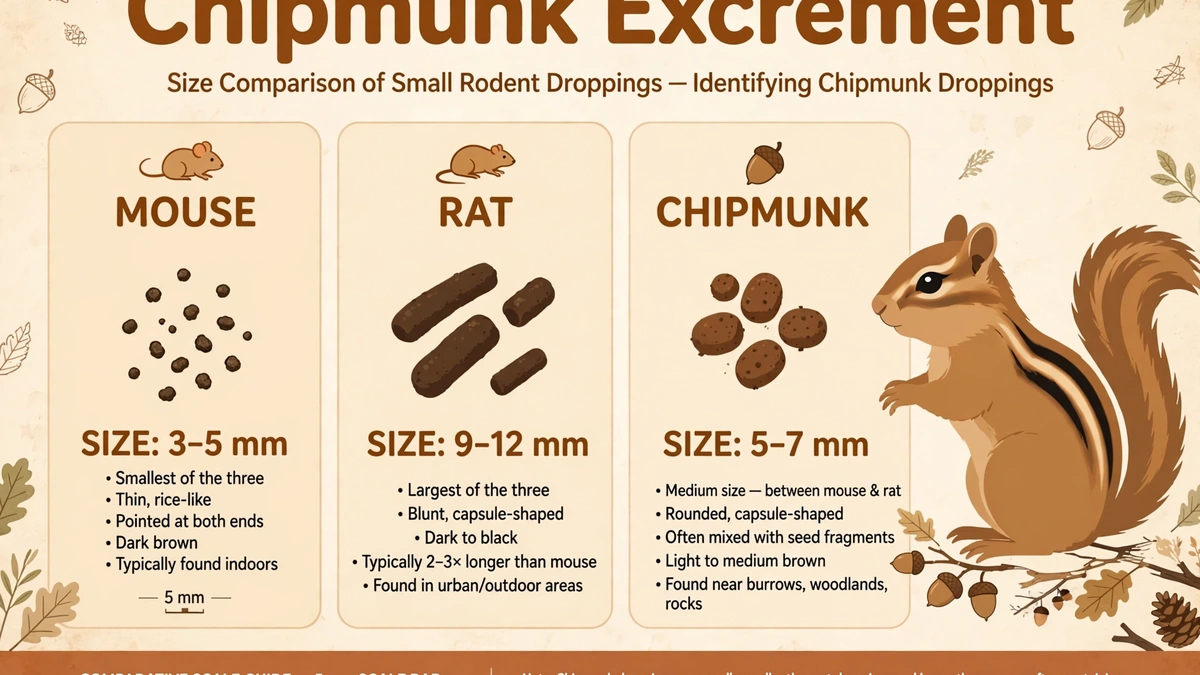
Chipmunk droppings are small, firm pellets, roughly the size of a grain of rice. Most sources put them at about 6 to 10 mm long (roughly a quarter to three-eighths of an inch) and a few millimetres thick. They are oblong, with slightly tapered ends and a thicker middle — plumper than a mouse dropping, and clearly smaller than a rat dropping. Fresh pellets are dark brown to nearly black and slightly moist. As they age they dry out, turn duller and grayer, and become brittle enough to crumble. You may also spot tiny bits of seed husk or insect shell in them, left over from what the chipmunk has been eating.
The important thing is that size alone cannot confirm an identification. Sources disagree slightly on exact measurements, and a single pellet tells you very little. What matters is the combination of size, shape, colour, quantity, and — most of all — where you found it.
Why You Rarely Find Chipmunk Droppings
Chipmunks are unusual among yard rodents: they use latrine chambers inside their burrows. The majority of their waste ends up underground, not scattered where you would see it. That habit is the single most useful identification clue you have.
Finding a few scattered pellets on a deck, along a foundation wall, or near a burrow entrance usually means a chipmunk passing through. A real accumulation — a pile of pellets in an attic, along a wall, or inside a drawer — almost always means mice or rats instead, because those animals drop waste wherever they travel. If you are finding droppings in quantity indoors, you are almost certainly not dealing with a chipmunk.
Chipmunk Droppings vs Mouse, Rat and Squirrel Droppings
This is the comparison most people actually need, because all four look like small dark pellets at a glance. Size, shape, and location separate them.
| Droppings | Size | Shape | Colour | Where you find them |
|---|---|---|---|---|
| Mouse | 3–6 mm (1/8–1/4 in) | Thin, rice-like, pointed at both ends | Dark black | Scattered along walls, in drawers, indoors |
| Chipmunk | 6–10 mm (1/4–3/8 in) | Oblong, thicker middle, tapered ends | Dark brown to black, gray when old | Near burrows, decks, foundations; rarely in piles |
| Rat | 12–19 mm (1/2–3/4 in) | Large, blunt or capsule-shaped | Dark brown to black | Basements, sewers, along walls |
| Gray squirrel | About 10 mm (3/8 in) | Similar to chipmunk, slightly larger | Brown to black | Attics, trees, rooflines |
Mouse droppings are the most common mix-up: they are thinner, with distinct points at both ends, like dark grains of rice. Chipmunk droppings are thicker through the middle with blunter ends. Rat droppings are so much larger that they are easy to rule out. Squirrel droppings are the hardest to separate from chipmunk droppings by size alone — there, location decides: squirrel droppings turn up in attics and along rooflines, while chipmunk droppings turn up near ground-level burrows.
Is Chipmunk Excrement Dangerous?
Yes, it should be treated with care. Like other rodent droppings, chipmunk excrement can carry germs, including salmonella, leptospirosis, and tularemia, and chipmunks can also carry ticks. The main risk is not the pellet itself but the dust: breathing in air contaminated with dried droppings is how most rodent-borne illness spreads, which is why dry sweeping or vacuuming droppings is dangerous.
Pets need the same caution. Dogs that sniff around droppings or dig near burrows can pick up germs, so keep them away from any area where you have found pellets until it is cleaned. The same care behind dog bite prevention applies here: wild animals around the home deserve respect, and a little distance keeps everyone safe. Keeping a dog healthy is a year-round habit — from keeping your dog safe on trips to preventing infections in dogs after outdoor adventures.
How to Clean Up Chipmunk Droppings Safely
Clean up droppings the way the CDC recommends for rodent waste. Do not sweep or vacuum them while they are dry — that stirs contaminated dust into the air.
- Ventilate first. Open doors and windows and leave the area for about 30 minutes before you start, especially in an enclosed space like a garage or shed.
- Wear gloves. Put on rubber or plastic gloves before touching anything.
- Wet the droppings. Spray them with a household disinfectant or a bleach solution (1 part bleach to 9 parts water, made fresh) until they are very wet. Let the disinfectant soak for 5 minutes.
- Wipe, do not sweep. Use paper towels to pick up the droppings and the cleaning product, and put the towels in a covered bin that gets emptied regularly.
- Disinfect the area. Mop or sponge hard surfaces with disinfectant, including floors, countertops, cabinets, and drawers.
- Wash up. Wash your gloved hands with soap and water before removing the gloves, then wash your bare hands with soap and warm water.
If droppings are indoors, clustered in an enclosed space, or mixed with nesting material, treat the area as a health concern and consider calling a professional. If anyone in the household develops a fever or flu-like symptoms after a cleanup, see a doctor and mention the rodent exposure.
Signs of a Chipmunk Problem
A few pellets are not a problem by themselves — but they can be the first sign of chipmunks living close to your home. Look for these other clues:
- Burrow entrances. Small holes about 2 inches wide near foundations, under decks, or in garden beds — with no soil mound around them, unlike mole or vole holes.
- Chewed plants. Missing bulbs, nibbled fruit, stripped seeds, or an empty bird feeder.
- Small holes and tunnels. Shallow tunnels alongside foundations, under patios, or beneath woodpiles.
- Daytime activity. Quick, darting movement and chattering calls at dawn and dusk — chipmunks are daytime animals, unlike mice and rats.
Chipmunks do little damage on their own, and many gardeners tolerate them. If they are digging up bulbs or getting into the house, the fix is prevention: seal gaps in foundations (a chipmunk can squeeze through an opening no wider than a coin), store birdseed in sealed containers, and clear woodpiles and dense ground cover near the house.
Frequently Asked Questions
How big is chipmunk poop?
About 6 to 10 mm long (roughly a quarter to three-eighths of an inch) — about the size of a grain of rice. Sources vary slightly, so treat size as a clue, not proof.
Do chipmunks poop in the house?
Rarely. Chipmunks deposit most of their waste in latrine chambers inside their burrows, so droppings found indoors in any quantity are far more likely to be mice.
Can chipmunk droppings make you sick?
Yes. Like other rodent droppings, they can carry salmonella, leptospirosis, and other germs. Clean them up with gloves and disinfectant, and never sweep or vacuum them while dry.
How do you keep chipmunks away from the house?
Seal foundation gaps, store birdseed and pet food in sealed containers, clear woodpiles and dense cover near the house, and remove fallen fruit. That removes the food and shelter that bring them close.
Chipmunk excrement is small, dark, and easy to mistake for mouse droppings — but the context usually gives it away. A few pellets near a burrow entrance, with no pile anywhere, is classic chipmunk. A trail of pellets along a wall indoors is almost certainly mice. Either way, treat droppings with care: gloves, disinfectant, and no dry sweeping — and your yard stays safe for everyone, two-legged and four-legged alike.