
Have you ever written “we had to make due with what we had,” then stopped and wondered if that was right? The question of make do or make due has a simple answer: the correct phrase is “make do.” It means to manage with what you have, even when it is not exactly what you wanted. “Make due” is a common spelling mistake — the two words sound alike in many accents, so the wrong spelling slips in easily. This guide explains the difference, why the mistake happens, and how to use the phrase with confidence.
What Does “Make Do” Mean?
“Make do” is an idiom that means to cope with what is available, or to get by with less than you would like. Cambridge Dictionary defines it as managing without something you would like, or managing with something of lower quality than you would prefer. The idea is resourcefulness: you do not have the ideal thing, so you make the thing you do have work.
- “We did not have enough chairs, so we had to make do with stools.”
- “The kitchen is small, but we make do — it works for us.”
- “With only a phone camera, she made do and took beautiful photos anyway.”
The phrase is standard in both British and American English, and it works the same way in both. It is an old idiom — the idea behind it connects to the older use of “do” meaning “to serve” or “to be sufficient.” When you make do, you make what you have serve your needs.
Why Do People Write “Make Due”?
The confusion comes almost entirely from sound. In many varieties of English, especially American English, “do” and “due” can sound very similar — sometimes identical — in everyday speech. When you hear the phrase rather than seeing it written down, “due” feels like a natural spelling.
But “due” means something different. It describes something owed, expected, scheduled, or deserved:
- “The payment is due tomorrow.” (owed)
- “The report is due on Friday.” (scheduled)
- “She is due a refund.” (deserved)
None of those meanings fits the idiom about coping with limited resources. Substituting “due” for “do” changes the meaning of the phrase entirely — which is why “make due” reads as a spelling error to anyone who knows the idiom, even when the intended meaning is clear from context.
Make Do vs Make Due
| Phrase | Correct? | Meaning | Example |
|---|---|---|---|
| Make do | Yes | Manage with what is available | “We made do with a small kitchen.” |
| Make due | No | Not a standard idiom; “due” means owed or expected | “The payment is due tomorrow.” |
A simple way to remember it: make do = make something work. The word “do” is about action and managing. “Due” is about deadlines, bills, and obligations — never about improvising. If you are not talking about something owed or expected, you almost certainly mean “make do.”
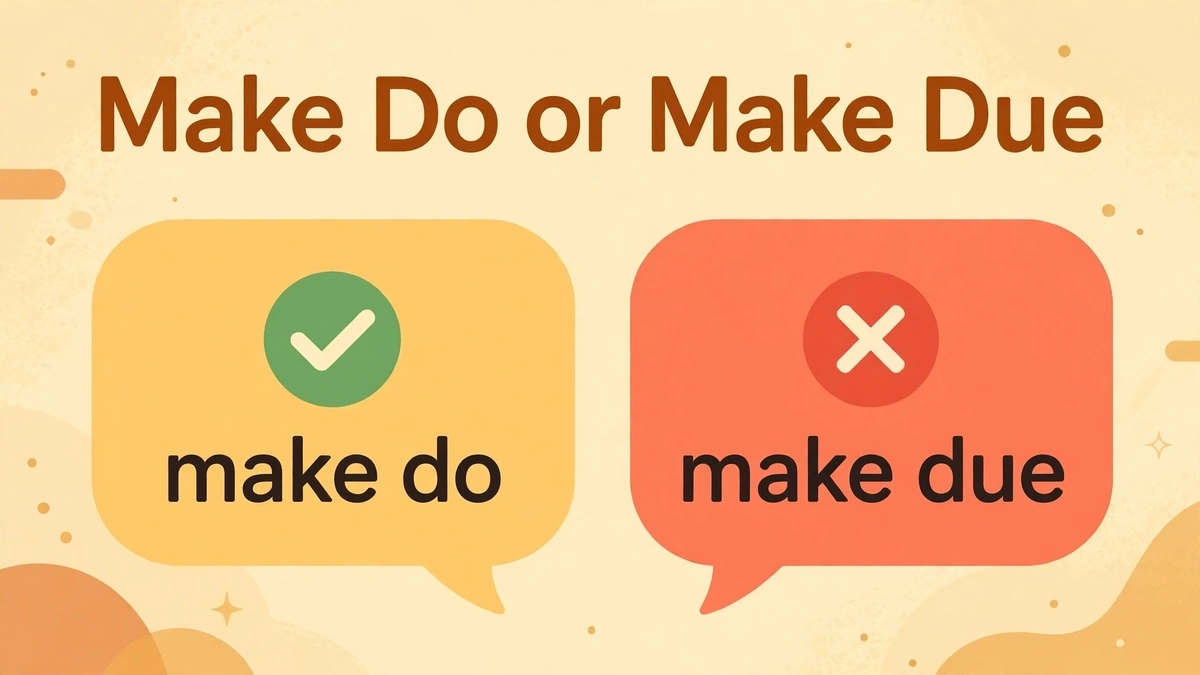
Correct and Incorrect Examples
Seeing the two side by side makes the difference obvious:
- Correct: “We had to make do with the old table until the new one arrived.”
- Incorrect: “We had to make due with the old table until the new one arrived.”
- Correct: “The team made do with three players out sick.”
- Incorrect: “The team made due with three players out sick.”
- Correct: “Money was tight, so they made do with what was in the pantry.”
- Incorrect: “Money was tight, so they made due with what was in the pantry.”
Notice that the incorrect versions are still understandable — a reader will know what you mean. But in professional writing, schoolwork, or anything public, “make due” marks the writing as careless. It is the kind of small error that costs credibility even when the meaning survives.
Synonyms for “Make Do”
If you want a different way to say it, these all carry the same idea of managing with what is available:
- Manage — “We managed with what we had.”
- Improvise — “She improvised with the ingredients on hand.”
- Cope — “They coped with the smaller budget.”
- Get by — “We got by on very little that winter.”
- Make the most of — “They made the most of a small garden.”
Like “make do,” these are all about working around a limitation rather than removing it. That is what makes the idiom useful: it says, in two words, that the situation was not ideal and you handled it anyway.
Dos and Don’ts
A few habits keep the phrase landing the way you mean it:
- Do use “make do” whenever you mean “manage with what is available” — it is always the right spelling for that meaning.
- Do use the memory trick: “You do what you can with what you have.”
- Do not write “make due” for the idiom, even in casual messages — the mistake is easy to repeat once it becomes a habit.
- Do not confuse it with phrases where “due” genuinely belongs, like “due date,” “due process,” or “in due course.”
- Do remember that “make do” belongs to the same family as other easily confused pairs — worse or worst, among vs amongst, and principal vs principle — where a small spelling change carries a real meaning change.
Frequently Asked Questions
Is it “make do” or “make due”?
“Make do” is correct. It means to manage with what you have, even when it is not ideal. “Make due” is not the standard spelling of this idiom.
What does “make do” mean?
It means to cope with what is available — to accept a situation that is less than perfect and find a way to work with it. Cambridge defines it as managing without something you would like, or managing with something of lower quality than you would prefer.
Why do people write “make due”?
Because “do” and “due” sound alike in many accents. Writers choose the familiar spelling “due” when they hear the phrase rather than seeing it written. It is a sound-based mistake, not a real spelling variation.
Is “make due” ever correct?
Not for this idiom. The word “due” is correct in other expressions — “payment due,” “due date,” “in due course” — but not as part of the phrase meaning “manage with what you have.”
What is a synonym for “make do”?
Manage, improvise, cope, get by, and make the most of all work. “We managed with what we had” says the same thing as “we made do with what we had.”
— “Make do” is the phrase to use whenever you mean “manage with what you have” — and now that you know “due” belongs to deadlines and bills, not improvisation, the mistake is easy to avoid. Two small words, one clear rule: do is for doing, due is for what is owed.