
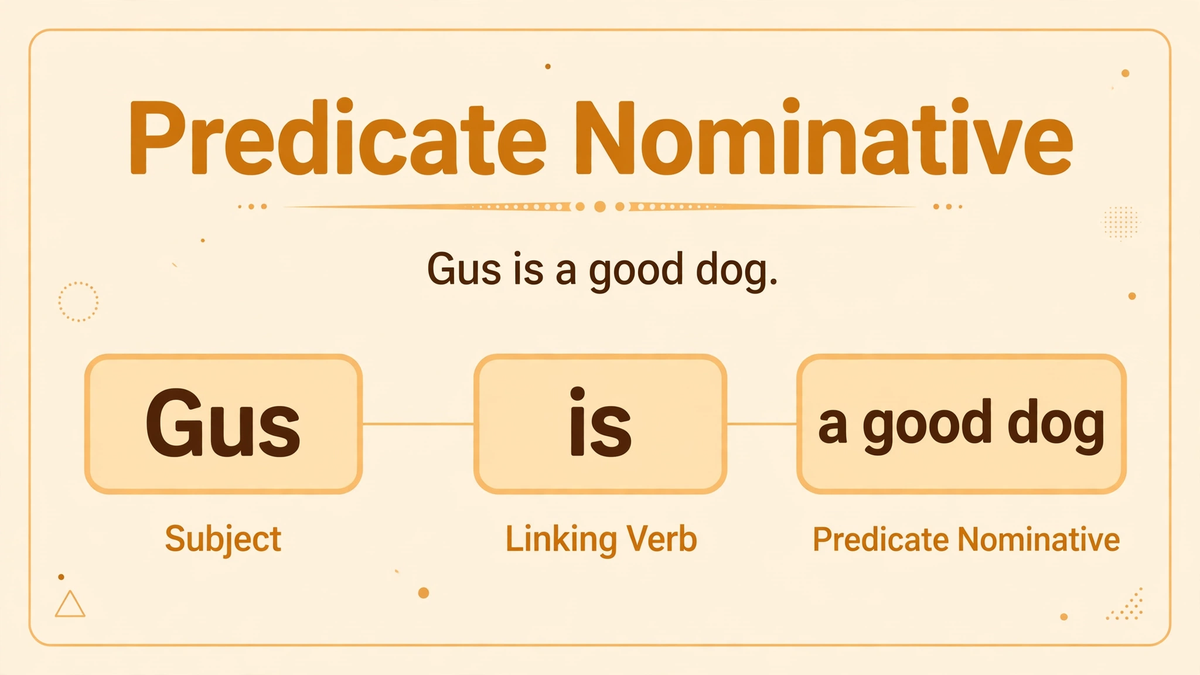
A predicate nominative is a noun or pronoun that comes after a linking verb and renames the subject. In the sentence “Gus is a good dog,” the subject is Gus, the linking verb is is, and a good dog is the predicate nominative — it tells you what Gus is.
The name sounds technical, but the idea is simple. A predicate nominative answers the question “What is the subject?” rather than “What did the subject do?” Once you know the pattern — subject, linking verb, renaming noun — you will start spotting predicate nominatives everywhere, from everyday conversation to the books you read.
What Is a Predicate Nominative?
A predicate nominative, also called a predicate noun, is a type of subject complement. A subject complement is a word or phrase that follows a linking verb and completes the meaning of the subject. When that complement is a noun or pronoun, it is a predicate nominative. When it is an adjective, it is a predicate adjective instead.
Look at the parts of a simple example:
- Subject: Gus
- Linking verb: is
- Predicate nominative: a good dog
The predicate nominative is not just the single noun. It includes everything attached to that noun: articles (a, the), adjectives (good), and prepositional phrases that describe it. In “Gus became the happiest dog in the neighborhood,” the whole phrase the happiest dog in the neighborhood is the predicate nominative, with dog as its main noun.
A predicate nominative can also be a pronoun. In “The winner is she,” the pronoun she renames the subject winner. Pronoun predicate nominatives are where most of the confusion about this rule comes from, and they are covered in the mistakes section below.
How to Use a Predicate Nominative
A predicate nominative can only follow a linking verb. Linking verbs do not show action. They connect the subject to a word that describes or identifies it, expressing a state of being rather than something the subject does. The most common linking verb is be in all its forms: am, is, are, was, were, been, and being.
Here are everyday examples with the predicate nominative in bold:
- Gus is a golden retriever.
- My sister became a veterinarian.
- The old house on the corner seems a bargain.
- Her dream was a quiet life by the sea.
- By December, he will have been a teacher for ten years.
Predicate nominatives work in every tense. The verb changes; the pattern stays the same.
Simple and Compound Predicate Nominatives
A simple predicate nominative contains one noun or noun phrase. A compound predicate nominative joins two or more nouns or noun phrases with a conjunction such as and or or, and both rename the same subject.
- Simple: Gus is a loyal companion.
- Compound: Gus is a loyal companion and a fearless squirrel chaser.
- Compound: She was a nurse, a painter, and a marathon runner.
Compound predicate nominatives are a handy way to pack more information into a sentence without writing a second one.
Predicate Nominative vs. Predicate Adjective
The predicate nominative and the predicate adjective are the two kinds of subject complement, and they are easy to mix up because both follow linking verbs and both describe the subject. The difference is the part of speech: a predicate nominative is a noun or noun phrase, while a predicate adjective is an adjective or adjective phrase. A predicative nominal renames the subject; a predicative adjective describes it.
Compare these pairs, which say almost the same thing with different grammar:
- Predicate adjective: Gus is loyal.
- Predicate nominative: Gus is a loyal friend.
- Predicate adjective: The soup tastes salty.
- Predicate nominative: The soup is a salty mess.
- Predicate adjective: She became happy.
- Predicate nominative: She became a happy person.
The quick check: if the word after the linking verb is a noun or pronoun, it is a predicate nominative. If it is an adjective, it is a predicate adjective.
Linking Verbs That Take a Predicate Nominative
Only three verbs are always linking verbs:
- be — am, is, are, was, were, been, being
- become
- seem
Other verbs can be linking verbs or action verbs depending on how they are used. When they act as linking verbs, they can take a predicate nominative; when they act as action verbs, they cannot.
- remain: “She remained the team captain.” (linking — the team captain is a predicate nominative) vs. “She remained in her seat.” (action — no renaming noun follows)
- stay: “He stayed a skeptic.” (linking) vs. “He stayed home.” (action)
- appear: “The plan appears a success.” (linking) vs. “A deer appeared in the yard.” (action)
- feel: “The fabric feels silk.” (linking — silk renames the fabric) vs. “She felt the fabric.” (action — the fabric is a direct object, not a predicate nominative)
- look: “He looks a fool in that hat.” (linking) vs. “He looked at the photograph.” (action)
- prove: “The rumor proved false.” (linking, predicate adjective) vs. “The rumor proved a lie.” (linking, predicate nominative) vs. “She proved her point.” (action)
- turn: “The milk turned sour.” (linking) vs. “She turned the page.” (action)
The test is always the same: does the word after the verb rename the subject, or does it receive the verb’s action? If it renames the subject, you are looking at a predicate nominative.
How to Spot a Predicate Nominative
Use this three-step check on any sentence you are unsure about:
- Find the linking verb. Look for a form of be, become, seem, or one of the sometimes-linking verbs above.
- Look at what follows it. Is it a noun or pronoun? If it is an adjective, it is a predicate adjective, not a predicate nominative. If it is an adverb or a prepositional phrase of place or time, it is neither.
- Try the equals sign. Rewrite the sentence as subject = complement. “Gus = a good dog” makes sense, so a good dog is a predicate nominative. “Gus = quickly” does not, so quickly is not one.
The equals-sign test also protects you from the most common error: mistaking a direct object for a predicate nominative. In “Gus chased a squirrel,” a squirrel receives the action of chasing, and “Gus = a squirrel” is nonsense. There is no linking verb and no renaming, so there is no predicate nominative.
Common Mistakes to Avoid
1. Using the wrong pronoun case
Traditional grammar says a pronoun predicate nominative should be in the subject (nominative) case: “It is I,” “The winner was she,” “It was they who called.” In everyday speech, most people say “It is me,” “The winner was her,” and “It was them.” The traditional form is still expected in formal writing and exams, while the objective form is normal in casual conversation. Knowing both lets you choose on purpose instead of by accident. Small word-choice slips like this are easy to make — the same goes for pairs such as awhile vs a while, where a tiny difference changes the meaning.
2. Making the verb agree with the complement instead of the subject
The verb agrees with the subject, never with the predicate nominative. “The problem is the delays” is correct even though delays is plural, because the subject problem is singular. Flip the sentence and the verb flips too: “The delays are the problem.” Confusing two similar-looking words is a related trap — see our guide to affect vs effect for another pair that trips up even careful writers.
3. Treating a direct object as a predicate nominative
Only linking verbs take predicate nominatives. After an action verb, the noun that follows is usually a direct object. “She baked a cake” has no predicate nominative; “She became a baker” does. If the verb shows action, stop looking for one.
4. Forgetting that the whole noun phrase counts
When you are asked to identify the predicate nominative, include its modifiers. In “Gus is the best dog in the whole world,” the predicate nominative is the full phrase the best dog in the whole world, not just dog. Leaving out the modifiers gives an incomplete answer. This is the same kind of precision that matters with lookalike words such as principal vs principle, where the exact word — and the exact phrase — is what counts.
Predicate Nominative Examples in Everyday Sentences
- Gus is a golden retriever.
- Our walk in the park became the best part of my day.
- The loudest voice in the room was the smallest dog.
- Her first job was a dog walker.
- The answer seems an obvious one.
- After years of practice, she became a champion trainer and a patient teacher.
- The puppy in the window is the one we adopted.
- His favorite season is autumn.
- The quietest member of the family is Gus, asleep under the table.
- What I need most right now is a nap and a cup of tea.
Notice how each example renames or identifies the subject rather than describing an action. That renaming is the heart of the predicate nominative, and once you can hear it, the rule stops feeling like a grammar lesson and starts feeling like a tool you already use every day.
Predicate Nominative FAQs
What is a predicate nominative in simple terms?
A predicate nominative is a noun or pronoun that comes after a linking verb and renames the subject. In “Gus is a good dog,” a good dog is the predicate nominative because it tells you what Gus is.
What is the difference between a predicate nominative and a predicate adjective?
Both are subject complements that follow linking verbs. A predicate nominative is a noun or pronoun (“She is a doctor”), while a predicate adjective is an adjective (“She is kind”).
Can a predicate nominative be more than one word?
Yes. It is usually a noun phrase that includes articles, adjectives, and prepositional phrases attached to the main noun — for example, the happiest dog in the neighborhood in “Gus became the happiest dog in the neighborhood.”
Which verbs are followed by a predicate nominative?
Only linking verbs: always be, become, and seem, plus verbs such as remain, stay, appear, feel, look, prove, and turn when they are used as linking verbs rather than action verbs.
Is “It is me” wrong?
Traditional grammar prefers “It is I,” because a predicate nominative pronoun takes the nominative case. In everyday speech, “It is me” is standard and widely accepted. Use “It is I” in formal writing and exams; “It is me” is fine in conversation.