
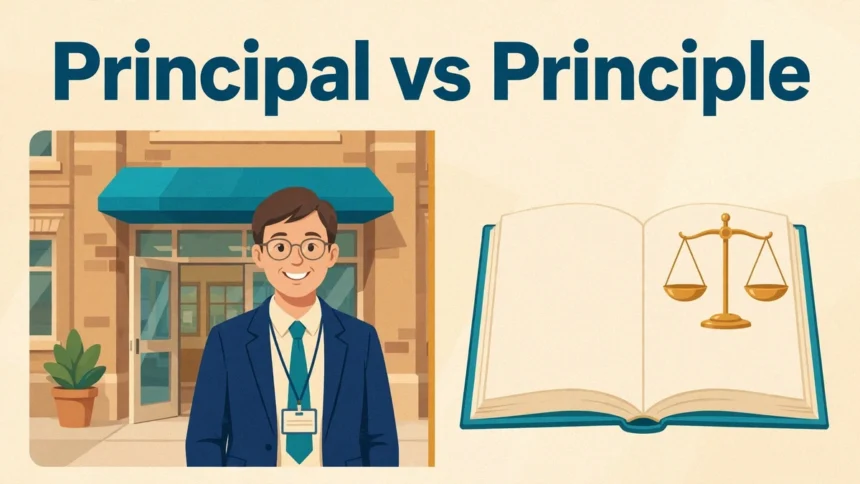
A principal vs principle mix-up is one of the most common spelling mistakes in English. The two words sound exactly the same — both are pronounced PRIN-suh-pul — but they mean completely different things, and swapping them changes the meaning of a sentence. Whether you search for “principal vs principle” or “principle vs principal”, the answer is the same: principal points to the main person, thing, or sum of money, while principle names a rule or belief. This guide explains the difference with a quick comparison, clear examples, memory tricks, and a short quiz.
Principal vs Principle at a Glance
| Principal | Principle | |
|---|---|---|
| Part of speech | Noun or adjective | Noun only |
| Core meaning | Main, most important; a person in charge; a sum of money | A rule, belief, standard, or fundamental idea |
| As a noun | The school principal, a principal investigator, the loan principal | A guiding principle, a moral principle, a scientific principle |
| As an adjective | The principal reason, the principal city | Never an adjective (use “principled” instead) |
| Never means | A rule or belief | A person, or a sum of money |
Both words come from the same Latin root, princeps, meaning “first” or “chief” — which is why they look so alike. Their meanings, though, have nothing in common.
What Does Principal Mean?
Principal works as both an adjective and a noun.
As an adjective, it means main, chief, or most important:
- “The principal reason for the delay was the weather.”
- “Vegetables are the principal ingredients in this soup.”
- “Our principal concern is safety.”
As a noun, it usually means a person in a leading position — most famously the head of a school:
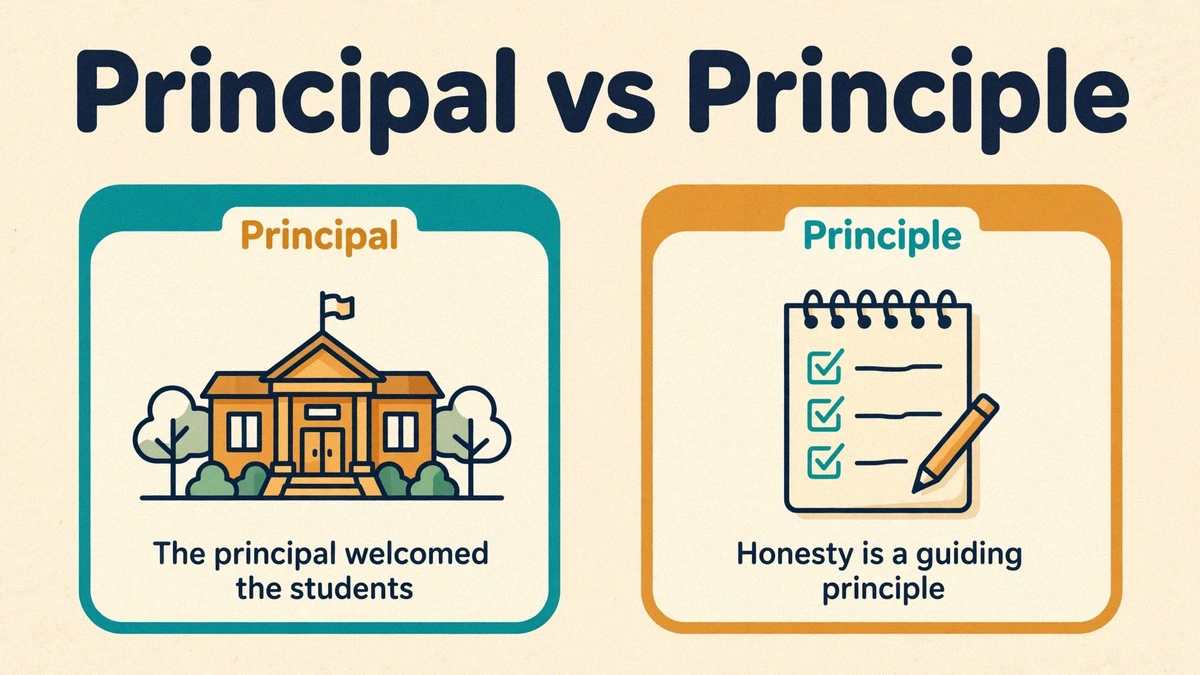
- “The principal announced a new school policy.”
- “She is the principal cellist of the orchestra.”
- “The principal investigator reviewed the study before it was submitted.”
Merriam-Webster defines principal as “most important, consequential, or influential” and warns readers not to confuse it with the similar word principle — see Merriam-Webster’s entry for principal.
Principal in Finance
In finance, principal is the original sum of money borrowed or invested, as distinct from interest:
- “After five years of payments, the principal on her loan had fallen by half.”
- “Investing involves market risk, including possible loss of principal.”
The correct spelling for these amounts is always principal, never principle. Interest is the cost of borrowing; the principal is the amount itself.
What Does Principle Mean?
Principle is always a noun. A principle is a fundamental truth or rule that serves as the foundation for a system of beliefs or behaviour. It can describe a moral standard, a general law, or an idea on which a system or method is based.
As a moral or ethical rule:
- “Honesty is a guiding principle.”
- “She refused to lie as a matter of principle.”
- “Fairness is one of the principles behind the programme.”
As a scientific or technical idea:
- “Archimedes’ principle explains why objects float.”
- “The engineers applied established principles of fluid mechanics.”
A person who acts consistently according to strong beliefs is described as principled — “He took a principled stand against the policy.” That adjective is the form to use when you need an adjective for principle, because principle itself never works as one.
How to Choose Between Principal and Principle
Ask what the word is doing in the sentence:
- A person, the main thing, or money? Use principal. “The principal dancer,” “the principal objective,” “the loan principal.”
- A rule, belief, or fundamental idea? Use principle. “A guiding principle,” “the principles of design,” “on principle.”
Two quick swap tests also work. If you can replace the word with “main” and the sentence still makes sense, use principal: “the main reason” works, so “the principal reason” is right. If you can replace it with “rule” and the sentence still makes sense, use principle: “a guiding rule” works, so “a guiding principle” is right.
When two closely related ideas sit side by side in one sentence, a semicolon can join them as cleanly as any word choice can: “The principal approved the plan; the guiding principle was fairness to every student.”
Memory Tricks That Actually Work
- Principal ends in -pal. The school principal is your pal — and so is anything main or most important. If the word points to a person or the main thing, think “pal.”
- Principle ends in -le, like rule. A principle is a rule, a belief, or a standard. If the word names a rule, think “rule.”
- Principle is never a person and never money. If the sentence is about someone in charge or a sum of money, principle cannot be right.
Phrases People Get Wrong
In principle means in theory, or as a general idea, even if the details are not settled: “The council agreed in principle to extend library hours, but staffing had not been finalised.” The correct spelling is in principle, never “in principal.”
On principle means because of a moral belief or standard: “The editor refused to publish the photograph on principle.” It is about the beliefs behind someone’s actions, not about a person in charge.
Principal amount is the original sum in a loan or investment, so it uses the money spelling: “The principal amount was $10,000.”
Principal reason and principal issue are also correct — they mean the main reason and the main issue.
Common Mistakes
| Wrong | Right | Why |
|---|---|---|
| It goes against my principals. | It goes against my principles. | Beliefs are principles, not people. |
| The principle of the school called a meeting. | The principal of the school called a meeting. | A person in charge is a principal. |
| She is a woman of high principals. | She is a woman of high principles. | Standards of conduct are principles. |
| The principle on the loan is $5,000. | The principal on the loan is $5,000. | Money is always principal. |
| We agreed in principal. | We agreed in principle. | The set phrase uses principle. |
Quick Quiz
Test yourself — the answers are below.
- “The ___ of the company addressed the staff.” (principal / principle)
- “One of our guiding ___ is to treat every customer fairly.” (principal / principle)
- “He paid off the ___ of the mortgage before touching the interest.” (principal / principle)
Answers: 1. principal — a person in charge. 2. principles — rules that guide behaviour. 3. principal — the original sum borrowed.
Frequently Asked Questions
What is the difference between principal and principle?
Principal means the main person, the main thing, or a sum of money. Principle means a rule, belief, or fundamental idea. Principal can be a noun or an adjective; principle is only ever a noun.
Is “principle” ever an adjective?
No. If you need an adjective form, use principled, as in “a principled decision.” Principal is the adjective form for “main” or “most important.”
Which spelling is used for a loan?
Always principal. The principal is the original amount borrowed or invested, before interest is added.
What does “in principle” mean?
It means in theory, or as a general rule, before the finer details are agreed. The correct phrase is “in principle,” not “in principal.”
English is full of words that sound alike but behave differently. A palindrome reads the same forwards and backwards, and the spelling of put and putting trips people up the same way principal and principle do. Once you know the trick — pal for the person, rule for the rule — this pair stops being confusing for good.