
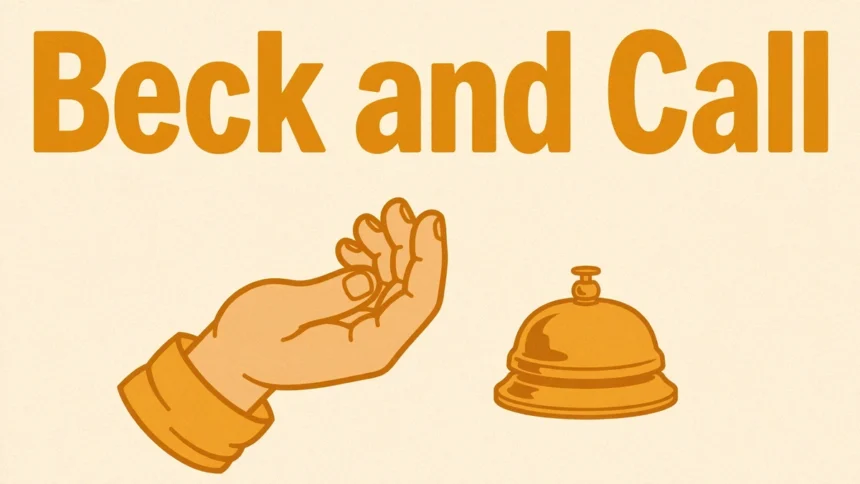
Beck and call is one of those phrases everyone has heard and almost no one can explain. To be at someone’s beck and call means to be ready to do whatever they ask, the moment they ask it. The phrase is hundreds of years old, one of its words is obsolete everywhere else, and it is spelled wrong more often than almost any other idiom. This guide covers the meaning, the two words inside it, where it came from, and the mistake to avoid.
What Does “Beck and Call” Mean?
To be at someone’s beck and call means to be always ready to do whatever that person asks. The Cambridge Dictionary defines it as “always willing and able to do whatever someone asks,” and Merriam-Webster gives the same sense: “always ready to do whatever someone asks.”
The phrase is almost always used with “at” — “at my beck and call,” “at his beck and call” — and it describes a relationship, not a single act:
- “The hotel manager keeps a driver at his beck and call.”
- “Go and get it yourself! I’m not at your beck and call, you know.”
- “She had a private nurse at her beck and call.”
Notice the tone in that second example: the phrase often carries a sting. It suggests subservience — one person waiting on another’s every wish — and saying it about yourself usually sounds like a complaint, not a boast.
Beck vs Call: The Two Halves
The idiom is two words doing two different jobs:
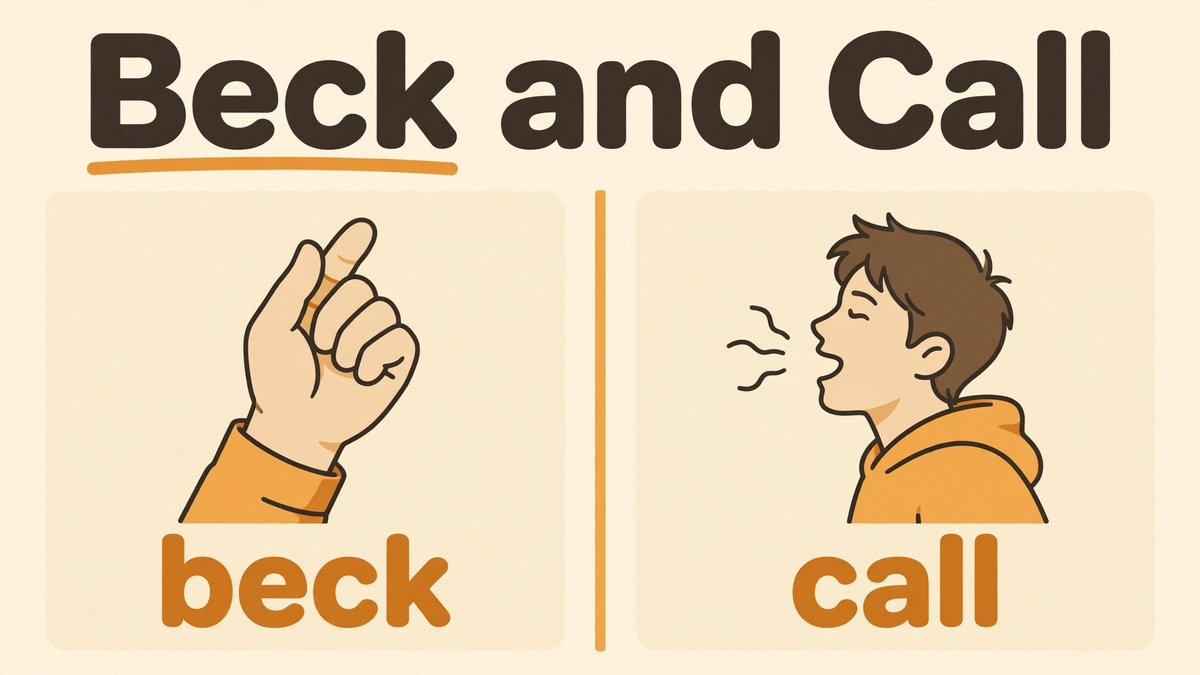
- Beck — a gesture, a silent signal of command: a nod, a wave, a pointed finger. The noun “beck” is obsolete today and survives almost only inside this phrase. The verb form still exists: to beckon someone is to gesture them over.
- Call — a vocal summons: using your voice to get someone’s attention and ask them to come.
Put together, they cover the whole range of summoning: whether the master waves or shouts, the servant comes. That is the whole meaning in miniature — total readiness, by gesture or by voice. An idiom is a phrase whose meaning cannot be worked out from its words alone, and “beck and call” is a good example: knowing “beck” and “call” separately does not tell you the phrase means obedience.
Where Does the Phrase Come From?
“Beck” comes from the Middle English word bekenen, from Old English gebecnian, meaning “to make a mute sign or signal.” The word has been used in English since the 13th century for a nod or a wave used to summon someone.
The phrase itself is old. One of the earliest written uses appears in 1611, in the poet Aemilia Lanyer’s collection Salve Deus Rex Judaeorum. The Irish bishop James Usher used it in a sermon in 1640. An earlier form, “at someone’s beck and command,” dates from the 17th century, and the phrase was already established enough by 1726 to appear in Sadducismus Triumphatus, a work on witches and apparitions. The picture behind it is simple and medieval: a master beckons a servant with a gesture, and if the gesture fails, he calls — so the servant is at his beck and call either way.
Beck and Call or Beckon Call?
It is beck and call, never “beckon call.” Writing it as “beckon call” is an eggcorn — a phrase that sounds right when spoken but is wrong when written down. “Beckon” is a verb (“She beckoned him over”); it is not part of the idiom. The Wiktionary entry for “beck and call” gives the idiom in its correct form, and every major dictionary agrees: “beckon call” is incorrect.
The confusion is understandable — “beck” is a word almost nobody uses outside this phrase, so the ear fills in the familiar verb “beckon.” But the correct phrase keeps the short, old noun: beck and call.
How to Use “Beck and Call” in a Sentence
The phrase works in everyday writing and speech, usually with “at”:
- At work: “The boss expects the whole team to be at his beck and call.” (This is a complaint about the boss, not praise.)
- At home: “I am not at your beck and call — ask politely and I will help.”
- In a story: “The old king kept a dozen servants at his beck and call.”
- As a refusal: “I have my own life. I cannot be at anyone’s beck and call.”
It is rarely a compliment. Use it when you want to point out that someone is expected to obey without question — and expect the person described to dislike the description.
The Tone Problem: Why It Stings
“Beck and call” carries a connotation of lower status. To say someone is at another’s beck and call is to say they have no choice, no boundaries, and no say in the matter. That is why it appears so often in complaints, refusals, and stories about unfair bosses and demanding relatives. The phrase is useful precisely because of that sting: it says in four words what would otherwise take a sentence about power and obedience.
If you want the same idea without the sting, say “on hand,” “available,” or “ready to help.” Those describe willingness without the master-and-servant picture.
Similar Phrases
A few nearby expressions carry some of the same meaning:
- At someone’s disposal — available for their use, without the subservience.
- At someone’s service — ready to help, politely.
- On call — available to be contacted, usually for work.
- Waiting hand and foot on someone — serving them constantly, with the same negative tone.
- Dancing attendance on someone — waiting on them obsequiously; an older phrase, recorded in Brewer’s Dictionary of Phrase and Fable (1905) as a near-synonym of “beck and call.”
Beck and Call in Formal Writing
Idioms belong in casual and creative writing more than in formal documents. In a formal letter, you would write “available at your convenience” rather than “at your beck and call” — the idiom is too informal and too loaded for a letter. The same care applies to punctuation: a semicolon in the wrong place can confuse a reader just as surely as a wrong idiom. And if you are writing to someone you appreciate, a warm note works better than any idiom — a good afternoon message says more with kindness than “beck and call” ever could.
Frequently Asked Questions
What does “at someone’s beck and call” mean?
It means always ready to do whatever that person asks, the moment they ask — by a gesture or by a spoken order.
Is it “beck and call” or “beckon call”?
Beck and call. “Beckon call” is incorrect — “beckon” is a verb, not part of the idiom.
What does “beck” mean on its own?
Almost nothing in modern English. “Beck” was a noun meaning a gesture or signal of command, like a nod or a wave. It survives almost only inside this phrase; the verb “to beckon” is its living relative.
Is “beck and call” negative?
Usually, yes. It suggests subservience and a power imbalance, so it most often appears in complaints and refusals rather than praise.