
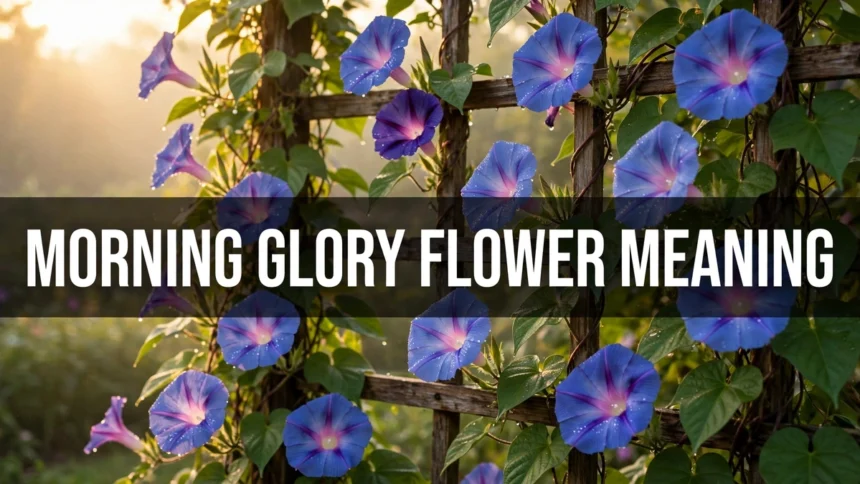
What is the morning glory flower meaning? In short: love, renewal, and the fleeting beauty of a single day. Morning glory is the common name for over 1,000 species of flowering plants in the family Convolvulaceae, most famously the genus Ipomoea — fast-growing vines with trumpet-shaped blooms that open with the sunrise and fade by the afternoon. That one-day life is not a flaw in the flower. It is the whole meaning: a bloom that cannot be kept is a reminder to notice it while it lasts.
Why the flower only lasts a day
The meaning starts with the biology. Most morning glory flowers open early in the morning, around 8 a.m., and begin to fade by late morning as the corolla curls inward. Each bloom lasts a single day and never reopens — but the vine keeps producing fresh buds, so a healthy plant flowers for months, one morning at a time.
That daily rhythm is the engine of almost every meaning the flower carries. Cultures from Japan to Victorian England looked at the same behavior and reached the same conclusion: love is precious because it is fleeting, each day is a gift, and the most beautiful things cannot be held indefinitely. The vine itself adds a second idea — resilience. It climbs, twines, and returns every morning, so the flower stands for renewal and fresh starts as much as for transience.
The name is literal, and the genus name tells a smaller story too: Ipomoea comes from the Greek ips, meaning worm, and homoios, meaning resembling — a nod to the vine’s worm-like, twining growth. The same genus also includes the sweet potato, Ipomoea batatas, though nobody calls a sweet potato a morning glory.
The short answer: love, renewal, and fleeting beauty
Across flower guides and cultural traditions, the morning glory’s core meanings are consistent:
- Love and affection — the flower’s climbing, clinging habit reads as a strong, persistent bond, and its daily return suggests feelings renewed every morning.
- Renewal and new beginnings — each sunrise brings fresh blooms, so the flower stands for fresh starts and the promise of a new day.
- Fleeting beauty and mortality — a bloom that lives one day is a gentle reminder of the brevity of life and the importance of appreciating the present moment.
- Resilience and tenacity — the vine grows fast, climbs whatever it touches, and comes back morning after morning, even in poor soil.
- Unrequited love — the sadder side of the same idea: love that fades before it is returned, explored in the Victorian section below.
It is a flower of tenderness and tenacity at once: pursue your dreams, the symbolism says, but with gentle strength.
What each morning glory color means
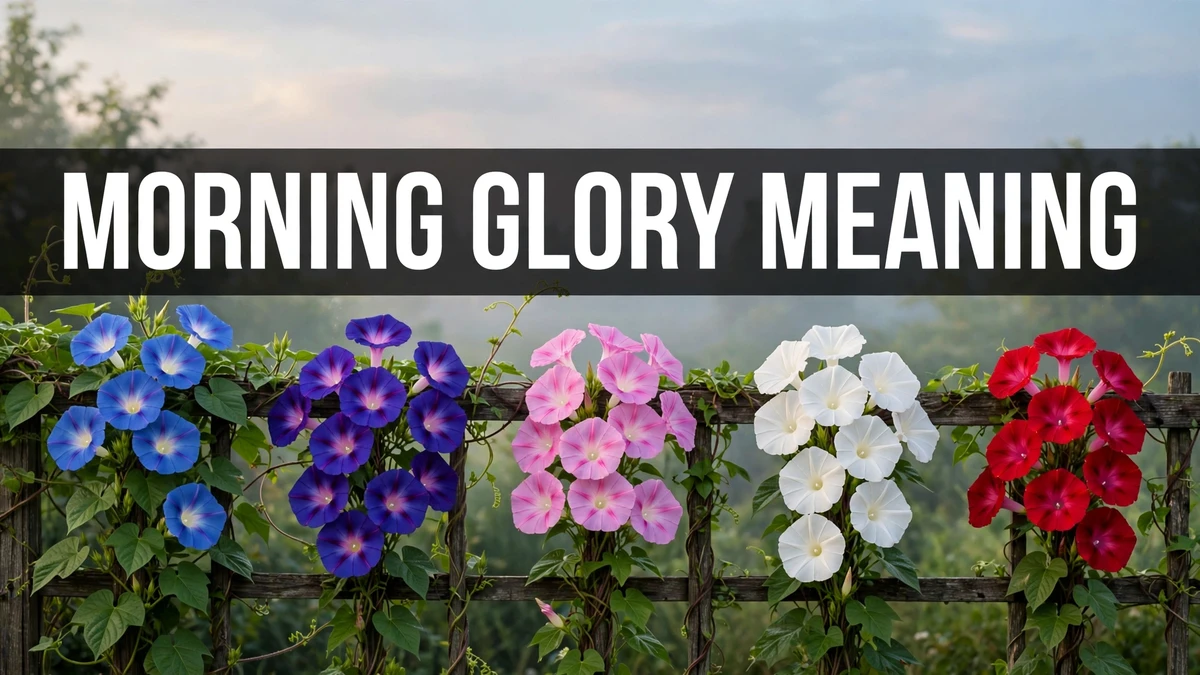
Like most flowers that come in many colors, the morning glory changes its message with its color:
- Blue (the classic, including ‘Heavenly Blue’): trust, respect, and enduring love — a calm, deep, sincere love, with a sense of peace and serenity. The most famous morning glory of all, Ipomoea tricolor ‘Heavenly Blue’, is this sky-blue trumpet with a white throat.
- Purple: nobility, royalty, grace, and beauty — purple dye was historically rare and expensive, so the color has long been linked to eminence and admiration.
- Pink: gentle affection, gratitude, and tenderness — a softer, warmer message, fitting for new relationships and for saying thank you.
- Red: passionate love and a strong heart — deep emotion, strength, and devotion.
- White: purity, innocence, and spiritual peace — a clear heart and a sincere wish, often chosen for new beginnings.
If you are choosing for a specific occasion, let the color do the talking: blue for trust and lasting love, pink for gratitude, red for a declaration, white for a pure and peaceful wish.
The Victorian meaning: love in vain
In Victorian England, flowers sent coded messages in a system known as floriography, the language of flowers — and the morning glory carried one of its most bittersweet messages: love in vain, or unrequited love. The flower that could not last the day became the emblem of love that could not be fulfilled, of longing that faded before it was returned.
The same tradition also gave it a gentler reading: “I think of you” — because the flower opens its face every morning, just as you might think of a loved one at the start of every day. The two meanings sit together honestly. The morning glory is a flower of affection, but it is affection with an edge of melancholy, and that duality is why it has stayed in the language of flowers while plainer blooms have been forgotten.
Morning glory in Japan: asagao
Nowhere is the morning glory more loved than in Japan, where it is called asagao — “morning face.” It has been cultivated there since the 8th century, in the Nara period, and selective breeding reached a peak during the Edo era of the 17th to 19th centuries, when growers produced the varied, mutant forms known as henka-asagao.
In Japanese culture the asagao signifies fleeting beauty and the transient nature of life — the same lesson the flower teaches everywhere, sharpened by a culture that has always found beauty in impermanence. Dreaming of an asagao is considered a sign of good luck and prosperity, and the flower remains a beloved summer motif in Japanese art, textiles, and gardens, centuries after it first arrived from China.
Morning glory in China and beyond
Chinese folklore ties the morning glory to the Cowherd and the Weaver Girl, two celestial lovers separated in the sky who are allowed to meet only once a year. The flower’s single day of glory mirrors their single day together — a brief encounter made precious by its rarity.
Elsewhere, the flower’s meanings branch in different directions. Some Native American traditions read it as strength and protection against evil spirits. In Mexico, Aztec priests used the seeds of morning glory species in ritual, and the seeds are known to contain ergoline alkaloids — a history worth knowing, and a reason for one practical caution: morning glory seeds can cause vomiting and disorientation if eaten in quantity, so keep seed packets away from pets and children. The vines and flowers themselves are a much smaller concern than the seeds.
One relative keeps the opposite hours: the moonflower, Ipomoea alba, opens at dusk and closes by morning — the night shift of the same family.
A September birth flower
The morning glory is one of the two September birth flowers, alongside the aster. The pairing suits the month: September is a season of transitions, cooler temperatures, and new starts, and a flower that is reborn every morning fits it exactly. For someone born in September, it can represent emotional bonds and quiet persistence — a personal, symbolic gift for a birthday or anniversary. Give blue for a September birthday, to say the bond endures, or pink for gratitude to someone who has been there through a changing season.
Giving morning glories well
Morning glories are easy to grow and easy to give — with a little thought. In the garden, they are fast-growing annual vines that need full sun, well-drained soil, and something to climb: a trellis, fence, or arch. Sow after the last frost, soak the hard seeds in warm water for a day before planting to speed germination, and hold back on fertilizer — too much feeding produces leaves at the expense of flowers. Deadhead spent blooms and the vine will keep flowering from early summer until the first frost.
As a gift, the flower suits occasions where the message is about the moment rather than forever: a new beginning, a fresh start, a thank-you, or a September birthday. For remembrance, the forget-me-not carries the clearer message of faithful memory — the morning glory says something different, and just as true: this day mattered, and I noticed it.
The bottom line
The morning glory means love, renewal, and fleeting beauty — a trumpet that opens at dawn, fades by afternoon, and returns the next morning as if nothing had happened. Its colors sharpen the message: blue for trust, purple for grace, pink for gratitude, red for passion, white for purity. And its history, from the Japanese asagao to the Victorian language of flowers to the Cowherd and the Weaver Girl, keeps returning to the same lesson: the most beautiful things are the ones that do not last, so they are worth looking at while they are here. Flowers carry meanings that outlast their blooms, and the morning glory belongs beside the other meanings on this site — the gladiolus, with its strength of character, and the bonsai, with its slow patience — as the briefest and brightest symbol of all.