
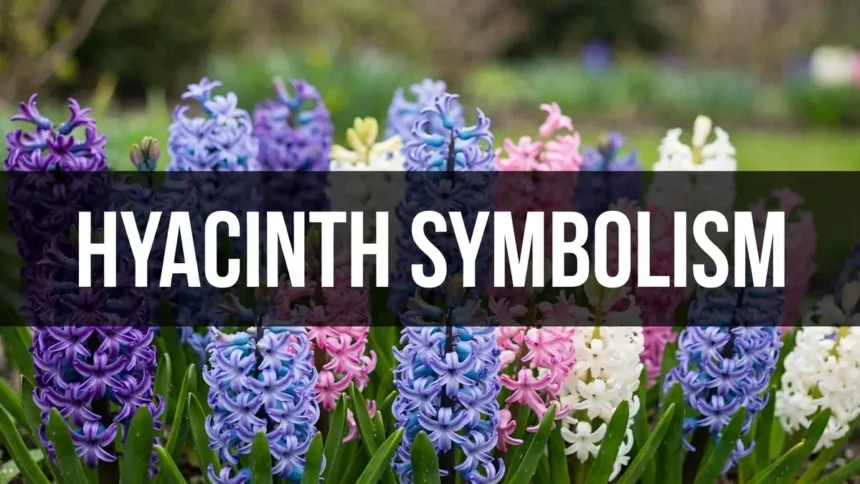
What is hyacinth symbolism? In a sentence: sincerity, remembrance, and renewal — with the exact message depending on the color you choose. The hyacinth is a fragrant spring flower that grows from a bulb, its dense spike of small star-shaped blooms opening in shades of blue, purple, pink, white, red, and yellow. But its meaning is older and stranger than its cheerful spring appearance suggests: it is named for a young man who died in a game, and the flower is said to have sprung from his blood. That story of love, jealousy, and loss is why the hyacinth can say “I am sorry” and “I will remember you” and “I am glad to see you” — all with the same flower, in different colors.
The hyacinth belongs to the genus Hyacinthus, a small group of bulbous, spring-blooming perennials in the asparagus family, native to the eastern Mediterranean — from southern Turkey through Lebanon, Syria, and Israel. The garden hyacinth most people know is Hyacinthus orientalis, the common or Dutch hyacinth, bred over centuries into the dense, intensely fragrant spikes sold today. It should not be confused with grape hyacinths (Muscari), which are a different genus altogether despite the shared name.
The Greek myth behind the hyacinth
The flower’s meaning starts with a myth, and the myth is a tragedy. Hyacinthus was a beautiful Spartan youth, loved by Apollo, the god of the sun, music, and prophecy. According to the story, the two were playing a game of discus throwing when Zephyrus, the god of the west wind — who also loved Hyacinthus and was jealous of Apollo — blew the discus off course. It struck Hyacinthus and killed him. Grieving, Apollo created the hyacinth from the youth’s blood, so that the flower would carry his memory.
Some versions of the tale add a detail that has stuck to the flower ever since: the petals were said to be marked with the Greek letters “AI, AI” — meaning “alas” — a permanent cry of grief written into the bloom. Whether or not anyone can see those letters in a real hyacinth, the idea captures what the flower has meant ever since: love cut short, sorrow, and a memory that refuses to fade. The myth also explains the hyacinth’s second, happier layer of meaning. Because the flower returns every spring from a bulb that looked dead all winter, it stands for rebirth and renewal — life coming back after loss, exactly as the story’s grief gives way to a flower that blooms again each year.
The short answer: what hyacinths symbolize
Taken together, the hyacinth’s core meanings are sincerity and constancy, remembrance, sorrow and apology, and spring renewal. In the Victorian language of flowers — floriography, the system by which bouquets carried messages that could not be spoken aloud — the hyacinth as a whole stood for sport, games, and play, a nod to the discus game in which Hyacinthus died. That general meaning is the starting point, not the whole story: the Victorians, and florists ever since, have let the color do the real talking.
That is what makes the hyacinth such a useful flower to give. A single stem says little on its own; the color you choose turns it into a specific message, from a promise of loyalty to an apology to a cheerful hello.
What each hyacinth color means
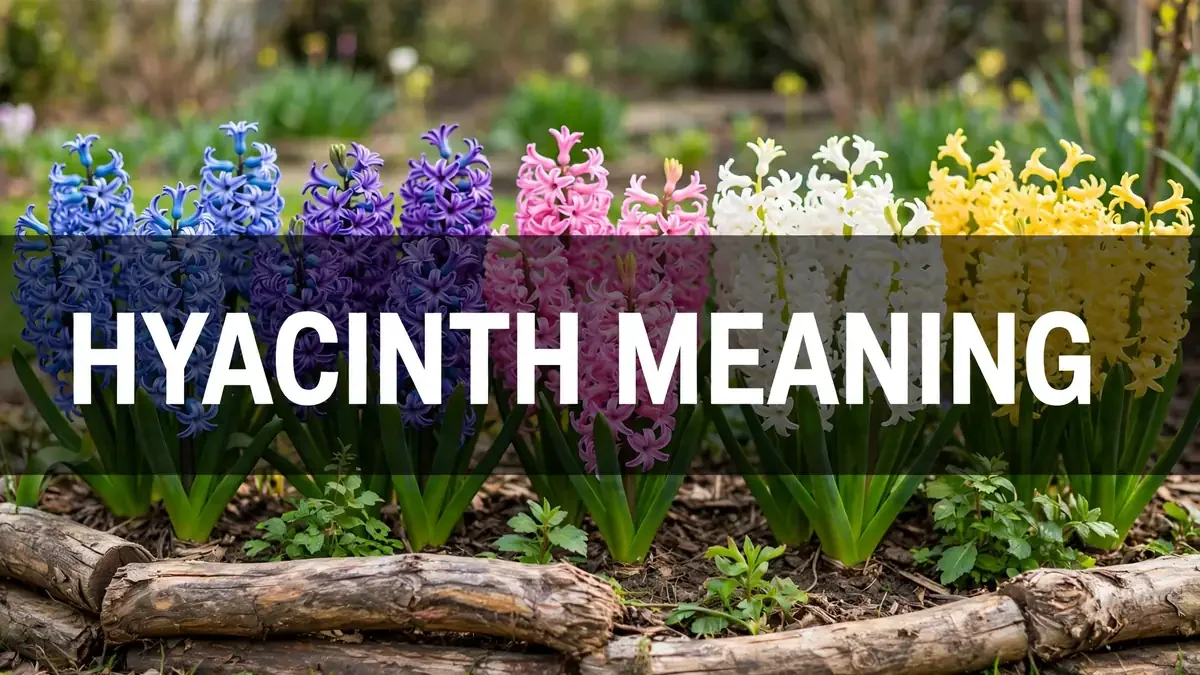
Like the gladiolus, whose message also changes with its color, the hyacinth shifts its meaning from one shade to the next:
- Blue: sincerity, constancy, and loyalty. Blue is the classic hyacinth color and the most positive of its meanings — a promise that your feelings are true and will not change. Give blue hyacinths to a close friend or partner to say you can be trusted.
- Purple: sorrow, apology, and forgiveness. Purple carries the deepest and saddest meaning of all the colors, tied directly to Apollo’s grief in the myth. It is the traditional color for saying sorry and asking to be forgiven.
- White: purity, loveliness, remembrance, and prayer. White hyacinths are given to say someone is in your thoughts — at a memorial, to offer comfort, or at a wedding, where they also stand for devotion and new beginnings.
- Pink: playfulness, happiness, and a cheerful spirit. Pink is the lightest of the hyacinth’s meanings, closest to the Victorian “sport and play” sense of the flower. It suits birthdays and congratulations.
- Yellow: jealousy. Yellow is the one color to give with care: in the language of flowers it means envy, a direct echo of Zephyrus’s jealousy in the myth.
- Red or deep pink: affection, energy, and romantic interest. Like many red flowers, red hyacinths suggest passion — though this meaning is less firmly established than those of blue, white, or purple, so it works best as a bold romantic gesture rather than a precise message.
If you are choosing for a specific occasion, let the color choose for you: blue for friendship, purple for an apology, white for sympathy or a wedding, pink for a celebration, and never yellow unless jealousy is genuinely the message you mean to send.
Hyacinths around the world
The hyacinth’s symbolism travels well beyond Greece. In Iran, hyacinths — sonbol, meaning “cluster” — are part of the Haft-Seen table for Nowruz, the Persian New Year held at the spring equinox, where they stand for spring, renewal, and fresh beginnings. The flower’s return each spring makes it a natural emblem for a new year.
In literature, the hyacinth has kept its association with memory and loss. In T. S. Eliot’s The Waste Land, the “hyacinth girl” and the “hyacinth garden” scene carry the flower’s emotional weight — intimacy, memory, and a happiness that cannot quite be held onto. It is a small moment in a long poem, but it shows how firmly the flower’s mythological meaning had settled into English literature: a hyacinth is never just a pretty spring flower.
The flower also has a long history as a garden plant in its own right. Hyacinths were brought to Western Europe in the 1560s, and by the 18th century they had become so fashionable in the Netherlands that Dutch growers were cultivating over 2,000 varieties, with rare colors prized by wealthy collectors. The hyacinth’s popularity has never really faded since — gardeners still grow it for the same reasons those collectors did: the intense fragrance, the reliable spring bloom, and the range of colors.
When to give hyacinths
Because the color carries the message, hyacinths suit more occasions than most spring flowers — as long as the color matches the moment. Give blue hyacinths to a friend you trust, or to mark a promise. Give purple when you need to say sorry and mean it. Give white at a memorial or funeral, where it says “remembered, always,” or at a wedding, where it speaks of devotion. Give pink for a birthday or a congratulation, where its playfulness is exactly right. And give a potted hyacinth — one of the most popular spring gifts — when you want the message to last: unlike cut flowers, a potted bulb can be planted outdoors after flowering and may bloom again the following spring, a living reminder of the occasion.
A practical note for anyone receiving one: hyacinth bulbs are inedible and contain oxalic acid, which can mildly irritate the skin, so wear gloves when handling the bulbs. In the garden, plant them in autumn in well-drained soil in full sun to partial shade, and leave the foliage in place after flowering so the bulb can store energy for next year — the same quiet patience that the bonsai teaches in a different form.
The bottom line
Hyacinth symbolism is sincerity, remembrance, sorrow, and renewal — a flower born from a Greek myth of love and loss, whose meaning changes completely with its color. Blue promises constancy, purple apologizes, white remembers and prays, pink plays, yellow warns of jealousy, and red declares affection. Choose the color to match the message, and a simple spring flower says exactly what you mean. Flowers carry meanings that outlast their blooms, and the hyacinth belongs beside the other meanings on this site — the forget-me-not, with its plea not to be forgotten, the gladiolus, with its strength of character, and the bonsai, with its patience — as one of the clearest symbols we have of a love that loss could not erase.