
If you have ever wondered what carrier pre select means, the short answer is that it is a standing instruction on a fixed telephone line. Once you set it up, the calls you choose are routed automatically through the carrier you picked. You just dial the number as normal — no extra code, no new equipment, and no change to your telephone line itself.
It is also written as “carrier pre-selection” and shortened to CPS. It comes from the era when one company owned the telephone lines into most homes and carried nearly all the calls on them. Carrier pre select let a customer keep that line but have some of their calls carried by a different company instead — usually a rival offering cheaper rates for long-distance or international calls.
Carrier Pre Select Meaning
Carrier pre select is a telecom facility that lets a fixed-line subscriber choose, in advance, which carrier will carry certain types of their outgoing calls. The choice is stored in the telephone exchange, so every time you make a call of a type you pre-selected — for example, all international calls — the exchange sends it over your chosen carrier’s network automatically.
Wikipedia’s definition of carrier preselect puts it simply: it is a method of routing calls for least-cost routing without the need to program a PBX telephone system. A subscriber whose line is maintained by one company, usually a former monopoly provider such as BT in the UK, can choose to have some of their calls automatically routed across a different company’s network, such as TalkTalk, without entering a special code or installing special equipment.
Your line rental stays with the company that maintains your line. Only the calls you pre-select move to the other carrier, and the charges for those calls usually appear on that carrier’s bill instead.
How Carrier Pre Select Works
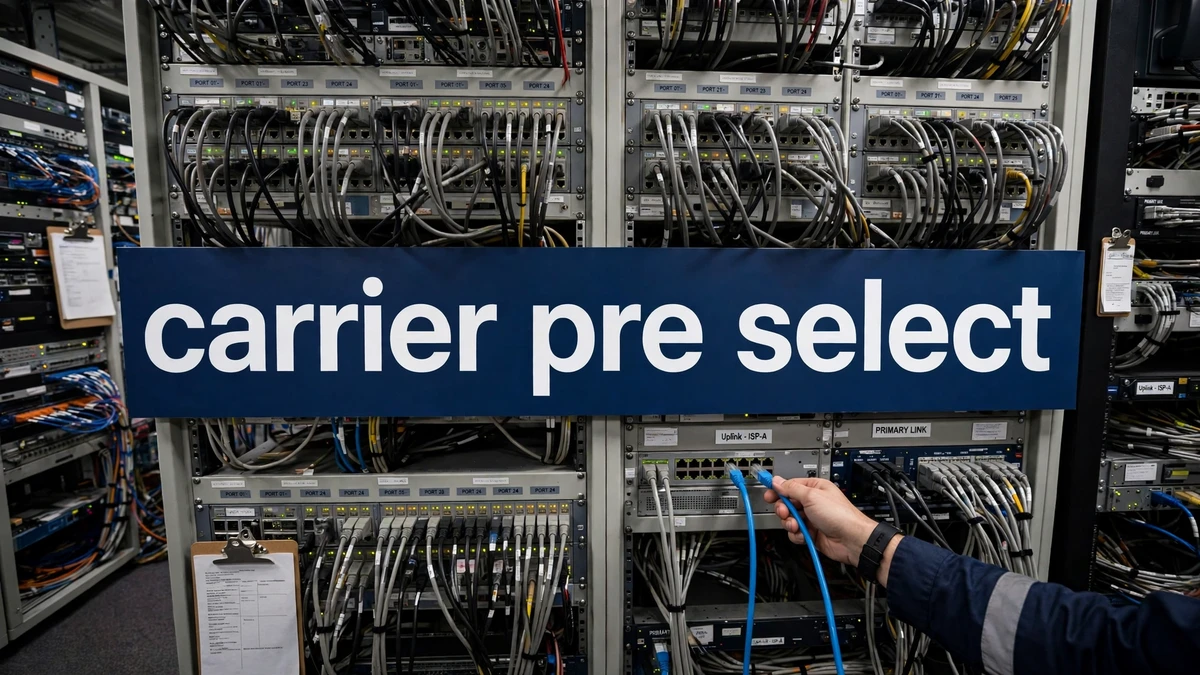
The routing happens inside the telephone exchange, not in your home, which is why you need no new equipment. The process works like this:
- You subscribe to a pre-select carrier, agreeing it will carry certain kinds of your calls — for example, all national calls or all international calls.
- Your line provider records the choice in its exchange, against your telephone number.
- You dial as normal. The exchange checks the type of call against your stored selection and hands pre-selected calls to your chosen carrier’s network.
- You are billed by the carrier that carried the call, at its own rates, while your line rental and other calls stay on your original provider’s bill.
Nothing changes at your end. The phone, the socket, and the number you dial are all exactly the same. The only difference is which company’s network carries the call after it leaves the exchange — and, usually, what the call costs.
Carrier Pre Select vs Call-by-Call
Before carrier pre select, the only way to use a rival carrier from the same line was call-by-call selection: dialling a short access code in front of the number, every single time. Carrier pre select removed that friction.
| Carrier Pre Select (CPS) | Call-by-Call Selection | |
|---|---|---|
| What you dial | Just the phone number | An access code, then the phone number |
| When the choice is made | Once, in advance | On every single call |
| Equipment needed | None | None |
| Which calls it covers | Whole categories you chose (for example, all international calls) | Only the call you dial the code for |
| Risk of forgetting | None — it is automatic | High — forget the code and the call goes by the default carrier |
The two methods were designed to work together. Under the UK’s rules, a subscriber who had pre-selected a carrier could still suspend that choice for a single call by dialling an access code — a one-off override without cancelling the standing instruction.
How to Set Up or Change Carrier Pre Select
Setting it up is a request to your existing line provider, not to the carrier you want to use. The provider that maintains your line is the one that programs the exchange, so it is the one that has to make the change.
- Choose your carrier and your call types, and compare rates for the kinds of calls you actually make.
- Contact your line provider and ask for carrier pre-selection, naming the carrier and the call categories. Under the UK’s 1999 carrier pre-selection regulations, the line provider had to supply the facility to any subscriber who asked for it in writing.
- Confirm exactly which call types are covered and when the change takes effect.
- To change or cancel it, contact your line provider again. The pre-selected carrier cannot change your routing on its own — the instruction lives in your line provider’s exchange.
Because the mechanism belongs to the fixed-line world, availability today depends on your provider and your country. If your provider no longer offers it, that is usually because its fixed-line call business has been replaced by newer services.
Why Was Carrier Pre Select Introduced?
Carrier pre select was a competition remedy. When telephone markets were opened up, the company that owned the wires into people’s homes still had an enormous advantage: every call started on its network. A rival could offer cheaper calls, but customers had to dial a code before every number to use it — and most people never bothered.
Regulators saw the access code as a barrier. By forcing the line owner to route a customer’s chosen calls to a rival automatically, they let new carriers compete on price without building their own lines into every home. Opening the market to rivals in this way was a deliberate endeavour to break a monopoly gently: the incumbent kept the line rental, the rival won the calls, and the customer got lower prices and a real choice. The goal was a more open and inclusive telephone market, in the plain sense of the word — one in which the company that owned the wires was no longer the only choice.
For businesses, there was a second benefit. A company with a private branch exchange (PBX) could use carrier pre select to get least-cost routing — automatically sending calls over the cheapest carrier — without reprogramming its own telephone system for every call.
Does Carrier Pre Select Still Matter Today?
As a consumer product, carrier pre select belongs mostly to history. Most calls today are made from mobiles, or over the internet through apps and voice-over-IP services, and the fixed-line world it was built for has shrunk. Many people no longer have a traditional landline at all.
That does not make the idea irrelevant. If you still make many long-distance or international calls on a fixed line, and your line provider charges more than a rival for them, pre-selection is still the simplest way to pay the rival’s rates without dialling a code each time. And as a piece of telecom history it matters too: it established the principle that the company owning the wires cannot force you to use it for everything — the same idea behind number portability and open broadband networks.
The shift is easy to see in everyday life: much of what used to be a phone call is now a text message, and if you have ever wondered what “sent as SMS” means, you have already noticed how the old landline world gave way to mobile messaging. Carrier pre select was a bridge between the monopoly era and the competitive one — and once the crossing was made, most people stopped noticing the bridge.
Frequently Asked Questions
Is carrier pre select the same as carrier selection?
No. Carrier selection, or call-by-call selection, means dialling an access code before a number to route that one call through a different carrier. Carrier pre select is the standing version: you choose once, in advance, and the exchange routes every call of the chosen types automatically.
Do I need new equipment to use carrier pre select?
No. The selection is stored in the telephone exchange, not in your home, so your existing phone and line work exactly as before. That was one of its main selling points: no special equipment and no access code to remember.
Can I still use another carrier for just one call?
Yes. You can suspend your pre-selection for an individual call by dialling an access code prefix, as long as you have arranged it with the alternative operator. Your standing pre-selection stays in place for all other calls.
The Rule to Remember
Carrier pre select is a set-it-once instruction: you choose the carrier in advance, and the exchange does the rest. It let customers keep their telephone line but pay a rival’s prices for the calls they chose, with no code to dial and no equipment to install. The fixed-line world it was built for has mostly faded, but the principle behind it — that the company owning the wires should not own all your calls — still shapes how phone markets work today.