
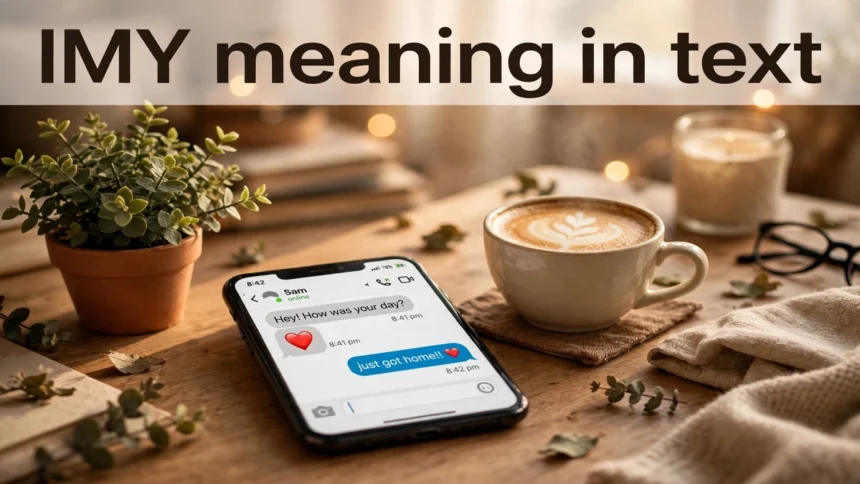
Getting a short message that just says “imy” can stop you for a second — is it a typo, or something you are supposed to know? The question of imy meaning in text has a simple answer: IMY stands for “I miss you.” It is a warm shortcut people send when they are thinking of someone and wish that person were closer. Like most internet slang, it is short because it is meant to be typed fast — and its meaning is clearest when you know who sent it and why.
What Does IMY Mean in Text?
IMY is an initialism: each letter stands for one word — I miss you. It shows up in text messages, Snapchat DMs, Instagram messages, WhatsApp chats, and TikTok comments, almost always as a small message of its own or at the end of a longer one. Collins English Dictionary lists IMY as an abbreviation for “I miss you” in messaging and social media.
It is usually written in lowercase — “imy” — which feels casual and soft. In all caps, “IMY” reads a little louder and more heartfelt, but the meaning is the same. It is one of the softest abbreviations in texting: quick to type, but it carries a real feeling, which is why getting one can make your day — or leave you wondering how to answer.
When Do People Send IMY?
People send IMY when distance or a busy schedule has kept them apart from someone they care about. It is almost always personal — it comes from someone who feels close to you.
- Long distance. Someone far away sends IMY to say the distance is on their mind: “Just thinking about you. IMY.”
- After a visit. Someone you just spent time with sends IMY the next day, once the house feels quiet again: “Already miss having you here. IMY!”
- Reconnecting with an old friend. A friend you have not spoken to in months sends it to reopen the conversation: “Hey, it’s been forever. IMY, let’s catch up soon.”
- A simple check-in. Sometimes there is no occasion at all — just someone thinking of you mid-day: “Saw your favourite song come on. IMY.”
IMY is not only for romantic messages. Friends, siblings, parents, and cousins send it too. The feeling is always the same: the sender wishes you were here, and three letters were the fastest honest way to say it.
Variations of IMY
The longer versions are easy to read once you know the basic form — the same message with extra feeling, or the reply to it.
| Short form | Means | When it is used |
|---|---|---|
| IMY | I miss you | The basic form, for any situation |
| IMYSM | I miss you so much | When the feeling is stronger than usual |
| IMYM | I miss you more | A playful reply: “I miss you more than you miss me” |
| IMYT / IMY2 | I miss you too | The reply when someone sends IMY first |
| IMYMTA | I miss you more than anything | The strongest version, saved for someone very close |
A few other spellings turn up as well: “IMU” also means “I miss you,” and “MYSM” means “miss you so much.” They are less common, but they mean the same thing. The standalone “MY” is almost never used, because “my” is already an ordinary English word and the message would be confusing.
IMY vs ILY
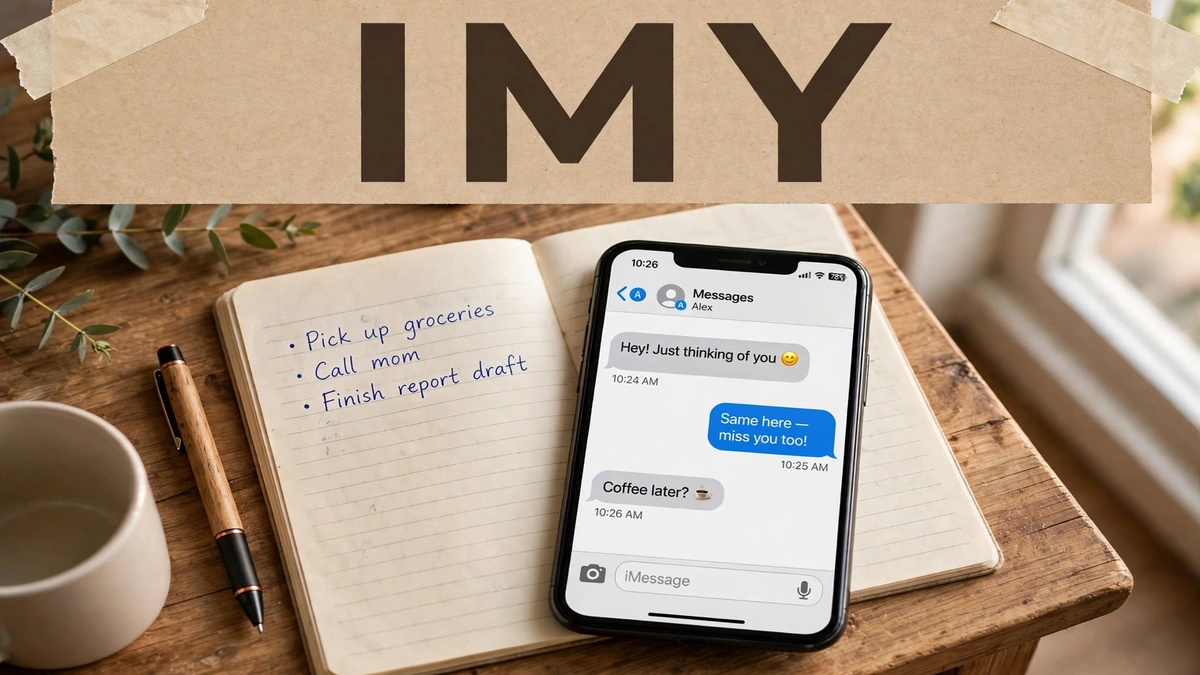
IMY and ILY look alike, and they are both messages of affection — but they mean different things, so it matters which one you send.
- IMY means “I miss you.” It is about distance: someone is far away, and you wish they were here.
- ILY means “I love you.” It is about feeling: it says how much someone means to you, whether they are near or far.
The two often appear together — “IMY, ILY” — because missing someone and loving them usually go hand in hand. But they are not interchangeable: ILY to a casual friend is a much bigger statement than IMY. If you are unsure, IMY is the safer choice: warm without being heavy.
How to Use IMY in a Text
IMY works best as a small, honest message. A few habits keep it landing the way you mean it:
- Use it as a whole message, or at the end of one. “IMY” alone is the simplest version; a short follow-up makes it warmer: “IMY, hope you’re doing well.”
- Match the spelling to the mood. Lowercase “imy” reads soft and casual; all caps “IMY” reads more heartfelt. Neither is wrong.
- Add an emoji when the feeling is warm. A heart or a smiling face makes it clear the message is affectionate: “imy ❤️”. A sad face works too when the distance is hard: “imy 😢”.
- Send it to someone who will understand it. IMY is most common among younger texters, so an older relative may not know what it means — with them, write out “I miss you.”
- Keep it out of formal messages. IMY is casual by design, so it belongs in chats with people you are close to — not work messages or texts to people you barely know.
IMY sits in the same family as other short texting abbreviations. HN is the opposite kind of message — a firm “hell no” — while WYF asks “where you from” and IMK means “in my knowledge.” Like IMY, they are all built for quick replies between people who already know each other.
How to Reply to IMY
If someone sends you IMY, they have told you they are thinking of you. The best answer depends on how you feel:
- Say it back: “IMY2!” or “I miss you too ❤️” — the simplest reply, and the one most people want to hear.
- Make a plan: “IMY too! Coffee this weekend?” — turns the feeling into something to look forward to.
- Match the feeling: “Aww, IMYSM. Can’t wait to see you.” — when you miss them just as much.
- Keep it light: “Same here! Let’s fix that soon 😊” — warm, without making it a big emotional moment.
Do not leave it on read, or answer with a flat “ok.” IMY is a small act of honesty — someone admitted they miss you — so even a short, warm answer beats silence. If you do not miss the person back, a kind reply still works: “That’s so sweet, thank you! Let’s catch up soon.”
Is IMY Rude?
No. IMY is one of the gentlest abbreviations in texting. It contains no swear words, no insult, and no hidden meaning — it is simply a short way to say “I miss you.” It is safe to send to friends, family, and partners, and it is generally considered safe for kids to use as well, since it is just a shorthand for an ordinary, kind sentence.
The only thing to watch is the relationship. Sending IMY to someone you barely know, or to an ex you have not spoken to in years, can feel confusing — not because the abbreviation is rude, but because the feeling does not match the relationship. With the right person, it is always welcome.
Frequently Asked Questions
What does IMY mean in text?
IMY means “I miss you” in texting — a short, warm way to tell someone you are thinking of them and wish they were closer. Each letter stands for one word: I, miss, you.
What does IMY mean on Snapchat?
On Snapchat, IMY means “I miss you.” It shows up in DMs as a quick, affectionate message from a friend or partner. The meaning is the same on Instagram, WhatsApp, and TikTok.
What does IMYSM mean?
IMYSM means “I miss you so much” — IMY with extra feeling. People use it when they really miss someone, for example after a long time apart.
How do you reply to IMY?
The simplest reply is “IMY2” or “I miss you too.” You can also make a plan — “IMY too! Let’s meet this weekend?” — or match the feeling with “IMYSM, can’t wait to see you.” Any warm reply works; the worst answer is none at all.
What is the difference between IMY and ILY?
IMY means “I miss you” and ILY means “I love you.” IMY is about distance — someone is far away and you wish they were here. ILY is about feeling. They often appear together, but they are not the same message.
Is IMY the same as “I miss you”?
Yes. IMY is simply the shortened form of “I miss you,” written for speed in texts and chats. It means exactly the same thing in three letters. Writing it out in full is better for someone who may not know the abbreviation.
IMY means “I miss you” — three letters that say someone is thinking of you and wishes you were closer. Whether it arrives from a partner across the country or a friend you have not seen in months, it is one of the warmest messages in texting, and the best reply is almost always to say it back.