
A huge synonym is a word you can use instead of “huge” when it has gone flat from overuse. “Huge” is one of the most repeated adjectives in English writing — in essays, in reports, in everyday messages — and it is usually doing a job a sharper word could do better. A huge crowd. A huge mistake. A huge success. Three different meanings, one tired word. Below are 40 synonyms for huge, grouped by what you actually mean, with examples so you can pick the right one.
What Does “Huge” Mean?
“Huge” is an adjective meaning very large or extensive. Merriam-Webster gives three senses: of great size or area (“huge buildings”), great in scale or degree (“a huge deficit”), and great in scope or character (“a dancer of huge talent”). The word comes from Middle English, from the Old French ahuge. A synonym is a word with the same or a very similar meaning — but no two synonyms are identical. Each one below carries its own shade of meaning, which is exactly why the groups matter: “gigantic” suggests something unnaturally large, “whopping” suggests a surprising amount, and “colossal” suggests something built on an epic scale. Pick the group first, then the word. The Cambridge English Thesaurus entry for huge lists 78 synonyms and antonyms for the word, but the 40 below cover nearly every sentence you will ever need.
Synonyms for Huge That Mean “Physically Big”
Use these when something is large in size, bulk, or area:
- enormous — “The enormous oak tree shaded the whole garden.”
- gigantic — “A gigantic wave rolled toward the shore.”
- massive — “The massive boulder blocked the path.”
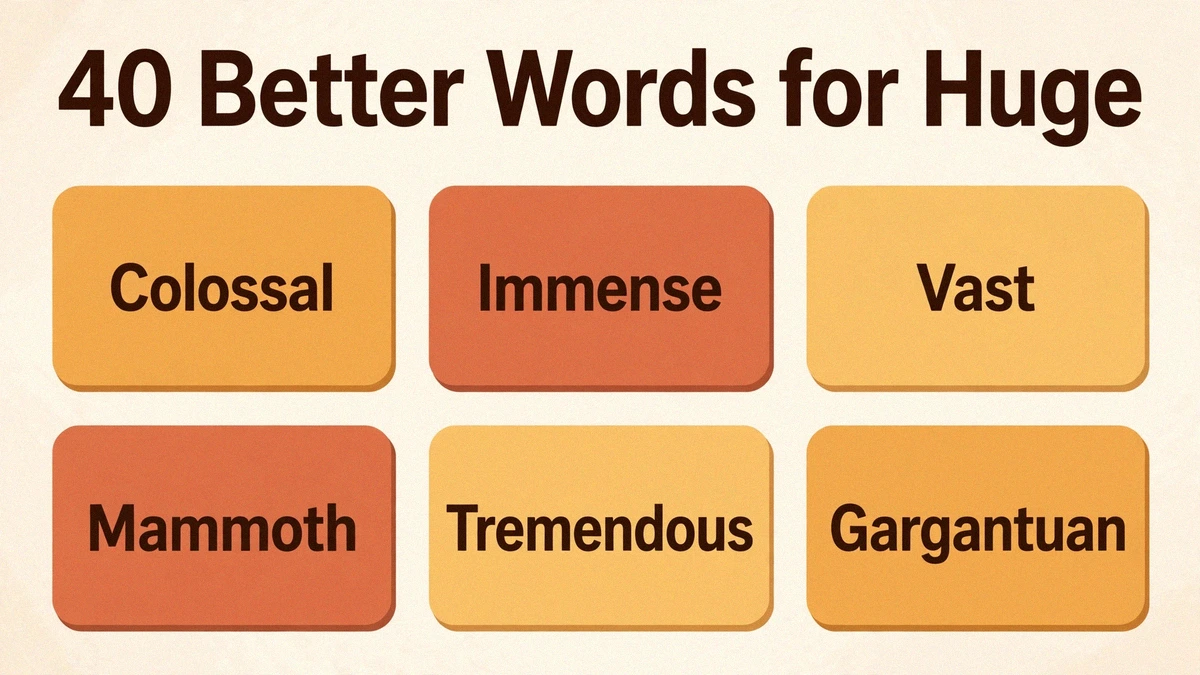
- colossal — “The colossal statue towered over the square.”
- immense — “An immense desert stretched to the horizon.”
- vast — “The vast ocean looked endless from the cliff.”
- mammoth — “The mammoth tent held two hundred people.”
- gargantuan — “The gargantuan sandwich fed the whole table.”
- titanic — “The titanic iceberg drifted slowly past the ship.”
- jumbo — “She ordered a jumbo coffee before the long drive.”
Synonyms for Huge That Mean “Great in Scale or Degree”
Use these when something is huge in amount, importance, or effect rather than in physical size:
- tremendous — “The news caused a tremendous stir in the town.”
- monumental — “Finishing the bridge was a monumental achievement.”
- astronomical — “The repair bill was astronomical.”
- prodigious — “Her prodigious memory surprised everyone.”
- stupendous — “The fireworks put on a stupendous display.”
- whopping — “They paid a whopping sum for the old house.”
- staggering — “The project ran up a staggering cost.”
- overwhelming — “She won by an overwhelming majority.”
- hefty — “The company paid a hefty fine.”
- considerable — “A considerable amount of rain fell overnight.”
Synonyms for Huge That Are Formal or Literary
Use these in essays, formal writing, or anywhere a weightier word earns its place. Formal words carry history with them — “Herculean” comes from Hercules and his famous labours, “Brobdingnagian” from the land of giants in Jonathan Swift’s Gulliver’s Travels, and “cyclopean” from the one-eyed Cyclops of Greek myth. A formal word rewards a quick check before you use it, the way our compulsory definition guide checks a word’s meaning, synonyms, and examples before you put it in a sentence.
- elephantine — “The elephantine sofa barely fit through the door.” (elephantine suggests a cumbersome, ponderous largeness)
- Brobdingnagian — “The Brobdingnagian feast covered three tables.”
- cyclopean — “The cyclopean walls were built from blocks no crane could lift.”
- Herculean — “Cleaning the old barn was a Herculean task.”
- leviathan — “The leviathan cruise ship dwarfed the harbour.”
- behemoth — “The behemoth factory employed the whole town.”
- monolithic — “The monolithic tower dominated the skyline.”
- mountainous — “A mountainous pile of laundry waited by the door.”
- towering — “A towering pile of books covered her desk.”
- oversized — “He wore an oversized coat that reached his knees.”
Synonyms for Huge That Are Casual and Fun
Use these in conversation, captions, and informal writing — never in a formal report:
- ginormous — “They baked a ginormous cake for the party.”
- humongous — “A humongous dog bounded across the park.”
- mega — “The sale was a mega event for the small town.”
- monster — “A monster wave crashed over the pier.”
- super-sized — “He ordered a super-sized meal after the hike.”
- king-size — “The king-size bed filled most of the room.”
- outsize — “She wore an outsize hat that shaded her whole face.”
- larger-than-life — “Her larger-than-life personality filled the room.”
- walloping — “They served a walloping portion of chips.” (British informal)
- XXL — “He bought an XXL jacket for the winter.”
Huge vs Enormous: What’s the Difference?
“Huge” and “enormous” are the closest pair on this list, and they are interchangeable in most sentences. The difference is one of degree and surprise: “huge” is the everyday default, while “enormous” often implies something that goes beyond what you expected or beyond the normal measure — an enormous mistake feels bigger than a huge mistake, because “enormous” carries a note of excess. In practice, use “huge” when you want plain clarity and “enormous” when you want the size to feel remarkable. Two words can look alike and mean different things — the same trap as principal vs principle, where one letter changes the meaning entirely — so check the shade before you swap.
How to Choose the Right Synonym
- Name the meaning first. Physical size, scale, formality, or fun? The group decides the word.
- Match the strength. “Astronomical” is stronger than “considerable.” Do not claim more than you mean.
- Match the register. “Ginormous” belongs in a text to a friend, not in a job application. “Brobdingnagian” belongs in an essay, not in a shopping list.
- Keep it natural. If a word sounds stiff in your sentence, it is the wrong word. Read the sentence aloud with the new word and check it still means what you meant.
- Do not swap blindly. A thesaurus gives you options, not answers — the sentence around the word decides.
The same approach works for other tired words. Our shows synonym guide groups 40 replacements for “shows” by meaning, just as this one does for “huge” — pick the group first, then the word.
Antonyms of Huge
Sometimes the opposite word is what you need. The antonym of “huge” is tiny — and close alternatives include small, minuscule, microscopic, and little. “The tiny cottage stood beside the huge hotel” says the opposite of “the huge cottage stood beside the tiny hotel,” and choosing between the two is a choice about what you mean, not just about style.
Frequently Asked Questions
What is the best synonym for huge?
It depends on the meaning. For physical size, use “enormous” or “gigantic.” For scale or amount, use “tremendous” or “whopping.” For formal writing, use “colossal” or “immense.” There is no single best synonym — the context decides.
What are some synonyms for huge?
Enormous, massive, gigantic, immense, vast, colossal, mammoth, gargantuan, tremendous, and monumental are the most useful ones. The full list above gives 40, grouped by meaning, with an example for each.
Is “ginormous” a real word?
Yes. “Ginormous” is a blend of “gigantic” and “enormous,” and it is listed in major dictionaries as informal. Use it in casual writing and conversation, not in formal work.
What is the opposite of huge?
“Tiny” is the direct antonym. “Small,” “minuscule,” “microscopic,” and “little” are close alternatives.
Is “huge” a weak word?
Not always — sometimes it is exactly right. It becomes weak only when it is repeated so often that it stops saying anything specific. Replace it where a sharper word fits, and keep it where it is clear and honest.