
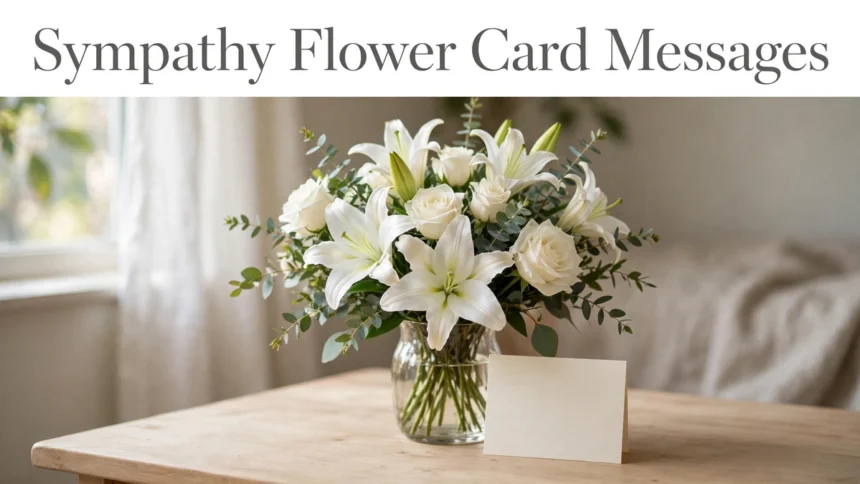
Finding the right words after a loss is one of the hardest small tasks grief hands you. These sympathy flower card messages are written to be copied, adapted, and signed as they are — short, sincere, and free of clichés — so you can say something kind without worrying that you have said the wrong thing.
A flower card is small, and that is part of its kindness. The family will read it in the middle of difficult days, so two or three honest sentences are enough. You do not need to explain the loss, offer advice, or find perfect words. You only need to show that you noticed, that you care, and that you are thinking of them.
How to Write a Sympathy Flower Card Message
Most good messages follow the same simple shape. Use it as a starting point, then make it your own:
- Say you are sorry. One plain sentence is enough: “I am so sorry for your loss.”
- Name the person, if you can. Using their name shows the message is personal, not generic. “I will miss Margaret” means far more than “I will miss them.”
- Offer something real. A specific offer beats a vague one. “I can bring dinner on Thursday” is better than “Let me know if you need anything.”
Keep the whole message to two or four sentences. Sign your full name clearly, so the family knows who sent the flowers — especially if you are sending them on behalf of a workplace or a group.
Short Sympathy Flower Card Messages
When you do not know the family well, or the card is very small, a single warm line is enough. Any of these works on its own:
- With deepest sympathy. We are thinking of you and your family.
- I am so sorry for your loss. Please know you are in my thoughts.
- Thinking of you during this difficult time, and sending all our love.
- With love and sympathy, from all of us.
- May you find comfort in the memories you shared.
- Holding you and your family in our thoughts today.
- So sorry to hear your sad news. We are here for you.
- With heartfelt condolences, and wishes for peace in the days ahead.
Sympathy Flower Card Messages for a Close Friend
When the loss is close to home, a short memory often means more than any formal phrase. If you knew the person who died, say so:
- I am so sorry, my friend. I loved spending time with your mum, and I will miss her laugh.
- There are no words that make this easier, but I am here — today, next week, and whenever you need me.
- Your dad was one of the kindest people I have ever known. I am grateful I got to know him.
- I keep thinking about the afternoons we all spent together. Thank you for sharing him with us.
- I am so sorry you are going through this. I will bring dinner on Thursday, and I will not stay long unless you want me to.
- She mattered so much, to so many people. I hope knowing that brings you a little comfort.
- I will never forget his stories, or the way he made everyone in the room feel welcome.
- I love you, and I am not going anywhere. Call me at any hour, for anything at all.
Sympathy Flower Card Messages for a Colleague
At work, keep the tone warm but professional, and sign the card with your name or your team’s name so the family knows who sent it:
- On behalf of the whole team, please accept our sincere condolences. We are thinking of you.
- We are so sorry for your loss. Take all the time you need — your work will be here when you are ready.
- Your colleagues are thinking of you and your family, and we are here to help in any way we can.
- Please accept these flowers with our deepest sympathy. We will miss seeing your mum at our office gatherings.
- We are sorry to hear about your father. He raised a wonderful person, and we are lucky to work with you.
- With sympathy from all of us at the office. There is no need to reply — just know we care.
- Thinking of you during this sad time. We have arranged cover for your work, so please do not worry about it.
If several colleagues are contributing, one shared card signed “With sympathy, from your team at [workplace]” is kinder than a dozen separate small notes.
Sympathy Flower Card Messages for a Neighbour
A neighbour’s card can be brief and practical — you live close by, and a concrete offer of help is worth more than a long message:
- We were so sorry to hear your sad news. We are just next door, whenever you need anything.
- Thinking of you and your family. Please do not hesitate to knock — for anything, at any time.
- Your husband was a lovely neighbour, and our street will miss him. With our sympathy.
- I am so sorry for your loss. I can collect your shopping or walk the dog this week — just say the word.
- With deepest sympathy from the neighbours at number 12. We are thinking of you.
- She always had time for a chat over the fence, and I will miss her. Please accept our condolences.
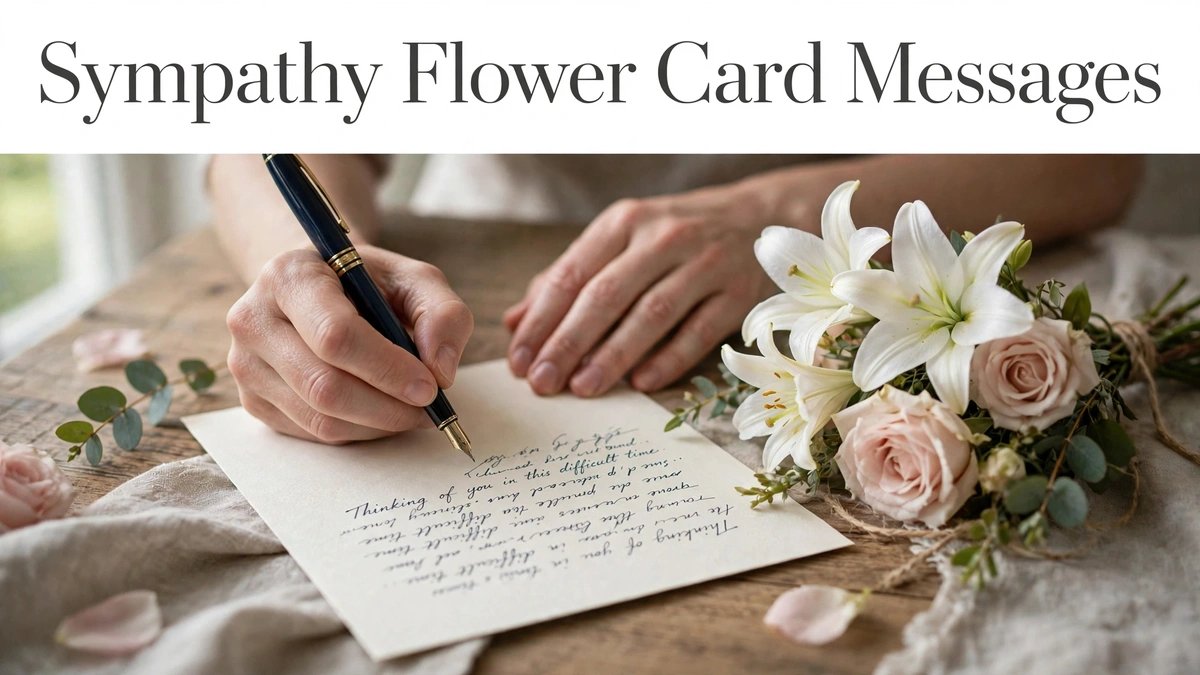
Sympathy Flower Card Messages for a Funeral Service
Flowers sent to a funeral home or service usually carry a short, formal message. These are written for that setting:
- In loving memory of [name]. With deepest sympathy, from [your name].
- Rest in peace, [name]. You will be greatly missed by all who knew you.
- With love and remembrance, honouring a life well lived.
- Please accept our condolences on the loss of your [mother/father/husband/wife]. Our thoughts are with you.
- In memory of [name], with sympathy and gratitude for a life that touched so many.
- With deepest sympathy to the whole family. [Name] will always be remembered with love.
- Sending these flowers in memory of [name], and holding you all in our thoughts today.
Check the funeral home’s wishes before ordering: some families ask for donations to a charity instead of flowers, and some services have limits on arrangement size. A quick call to the funeral home will confirm what is welcome.
Sympathy Flower Card Messages for the Loss of a Parent
Losing a parent is a loss many people carry for years, and a message that names what made them special is often kept and re-read:
- I am so sorry about your mum. She was warm, funny, and so proud of you — I hope that brings you comfort.
- Your father taught me a lot about patience and kindness. I am grateful I knew him.
- There is nothing that makes losing a parent easier, but I am here, and I will keep showing up.
- She loved you so much, and it showed in everything she did. I am thinking of you.
- I will miss your dad’s stories and his terrible jokes. Thank you for letting me be part of his life.
- With all my sympathy. Your mum’s kindness touched more people than she ever knew.
Which Flowers Suit Sympathy — and What They Mean
The flowers you choose speak before the card is opened, so it helps to know what the familiar choices mean. In the language of flowers, blooms have carried coded messages for centuries, and the traditional sympathy choices still carry those meanings today:
- White lilies are the most traditional sympathy flower, associated with peace and rebirth.
- White and cream roses convey respect and admiration. Soft pink roses are also appropriate; red roses are usually avoided, because they suggest romantic love.
- Chrysanthemums are linked with truth, loyalty, and devotion, and they last well in an arrangement.
- White carnations stand for admiration and gratitude, and they work well in mixed bouquets.
- White orchids convey sympathy and strength, and they last longer than many cut flowers.
- Forget-me-nots are the classic flower of remembrance — small, blue, and unmistakable in meaning. Read more about them in our guide to forget-me-not flower meaning.
- Hyacinths have long been linked with grief and rebirth, and soft blue or white varieties suit a sympathy arrangement. Our guide to hyacinth flower meaning explains the story behind that symbolism.
- Gladioli are often linked with strength of character, which makes them a thoughtful choice for honouring someone who faced a long illness with courage. See our guide to gladiolus flower meaning.
White and soft colours — cream, pale pink, lavender — are the safest choices for a funeral or memorial. Bright reds, oranges, and hot pinks can feel celebratory rather than solemn, and sunflowers, however cheerful, are usually out of place at a service. If you knew the person who died, their favourite flower or colour is always a thoughtful exception to these rules.
What to Avoid Writing
A few well-meant lines can land badly when someone is grieving. Avoid these:
- “I know how you feel.” You almost certainly do not, and it can sound dismissive even when it is meant kindly.
- “They are in a better place.” Unless you know the family’s faith, religious claims about the afterlife can miss the mark.
- “At least…” Any sentence starting with “at least” minimises the loss — “at least she lived a long life” is no comfort in the first days.
- “Call me if you need anything.” Most grieving people will not call. Offer something specific instead.
- Long stories about your own loss. A brief shared memory of the person who died is welcome; a long account of your own grief is not.
- Advice about grieving. Do not tell the family how to feel, how long to grieve, or what to do next.
Signing Off and Sending the Flowers
Send flowers promptly — ideally within two or three days of hearing the news, and a day or two before the service if they are going to the funeral home. Flowers sent to the family home can arrive any time in the weeks after the service, when the house has gone quiet and a reminder that people are still thinking of them means a great deal.
Sign your full name, and add your relationship if it is not obvious: “With love, Sarah — Emma’s friend from school.” If the flowers are from a group, sign the group name so the family is not left guessing.
Above all, keep it simple. A short, honest message on a sympathy flower card — a few lines, a name, and your signature — is enough. The flowers say the rest.