
A to whom it may concern letter is a formal letter addressed to a reader whose name you do not know. The phrase itself is the salutation — the greeting at the top of the letter — and it tells whoever opens the envelope that the letter is meant for the right person or office, even though that person has not been named. It is a useful tool, but it is also one of the most overused greetings in business writing. Used in the right place, it is correct and professional. Used where a name or a job title was available, it reads as if the writer did not bother to look.
This guide covers what the phrase means, when to use it, when to choose something better, the standard format of the letter, the capitalization and punctuation rules, and two short example openings you can adapt.
What “To Whom It May Concern” means
The phrase is a formal way of saying “to whoever this applies to.” It is used when the writer genuinely does not know who will read the letter — not just the person’s name, but their role or department as well. It appears most often on documents that are meant to be read by an unknown future reader, or passed from one office to another.
That is the key test: the greeting fits when the recipient is unknown by design, not when the writer simply has not looked. A general reference letter, for example, is written to be shown to employers the writer cannot predict, so no single recipient exists. An employment-verification letter works the same way — it confirms facts about a former employee for whoever asks for the confirmation. A formal complaint or request sent to a whole organization, rather than to a person, can also fit, provided no department or contact has been named for that kind of request.
It does not mean “Dear Sir or Madam,” and it should not be treated as a polite way of avoiding a name you could have found. The phrase is neutral and impersonal by design, which is exactly why it works for a general document and exactly why it falls flat on a letter meant for one specific person.
When to use it
Use “To Whom It May Concern” when one of these is true:
- A general reference or recommendation. You are writing about a person for unknown future readers — future employers, admissions offices, or licensing bodies — and there is no single recipient to name.
- An employment or tenancy verification. The letter confirms facts (dates, role, or status) for whoever needs the confirmation, and the requester has not named a recipient.
- A formal complaint, inquiry, or request to an organization as a whole. No department, team, or contact person has been given for the matter, and the letter is addressed to the organization itself.
- A document that will be filed or forwarded. The letter is meant to be kept on record and read later by someone you cannot identify now.
Formal letters still have a place for formal occasions, too — a written note or invitation connected with a ceremony such as a house blessing is one example of a moment when a careful, formal letter suits the occasion better than a quick message. In every case, the same rule applies: the greeting is right only when no more specific recipient exists.
When NOT to use it — and what to use instead
Do not use “To Whom It May Concern” when you can identify the reader, or when a role or department greeting would be more accurate. A job application is the clearest example: if the posting names a hiring manager, address that person by name. If it does not, “Dear Hiring Manager” is still better, because it names the reader’s role and shows the letter was written for that job, not copied to every employer.
| Situation | Better greeting | Why |
|---|---|---|
| Job application, named contact | Dear [Full Name]: | Addresses the actual person |
| Job application, no name given | Dear Hiring Manager: | Names the reader’s role |
| Application to a committee | Dear Search Committee: | Addresses the group deciding |
| Complaint or request to a known department | Dear Customer Support Team: | Reaches the team that can act |
| Letter to a department | Dear [Department] Team: | More specific than a general greeting |
| General reference, no recipient exists | To Whom It May Concern: | No single recipient to name |
A few greetings to avoid: “Dear Sir/Madam” reads dated and assumes the reader’s gender; “Dear Whoever It May Concern” is simply wrong; and “To Who It May Concern” uses the wrong pronoun — the fixed phrase uses “whom,” not “who.” Do not add “Dear” in front of it, either: “Dear To Whom It May Concern” doubles the greeting. Use one or the other, never both.
Before settling on the general greeting, spend a few minutes looking for a name. Check the job posting or the request itself, the organization’s team or contact page, and the department named in the instructions. If a colleague or contact there can tell you who should receive the letter, ask. Only when that search turns up nothing should you fall back on “To Whom It May Concern” — and if you do, a role or department greeting is still worth trying first.
The standard letter format
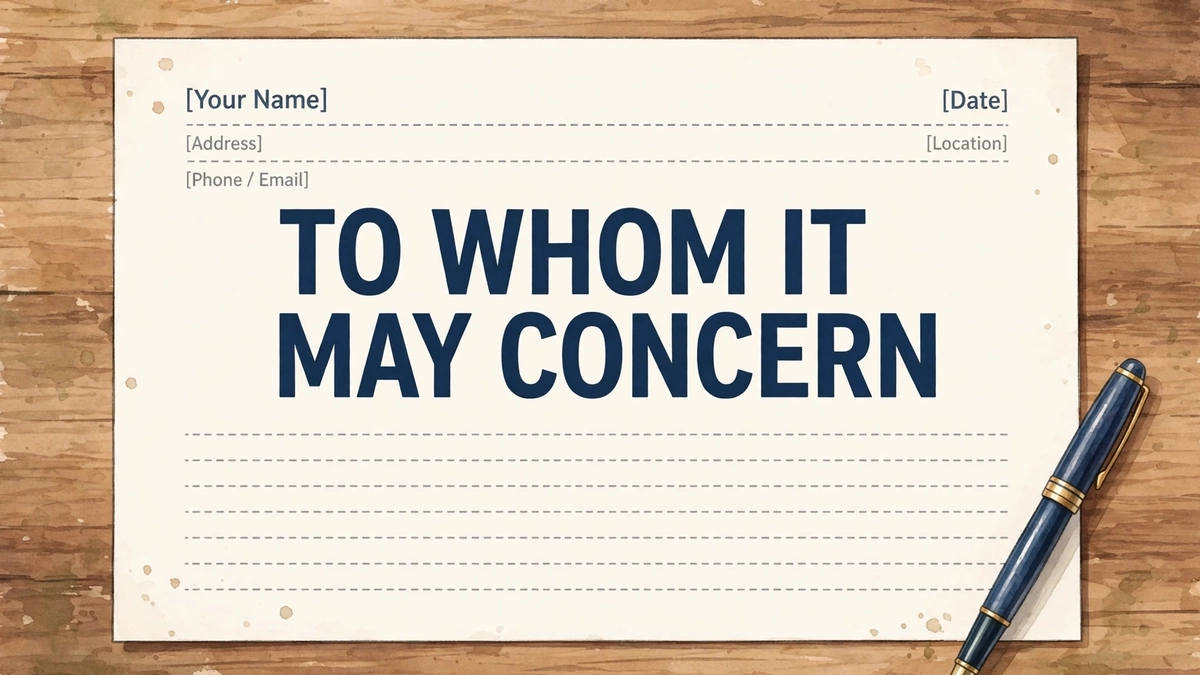
A “To Whom It May Concern” letter follows the standard full-block business letter format: everything aligned to the left margin, with a blank line between each part. The parts, in order, are:
- Sender’s address. Your name, street address, phone number, and email address at the top. If you are writing on company letterhead, the letterhead replaces this block.
- Date. The full date the letter is written, for example November 6, 2026. Write the month out in full; do not use a numeric-only date, which reads differently in different countries.
- Recipient’s address (if known). The organization’s name and mailing address, if you know them. If the recipient is genuinely unknown, leave this block out rather than guessing an address.
- Subject line (optional but helpful). A short line stating what the letter is about, for example “Subject: Employment verification — [Name], [Dates].” A clear subject helps an unknown reader route the letter to the right person.
- Salutation. “To Whom It May Concern:” on its own line, followed by a colon. Leave a blank line after it before the first paragraph.
- Introduction. One short paragraph stating who you are and why you are writing. Name the person, role, account, or matter the reader needs to recognize, so the letter is not a mystery after the first sentence.
- Body. One or two paragraphs with the facts: dates, roles, and one specific example or piece of evidence. State exact figures — dates, amounts, and reference numbers — precisely, the way any guide that gives exact measurements does, rather than rounding or approximating. Include only facts you can verify.
- Closing paragraph. State the action you are requesting, or explain how the reader can get more information, and give your contact details.
- Closing and signature. “Sincerely,” followed by a blank space for your handwritten signature on a printed letter, then your typed name and, if relevant, your title. For an email, use the same closing and a short signature block with your name and contact details.
Keep the letter to one page when you can. A general letter that runs long usually means the writer has included background the reader does not need. Short paragraphs, one idea each, and a clear request at the end will do more than a second page of extra detail.
Capitalization and punctuation rules
The rules for the greeting are short, and every one of them is easy to get wrong:
- Capitalize every word: “To Whom It May Concern” — the first letter of each word takes a capital. Writing it in lowercase (“to whom it may concern”) reads careless in a formal letter.
- Use “whom,” not “who”: the phrase is a fixed expression, and “whom” is the correct pronoun in it. “To Who It May Concern” is a common mistake.
- End with a colon, not a comma: in a formal U.S. business letter, the salutation takes a colon — “To Whom It May Concern:”. Purdue OWL’s punctuation guidance uses this exact greeting as its example of a colon after a business-letter salutation. A comma is the choice for informal letters and for most emails, but for a printed formal letter the colon is the convention.
- Do not bold or italicize the greeting: it sits on its own line in the same type as the rest of the letter.
- Do not add “Dear”: one greeting only.
The colon-versus-comma choice is the one people most often second-guess, and it is worth getting right because it is visible in the first line a reader sees. The same care with small marks pays off elsewhere in the letter, too: a colon introduces, while a semicolon joins — if you are unsure which mark a sentence needs, our guide to when to use a semicolon instead of a comma covers the two real jobs of the semicolon, with examples.
Two short example openings
These are templates, not letters to send as written. Replace every bracketed field with real facts, and delete any line that does not apply.
Example 1: a general reference
To Whom It May Concern:
I am pleased to recommend [Name], who worked with me as [role] at [Organization] from [start date] to [end date]. I supervised their work on [type of project], and I am writing to confirm their contribution and character for any future employer or institution that requests this reference.
Example 2: a formal request for verification
To Whom It May Concern:
I am writing to request written confirmation of [matter: for example, employment, tenancy, or enrolment] for [Name], who [was/is] [role or status] from [start date] to [end date]. Please send the confirmation to [address or email] by [date, if there is a deadline], and contact me at [phone or email] if any further information is needed.
In both examples, the first paragraph does the same job: it names the person and the matter in the first two sentences, so the reader never has to guess what the letter is about. The rest of the letter then supports that opening with one specific example or fact — a project, a result, a date — rather than general praise.
Common mistakes to avoid
- Using it for a job application when a name was available. The hiring manager’s name is often in the posting, on the company site, or one phone call away. A generic greeting on a cover letter reads as a mass mailing.
- Lowercase or wrong pronoun. “To whom it may concern,” and “To Who It May Concern” are both wrong in a formal letter.
- A comma instead of a colon. In a printed formal letter, the colon is the convention.
- Doubling the greeting. “Dear To Whom It May Concern” is two greetings stacked together. Pick one.
- Leaving placeholders in the final letter. Brackets, “[Name],” and sample contact details must all be replaced before sending. Read the finished letter once specifically to catch them.
- Padding the body. General praise without a fact behind it — “a great team player” with no example — tells the reader nothing. One verified example beats a paragraph of adjectives.
- Forgetting the request. A letter that explains a situation but never says what should happen next leaves the reader to guess. End with the action and your contact details.
Email or printed letter?
The greeting works the same in both, with two small differences. In an email, put the subject in the email subject field rather than as a line inside the message, and a comma after the greeting is acceptable, since email convention is less formal than a printed letter — though the colon still reads correctly and is the safer choice for a formal request. In a printed letter, keep the colon, leave room for a handwritten signature above your typed name, and print on plain, clean paper with no coloured fonts or decorative formatting.
If the letter is an attachment rather than the email itself, follow the recipient’s format and file requirements, and keep the same greeting and closing inside the attached document. The email that carries it should be short: one or two sentences saying what is attached and what you are asking for.
The bottom line
“To Whom It May Concern” is a correct, formal greeting for exactly one situation: a letter whose reader is genuinely unknown. Write it with every word capitalized and a colon at the end, place it on its own line in the standard business-letter format, state your purpose in the first paragraph, support it with verified facts, and close with a clear request and your contact details. And whenever a name, a role, or a department is available — “Dear Hiring Manager,” “Dear Search Committee,” “Dear Customer Support Team” — use that instead. The most professional greeting is the most specific one you can honestly write.