
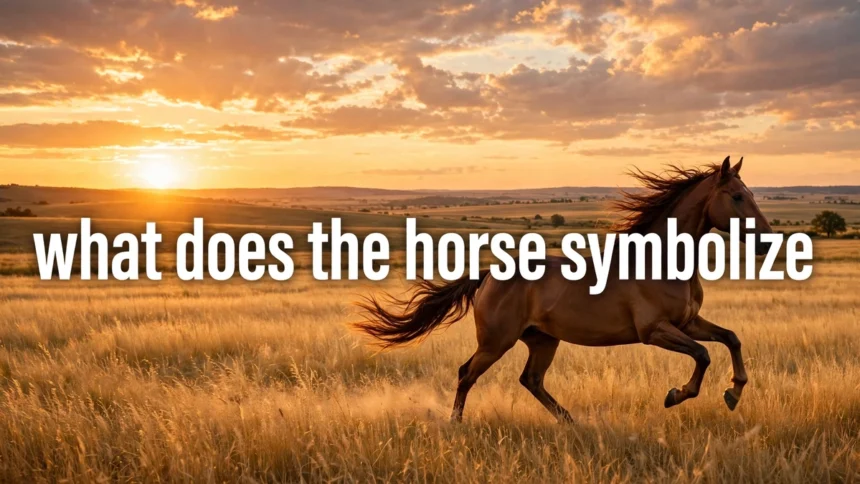
So what does the horse symbolize? In short: freedom, strength, loyalty, and spiritual guidance — with power and endurance close behind. Few animals carry as much meaning as the horse, and the reason is simple: for thousands of years, horses carried us. They pulled our ploughs and our chariots, carried our soldiers and our stories, and ran beside us in our myths. That long partnership is why the horse still feels like more than an animal — it feels like a picture of what we want to be: free, strong, and moving forward.
The short answer: freedom, strength, loyalty, and guidance
Across cultures, the same four meanings come up again and again. The horse means freedom, because nothing looks freer than a horse running with no fence in sight. It means strength and power, because for most of history a horse was the strongest engine anyone owned. It means loyalty, because a horse and rider learn to trust each other completely. And it means spiritual guidance, because in myth after myth the horse carries heroes — and souls — between worlds. Everything else the horse symbolizes grows out of those four roots.
Freedom and power: the wild horse and the war horse
The wild horse is the clearest picture of freedom there is. Mustangs roaming the open plains of North America live without boundaries and move as they please, and that image has become shorthand for an untamed spirit and personal independence. Before cars and trains, owning a horse meant something practical too: the ability to travel far, to leave, to choose where to go. A horse gave people independence in the most literal sense.
The same animal also meant power. Warriors rode horses into battle, kings prized the strongest horses as proof of wealth and status, and great empires — the Romans and the Mongols among them — expanded on horseback. Horses appear on coats of arms and royal crests as emblems of courage and nobility, and the connection survives in everyday language: we still measure engines in horsepower, and car makers still name their fastest machines after horses, from the Ford Mustang to the prancing horse of Ferrari.
Loyalty and partnership: the horse beside us
What makes the horse different from other symbols of power is that it is also a symbol of loyalty. A horse is not a machine; it is a partner. Riders talk about the bond with a horse — the trust that lets two creatures move as one — and that bond is why horses star in stories of devotion, from Black Beauty to War Horse. The horse does not just carry its rider; it chooses to stay beside them. That is why, in symbolism, the horse often stands for a faithful companion rather than brute force: strength that has agreed to be guided.
The spiritual horse: a messenger between worlds
In myth and folklore the horse is often a go-between, carrying souls, wisdom, and divine energy from one world to another. Horse symbolism is among the richest of any animal: the horse is linked to the sun and the moon, to life and to death, to water and to the wind, and it appears as a guide for heroes on every kind of journey. In many traditions, horses are seen as messengers between worlds, and in dreams a horse is read the same way — a strong, running horse taken as a sign of strength and progress, a calm horse as a sign of peace. These are traditions and interpretations, not facts, but they show how consistently people have trusted the horse as a guide.
What the horse’s color means
Like most symbols, the horse changes its message with its color:
- White: purity, victory, and enlightenment — the horse of heroes and of new beginnings.
- Black: mystery, death, and transformation — the horse of the unknown and of endings that lead somewhere new.
- Brown: steadiness, grounding, and reliability — the working horse, close to the earth.
- Chestnut: energy, passion, and warmth — the spirited horse, quick to move.
The color is never the whole meaning, but it sharpens it: the same animal can promise victory or warn of change, depending on the horse you picture.
Horses in myth, from Pegasus to Sleipnir
The myths agree on the horse even when they disagree about everything else. In Greek myth, Pegasus, the winged horse born from the blood of Medusa, helped the hero Bellerophon defeat the Chimera and became a constellation — a symbol of freedom, inspiration, and heroism, and of poetry itself. Poseidon, god of the sea, was also god of horses and was said to have created the first horse. In Hindu tradition, the horse-headed god Hayagriva stands for knowledge and learning, and seven horses pull the chariot of Surya, the sun god, across the sky each day. In Norse myth, Odin’s eight-legged horse Sleipnir was the fastest of all horses, able to travel between worlds, including the world of the dead. In Chinese culture the horse means speed, success, and ambition — the Tang dynasty prized horses as emblems of military strength — and people born in the Year of the Horse are traditionally described as loyal, vital, charming, and sociable. And the horse is old in our imagination: it is the most frequently painted animal in the cave paintings of Lascaux, made some 15,000 to 17,000 years ago, long before horses were domesticated.
The bottom line
The horse symbolizes freedom, strength, loyalty, and spiritual guidance — a creature that has carried us in the world and carried our stories beyond it. Whether you picture a wild mustang on an open plain, a white horse of victory, or Pegasus in the sky, the meaning holds: keep moving, stay loyal, and trust the strength that carries you. Small creatures carrying large meanings is a theme this site has touched before, in what do hummingbirds symbolize and what do bees represent — and the horse belongs in the same family, only larger, as does the blue jay with its own bold message.