
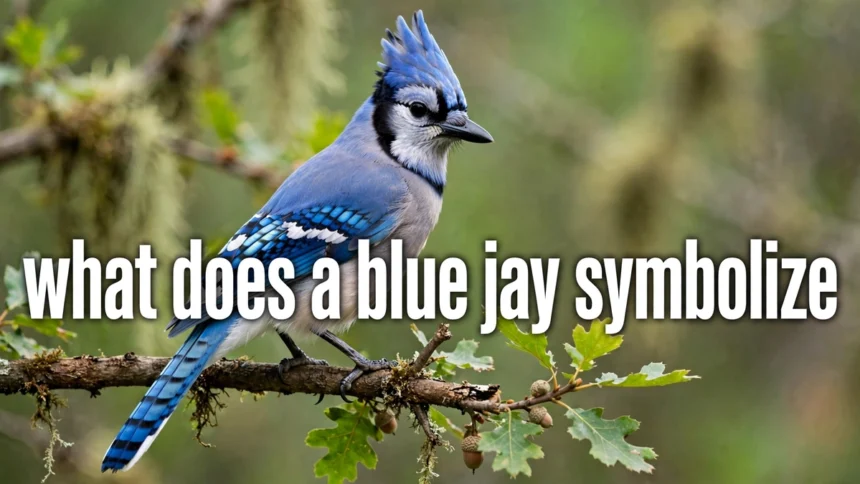
A blue jay announces itself. It is loud, bright, crest-raised, and unwilling to slip past unnoticed — and that personality is exactly why it collected so many meanings. So what does a blue jay symbolize? In most modern readings, the consistent answers are clear communication, intelligence, courage, and protection. But the older records tell a different story, and the gap between old and new is the most interesting thing about this bird. The real bird behind the symbol is worth knowing first.
The short answer: communication, courage, and protection
The most consistent modern meanings are communication and clarity. A blue jay is one of the noisiest birds in the North American woods: it calls, scolds, mimics hawk cries, and warns other birds of danger. That vocal, watchful life made it a natural symbol of speaking up, saying what is true, and staying alert. Three other meanings show up again and again:
- Intelligence and resourcefulness. Blue jays are corvids, relatives of crows and ravens, and they solve problems, remember where they hid food, and adapt to new places. They cache thousands of acorns each autumn, which also makes them planters of oak forests.
- Courage and protection. A blue jay will dive at a hawk, a cat, or a person who comes too close to its nest, despite the size difference. That fearlessness made it a symbol of standing your ground and defending family and territory.
- Loyalty and family bonds. Blue jays usually pair for life, stay in family groups through winter, and feed and guard their young together — a quieter meaning behind the loud exterior.
None of this is a fact about the future. It is symbolism — stories people have told about a striking bird. That distinction matters, because not every story about the blue jay is equally old.
The older story: a trickster and an errand-runner
Older American folklore gives the blue jay a much less flattering job. In Southern records from at least 1870 onward, the jaybird was said to carry sand to hell, and from 1889 that jays spend Fridays carrying sand or wood to the devil — which, the saying went, is why you never see one on a Friday. One Maryland record from 1899 has jays going as messengers to report backsliders, with the remark that heaven is no place for them.
Native American stories are more mixed, and more respectful. Among Ojibwe and other Algonquian-speaking peoples, the blue jay appears as a clever, sometimes mischievous figure — a watcher and boaster who uses wit to outsmart larger animals, and in some stories a helper who brings fire to humans. Writers from Thoreau, who called it “the bird of October,” to Emily Dickinson, who called it “a neighbor and a warrior too,” loved the same qualities: noise, nerve, and a refusal to be background.
The honest caution, from recent folklore research, is that many meanings repeated online today — a blue jay as a sign from heaven, a messenger of the dead, or an omen of letters, money, a birth, or a death — have no old printed record behind them. The earliest printed link with heaven dates to a 1993 spiritual guide, which gave the blue jay’s keynote as “the proper use of power.” Modern meanings can still be meaningful to the people who hold them, but they are modern, not ancient.
What a blue jay actually is
The blue jay (Cyanocitta cristata) is a songbird native to eastern and central North America, with bright blue, white, and black plumage, a prominent crest, and a black necklace across its throat. It lives in forests, parks, and suburbs, eats acorns, seeds, insects, and occasionally eggs or nestlings, and is famous for mimicry — it can imitate a red-tailed hawk’s scream well enough to scatter other birds from a feeder.
Its boldness has a practical root: a jay that warns loudly, mobs predators, and remembers thousands of hidden acorns survives better than a quiet one. That combination — tiny size beside a hawk, tireless noise, and fierce defence of the nest — is exactly why the bird became a symbol of speaking up and standing firm.

Seeing a blue jay: what people say it means
In plain terms, seeing a blue jay usually means you are in its range in a season when it is active, and it has noticed you before you noticed it. If you want more visits, offer peanuts in the shell and acorns at a platform feeder, keep a birdbath filled, and leave some oak trees standing — jays follow food, water, and cover, not messages.
The modern spiritual reading of a sighting is consistent: speak clearly, stay alert, and stand your ground. Repeated sightings, in that reading, are a prompt to examine your own voice — whether it is being suppressed, misused, or needs to be used. A single sighting, in older folk sayings, could mean good luck or coming rain. None of these readings predicts anything, and none should replace a real decision — they are stories, useful when they prompt reflection, not when they are treated as instructions.
And if you are out walking the dog when a blue jay scolds you from a branch, it is one more small outdoor character to notice — the same kind of everyday moment that makes a walk worth writing about, whether the walk ends at a garden or just around the block. Small birds carrying large meanings is a theme this site has touched before, in what do hummingbirds symbolize and what do bees represent — and the blue jay belongs in the same family: loud, clever, and easy to hear long before you see it. The older, darker folklore is worth remembering too, in what a ladybug landing on you means, where a small visitor also carried a story far bigger than itself.
The bottom line
A blue jay symbolizes clear communication, intelligence, courage, and protection in modern readings — and, in older folklore, a trickster and an errand-runner with a much darker job. The symbolism is worth enjoying, the bird is worth watching, and the best response is the simplest one: listen for the call, look up, and take the noise as a reminder to speak clearly and stand your ground.