
Someone at the table says it every time: your left palm itches, so money is on its way — or money is about to leave. Both versions are in circulation, and both are old. So what does it mean when your left palm itches? In folklore, the honest answer is that it depends on where you learned the saying. The most common English-language reading is that the left palm means money going out — but a large tradition says exactly the opposite, and the reason for the flip is part of the story.
The short answer: two opposite readings
The itchy-palm superstition is one of the oldest money omens in English-language folklore, with mentions traced back to at least the 16th century. Its core pattern is simple: one palm means money coming in, the other means money going out. Which palm is which, though, is where traditions divide:
- Most common English reading: left palm itching means money is going out — a bill, an unplanned purchase, or money lost in a transaction. Right palm itching means money is coming in.
- The flipped reading: in parts of Ireland, the Caribbean, and the American South, and in the saying “left to receive, right to give,” the left palm means money coming in — a debt repaid, a gift, or unexpected income — and the right means money going out.
Some traditions flip the meaning by gender instead of region (“right for a man, left for a woman”), which is why two people from the same town can swear by opposite versions. Neither reading is a fact about the future. They are folklore — stories people tell about an everyday sensation — and the fact that the story contradicts itself is a useful reminder not to plan your finances around an itch.
Why the meaning flips
The flip has a simple explanation: folk sayings travel by word of mouth, and “left receives, right gives” makes intuitive sense if you think of the left side of the body as receptive and the right as active. The opposite pairing makes equal sense if you think of the left hand as the spending hand (most people are right-handed, so the left hand holds the wallet or pays while the right does the work). Both metaphors are plausible, so both versions survived. Sayings travel the way games do — passed from person to person, changing slightly each time, as in two truths and a lie ideas, where a statement only matters because the group hears it together.
Folk tradition also adds rules for handling the omen. In some versions, scratching the itch is said to cancel the incoming fortune, while rubbing the palm on wood is said to seal in good luck (for a right palm) or block outgoing money (for a left palm). One version even gives the omen a deadline: folk tradition allows 24 to 48 hours for the money to arrive or leave, after which the omen is considered closed. These are charms, not advice — but they show how seriously people once took an itch.
What an itchy palm usually really means
In practice, an itchy palm almost always has a physical cause, and the common ones are easy to recognise:
- Dry skin. Hands are washed constantly, and dry skin itches — especially in winter or after frequent handwashing.
- Contact dermatitis. Palms touch everything, so they meet irritants daily: cleaning products, soaps, detergents, fragrances in lotions, and metals such as nickel from tools or handles.
- Hand eczema. Dyshidrotic eczema produces small, intensely itchy blisters on the palms and the sides of the fingers, and it is one of the most common causes of persistent palm itching.
- Nerve irritation. Carpal tunnel syndrome, pressure on the median nerve in the wrist, can cause itching, tingling, and numbness in the palm.
Persistent, unexplained itching that does not respond to moisturiser, or itching accompanied by yellowing skin, blisters, or swelling, is worth showing to a clinician rather than reading as an omen. This article makes no medical diagnosis; it simply notes that skin and nerve causes explain the overwhelming majority of itchy palms.
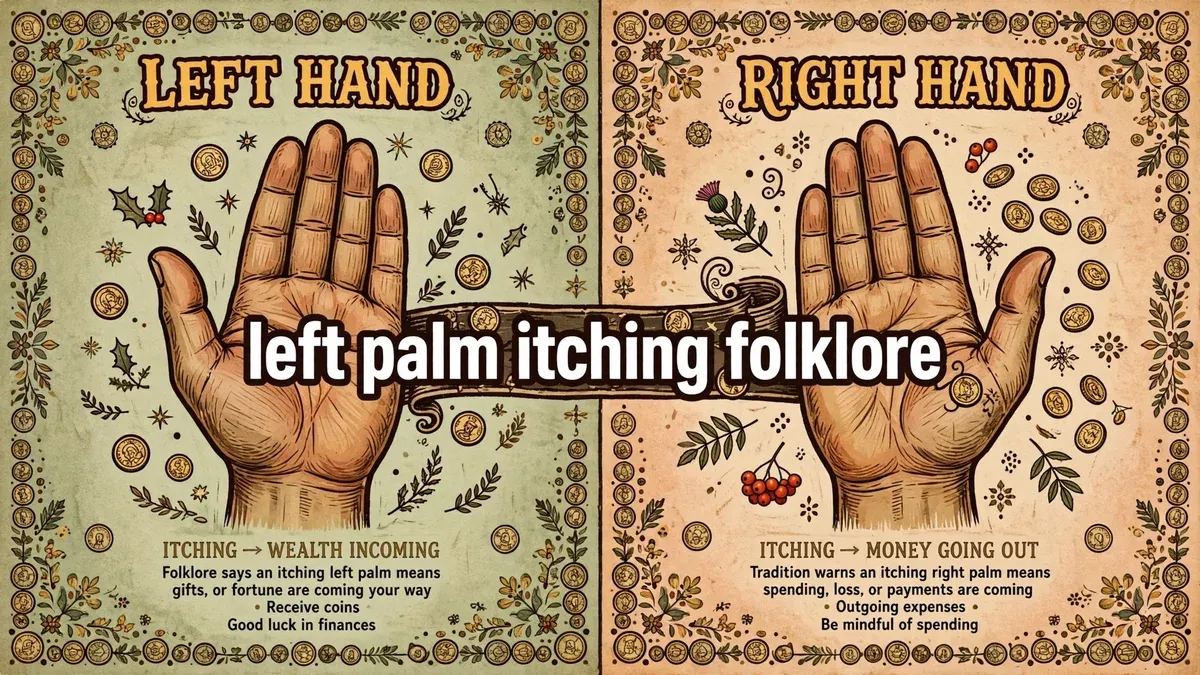
Left palm vs right palm at a glance
The two palms are a pair in every version of the saying, so it helps to see them together:
- Left palm, common reading: money going out — bills, spending, unplanned costs.
- Left palm, flipped reading: money coming in — a repaid debt, a gift, unexpected income.
- Right palm, common reading: money coming in.
- Right palm, flipped reading: money going out.
If your family says the opposite of what your neighbours say, both of you are following a real tradition. The saying’s history is a patchwork, not a single rule, and that is true of much folklore: small everyday signs carrying large meanings is a theme this site has touched before, in what a ladybug landing on you means and what do hummingbirds symbolize — and an itchy palm belongs in the same family, a sensation people noticed and then storied.
The bottom line
In folklore, an itchy left palm most commonly means money going out — but a large tradition says it means money coming in, and the flip depends on region and family custom. In reality, it usually means dry skin, an irritant, eczema, or a nerve issue. Enjoy the saying if you like it; check your hands, not your horoscope, if the itch stays.