
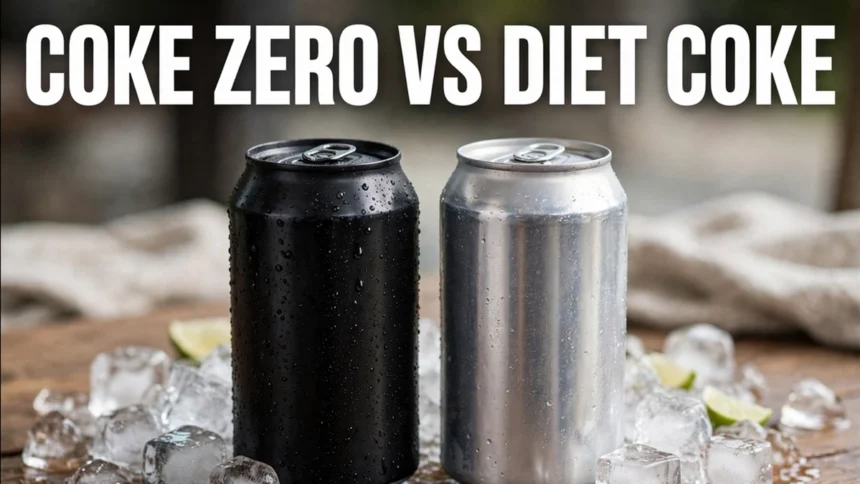
Standing in the drinks aisle with two sugar-free colas in front of you, it is fair to ask what actually separates them. The short answer to coke zero vs diet coke is that they are close cousins, not twins: both have zero calories and zero sugar, but Coke Zero is sweetened with a blend of aspartame and acesulfame potassium and is designed to taste like classic Coca-Cola, while Diet Coke is sweetened primarily with aspartame and has its own lighter, crisper flavour. Coke Zero also contains less caffeine per can.
At a glance
| Coke Zero (Coca-Cola Zero Sugar) | Diet Coke | |
|---|---|---|
| Calories / sugar | 0 / 0g | 0 / 0g |
| Sweeteners | Aspartame and acesulfame potassium (Ace-K) | Primarily aspartame |
| Caffeine (12 oz / 355 ml can) | 34 mg | 46 mg |
| Taste | Designed to taste like classic Coca-Cola | Distinct, lighter, crisper flavour |
| Launched | 2005 (as Coke Zero; later Coca-Cola Zero Sugar) | 1982 |
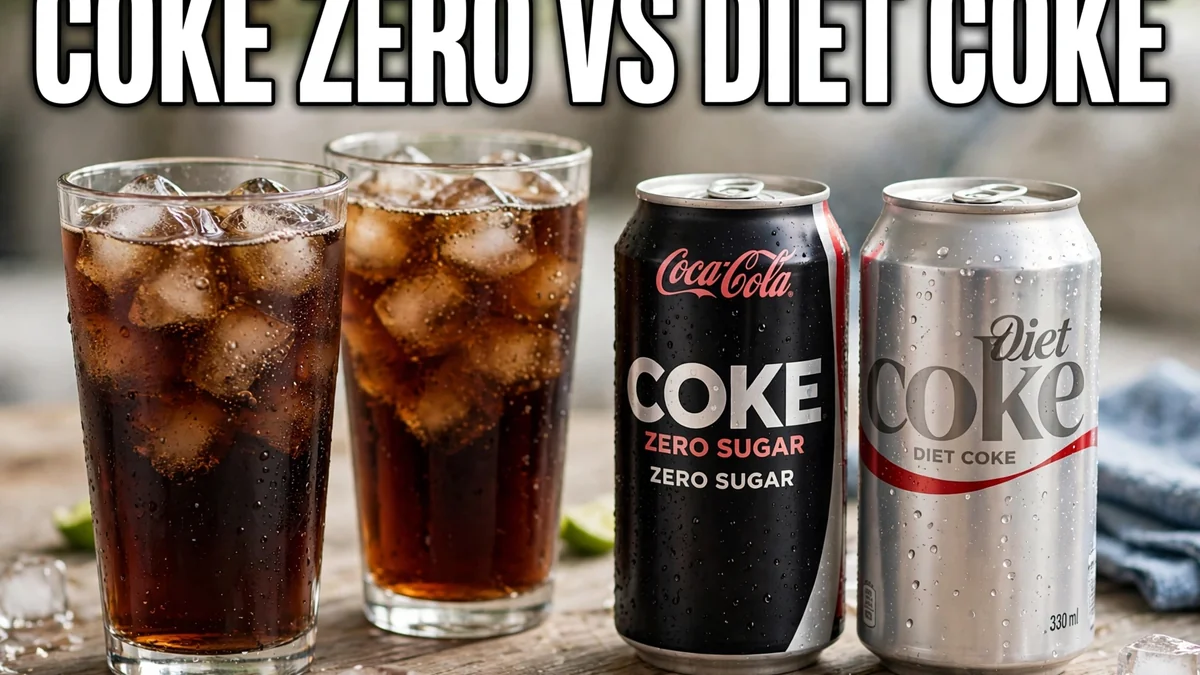
| Can | Black | Silver |
Taste: the difference you notice first
Taste is the main reason people choose one over the other. Coke Zero was formulated to taste as close to regular Coca-Cola as possible without sugar, and most tasters describe it as sweeter and richer. Diet Coke was designed as its own drink rather than a copy of classic Coke, so it tastes lighter and crisper, with some people noticing a slight citrus note. Neither tastes exactly like original Coca-Cola, and the same drink can taste slightly different from a fountain, a can or a bottle. If you want the closest thing to regular Coke without sugar, Coke Zero is the likelier pick; if you have always liked Diet Coke’s own flavour, there is no reason to switch. Choosing between drinks is a matter of taste first, much as picking a brew comes down to what you enjoy drinking, as explored in different types of coffee, explained.
Sweeteners: the real formula difference
Both drinks are sweetened without sugar, but the recipes differ. Coke Zero uses two calorie-free sweeteners together — aspartame and acesulfame potassium — and that blend is what lets it mimic classic Coke’s sweetness. Coca-Cola Zero Sugar is the current name for the drink originally launched as Coke Zero. Diet Coke, by contrast, uses aspartame as its primary sweetener, which gives it its distinct flavour; Diet Coke also comes in flavoured varieties and a version made with sucralose. Using two sweeteners together lets manufacturers use less of each while keeping the same sweetness, which is one reason the two drinks can taste different despite sharing most ingredients: carbonated water, caramel colour, phosphoric acid, natural flavours and caffeine.
Caffeine and nutrition
Nutritionally the two are nearly identical: zero calories, zero fat, zero carbohydrates, zero sugars and zero protein, with 40 mg of sodium per 12 oz can in both. The one clear gap is caffeine — 34 mg in Coke Zero against 46 mg in Diet Coke per 12 oz can. Both are well below the 400 mg daily caffeine limit for adults often cited by food regulators, so a single can of either is a small fraction of that limit; the gap only matters if you drink several cans a day or are sensitive to caffeine. Keeping track of caffeine across drinks takes the same care as measuring it in your morning brew, as covered in how much ground coffee per cup.
Both drinks contain phenylalanine (from aspartame), so people with phenylketonuria (PKU) should avoid both. Caffeine-free versions of both drinks are also available.
A short history
Diet Coke arrived first, launching in 1982 as Coca-Cola’s sugar-free option with its own identity, silver can and lighter taste. Coke Zero followed in 2005, in a black can, aimed at drinkers who wanted Coca-Cola’s flavour without sugar — and at an audience the “diet” label had not reached. It was later reformulated and rebranded as Coca-Cola Zero Sugar, with Coca-Cola saying the newer recipe has more real Coca-Cola flavour, still without sugar. The black-versus-silver packaging itself tells the marketing story: silver and light for Diet Coke, black and bold for Coke Zero.
Are the sweeteners safe?
This is where the debate lives, so it is worth stating what the sources actually say. Aspartame and acesulfame potassium are both approved food additives, and regulators such as the US Food and Drug Administration consider aspartame safe at current intake levels. At the same time, the World Health Organization’s cancer research arm has classified aspartame as “possibly carcinogenic to humans,” a classification that has itself been contested and that does not amount to proof of harm at normal intakes. Some people report headaches from aspartame, and longer-term, high-quality human studies are still called for. The honest summary is that both drinks are considered safe in moderation by regulators, that the evidence is debated rather than settled, and that anyone who prefers to avoid non-nutritive sweeteners altogether can choose sparkling water, flavoured water or kombucha instead.
Which should you choose?
Choose Coke Zero if you want the closest sugar-free match to classic Coca-Cola’s flavour and a little less caffeine. Choose Diet Coke if you prefer its lighter, crisper taste, or if it is simply the flavour you grew up with. There is no meaningful nutritional reason to prefer one over the other — the choice is taste, caffeine and habit. Cold drinks are also a matter of occasion: a chilled can on a hot day is a different pleasure from a hot brew, much like a frozen treat on a summer afternoon, as with frozen pupsicles for Gus.
The bottom line
Coke Zero and Diet Coke are both sugar-free, calorie-free colas, but they are not the same drink. Coke Zero blends aspartame with acesulfame potassium, has less caffeine, and aims at classic Coke’s flavour; Diet Coke leans on aspartame alone, has more caffeine, and tastes like itself. Try both cold, side by side, and let taste decide — that is the only test that settles this one.