

A café menu can feel like jargon: arabica or robusta, light or dark roast, pour-over or cold brew, flat white or cortado. Those are not four ways of saying the same thing — they are four separate layers, and every cup combines them. Once you can tell them apart, different types of coffee stop feeling like a secret code and start feeling like a menu you can use.
The four layers at a glance
| Layer | What it decides | Examples |
|---|---|---|
| Bean species | The raw character: flavour, body, caffeine strength | Arabica, robusta, liberica, excelsa |
| Roast level | How far the bean is roasted | Light, medium, dark |
| Brew method | How water meets the ground coffee | Espresso, pour-over, French press, cold brew |
| Finished drink | What is added afterwards, usually milk, water, or both | Latte, cappuccino, Americano, mocha |
Change any one layer and the cup changes. That is why café menus look so long.
Layer 1: The bean species
Coffee comes from the roasted seeds of the coffee plant, and the species is the first thing shaping your cup.
Arabica is the most widely grown and the most common in cafés: smoother and more aromatic, with flavours from fruity and floral to nutty and chocolatey.
Robusta is hardier, higher in caffeine, and stronger tasting, with a heavier body and a bitter, earthy edge. It is common in espresso blends, where it adds body and a thick crema.
Liberica is far less common, with larger beans and a woody, smoky, or floral flavour, grown mainly in Southeast Asia and West Africa. Excelsa, now classed as a liberica variety, adds tart, fruity complexity to blends. You will mostly meet these two only if you go looking for them.
In short: arabica usually means smoother and more varied; robusta means stronger and heavier. Blends mix the two to balance flavour, body, and cost.
Layer 2: The roast level
Roasting cooks the green bean until it develops flavour, and how far it goes matters a great deal.
Light roast keeps more of the bean’s original character: brighter, more acidic, with clearer fruity or floral notes. It suits gentle methods such as pour-over.
Medium roast is the middle ground: more body and sweetness than light roast, with some origin character still present. It is the most versatile roast, working across drip, pour-over, and French press.
Dark roast gives a bolder, heavier cup with smoky, chocolatey, or caramel notes and less origin character. It is common for espresso, where its boldness stands up to milk.
Note: a darker roast does not mean more caffeine. The difference is small; species and amount used matter far more.
Layer 3: The brew method
The brew method is how water extracts flavour from ground coffee, shaping body, clarity, and strength.
Espresso forces hot water through finely ground coffee under pressure, producing a small, concentrated shot topped with crema. It is the base for most café milk drinks, and also drunk on its own. Espresso is a method, not a bean or a roast — any bean can be made into espresso, though dark roasts are usual.
Pour-over drips hot water slowly through coffee in a paper filter, giving a clean, clear cup that shows off finer flavours. The equipment is simple and cheap, but it needs a little more attention than pushing a button.
French press steeps coarse grounds in hot water, then separates them with a mesh plunger. With no paper filter, more oils stay in the cup, giving a fuller, heavier body. It is forgiving, cheap, and suits medium and dark roasts.
Cold brew steeps coarse grounds in cool water for many hours, usually overnight, producing a smooth, naturally sweet cup with low acidity. It is not iced coffee — hot coffee cooled down — since cold brew is never heated.
Method is partly about taste and partly about routine. A pour-over suits a slow morning, much like planning to take your dog to work day suits a day when you can give the routine extra attention — while a French press, or cold brew made the night before, suits a morning when you need coffee ready with no fuss.
Layer 4: The finished drinks
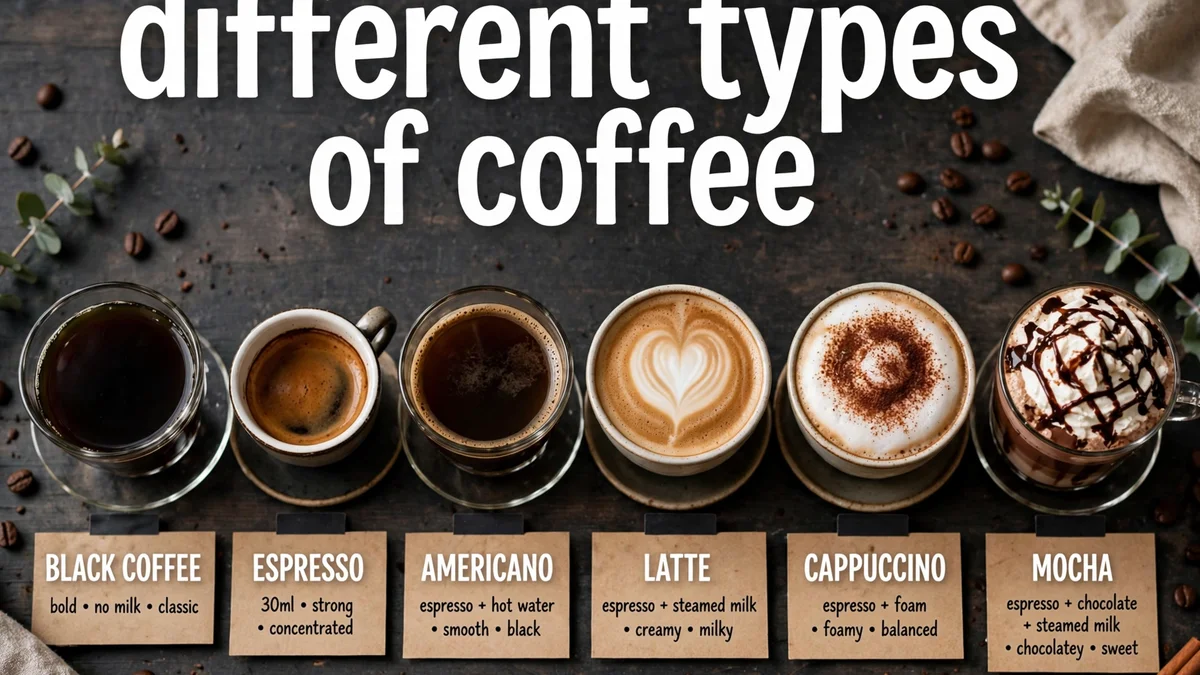
Most café drinks start with espresso and differ only in what is added. Learn the ratios and the menu shrinks to a handful of patterns.
Espresso is the starting point: a single or double shot, drunk as it is. A double shot is the base for most drinks below.
Americano is espresso diluted with hot water, roughly one part espresso to two parts water — a longer, filter-like drink without espresso’s intensity.
Latte is espresso with plenty of steamed milk and only a thin layer of foam — roughly one part espresso to three parts milk. It is mild, creamy, and the easiest milk drink for a newcomer.
Cappuccino uses roughly equal thirds — espresso, steamed milk, and foam — making it stronger and less milky than a latte, often dusted with cocoa or cinnamon.
Flat white is a double shot with a smaller amount of velvety steamed milk and very little foam — more coffee-forward than a latte.
Mocha is a latte with chocolate added — espresso, steamed milk, and chocolate syrup or cocoa, sometimes topped with whipped cream. It is the sweetest standard milk drink.
Cortado is equal parts espresso and warm milk, served small, usually in a glass — strong, smooth, and short, between a straight espresso and a milky latte.
Macchiato is an espresso “marked” with a small dollop of foam — barely a milk drink, for someone who wants to soften espresso’s edge without turning it milky. Note: a chain caramel macchiato is a different, much sweeter drink — a vanilla latte with caramel drizzle — not the traditional version.
Cold brew, as a finished drink, is served over ice, sometimes with milk or water. It keeps well in the fridge for a few days, so it is practical to brew in a batch.
Affogato is dessert, not a morning drink: vanilla ice cream or gelato “drowned” with a shot of hot espresso. The hot-cold contrast is the point; eat it straight away, with a spoon.
How to choose
Work backwards from what you like. If you like black coffee, try a pour-over or an Americano first; if you like milky drinks, start with a latte and move towards a flat white or cappuccino as you want more coffee flavour. If you like sweet drinks, a mocha is safer than a flavoured syrup drink, because you can still taste the coffee underneath.
Then change one layer at a time: the same drink with a different roast, or the same bean through a different method, and notice what changes. That is how you learn your own taste. Learning a new drink takes the same steady commitment as deciding to become a dog sitter — start with one method, get comfortable, then add another.
Coffee also makes a simple treat to share, but keep café treats for people. For a four-legged friend, valentines day gifts for your dog are safer than anything from a café menu, since chocolate and caffeine are not for dogs.
The bottom line
Menus look complicated because they combine four choices — bean, roast, brew method, and finished drink — into one list. Separate the layers and learn the standard ratios, and the menu becomes manageable: a latte is espresso plus plenty of steamed milk, a cappuccino is equal thirds, an Americano is espresso plus hot water, and cold brew is coffee steeped slowly in cold water.
Start with the drink matching what you already like, change one layer at a time, and you will find your usual order quickly — and know how to ask for it anywhere.