
So what does feather representation actually mean? In short: freedom, truth, and a message from beyond — the lightest object in nature carrying some of the heaviest meanings we have. A feather is what a bird leaves behind when it rises into the sky, so it is no surprise that people in nearly every culture have read it as a bridge: between earth and sky, between the human and the divine, between what is here and what is gone. Its exact message depends on the bird it came from and the color it carries, but the core is always the same: something weightless, carrying weight.
The short answer: freedom, truth, and messages from the divine
Feathers represent three things above all. They represent freedom, because they belong to flight — the one movement no fence can stop. They represent truth, because in the oldest story of all, a feather was the measure against which a human heart was weighed. And they represent messages from the divine, because a feather found unexpectedly, in a place where no feather should be, has been read for centuries as a sign that someone, somewhere, is watching over you. Everything else the feather means grows out of those three roots.
Freedom: the soul’s journey upward
The feather’s first meaning is the simplest: freedom. Birds soar without restriction, and the feather is the part of the bird that makes flight possible — light, strong, and built for the air. In tradition, finding a feather is read as a reminder to rise above earthly limits, to let go of what is heavy, and to trust that there is more above than below. Feathers are tied to the element of air, and to breath and life force, which is why they so often stand for the soul itself: the part of us that, like a feather on the wind, is not bound to the ground. In many spiritual traditions the feather is a picture of transcendence — the soul’s journey to higher ground, and the limitless potential that journey implies.
Truth: the feather of Ma’at
The oldest feather story comes from ancient Egypt, where the goddess Ma’at personified truth, justice, and cosmic order — and her symbol was an ostrich feather. In the Egyptian afterlife, the heart of the dead was weighed against that feather: if the heart balanced, the soul passed on; if it was heavier than the feather, it did not. A feather, the lightest of things, was the standard for a life. That image has lasted for thousands of years because it is so plain: truth is light, and a life lived well should balance against it. The feather of Ma’at is why feathers still stand for truth, justice, and moral balance in symbolism today.
Honor: eagle feathers and sacred trust
In many Indigenous cultures of North America, feathers are sacred objects, not ornaments — and none more so than the eagle feather. The eagle flies closest to the Creator, so its feather is understood as carrying a direct connection to the divine. Warriors who showed courage and leadership were awarded eagle feathers as marks of honor, and owning one was a sign of spiritual status, wisdom, and bravery. Feathers were worn in headdresses during ceremonies, used in prayer sticks and totems, and fanned in smudging rituals to purify spaces. The key point, and one worth respecting, is that these feathers were earned and treated as sacred — a gift and a responsibility, not a decoration.
Messages from the divine: angels, ancestors, and white feathers
In many traditions, a feather found unexpectedly is read as a message — from angels, from ancestors, or from a loved one who has passed. White feathers carry this meaning most strongly: they are often taken as a sign of angelic presence, comfort, and reassurance, especially after prayer or in a hard season. A feather found during a difficult time is read as “you are watched over”; one found after thinking of someone lost is read as “they are at peace.” These are beliefs, not facts, and they belong to the people who hold them — but they explain why a small white feather on a path can stop someone in their tracks. The feather, in this reading, is not a coincidence. It is a letter, delivered without a stamp.
What each type of feather means
The bird matters as much as the feather. In tradition, each type carries its own message:
- Eagle: spiritual connection, focus, bravery, and prestige — the highest honor.
- Owl: wisdom, introspection, and change — the ability to see what is hidden.
- Peacock: renewal, vision, and integrity — rebirth and the recognition of the divine in all things.
- Dove: peace, gentleness, and new beginnings — the Holy Spirit in Christian tradition.
- Raven: magic, healing, and protection — transformation and the embracing of all parts of the self.
A feather itself is a remarkable piece of engineering — a central shaft with barbs that zip together into a surface light enough to fly on and strong enough to steer with — and that structure is part of its symbolism: many small parts, working together, holding up something larger than themselves.
What each feather color means
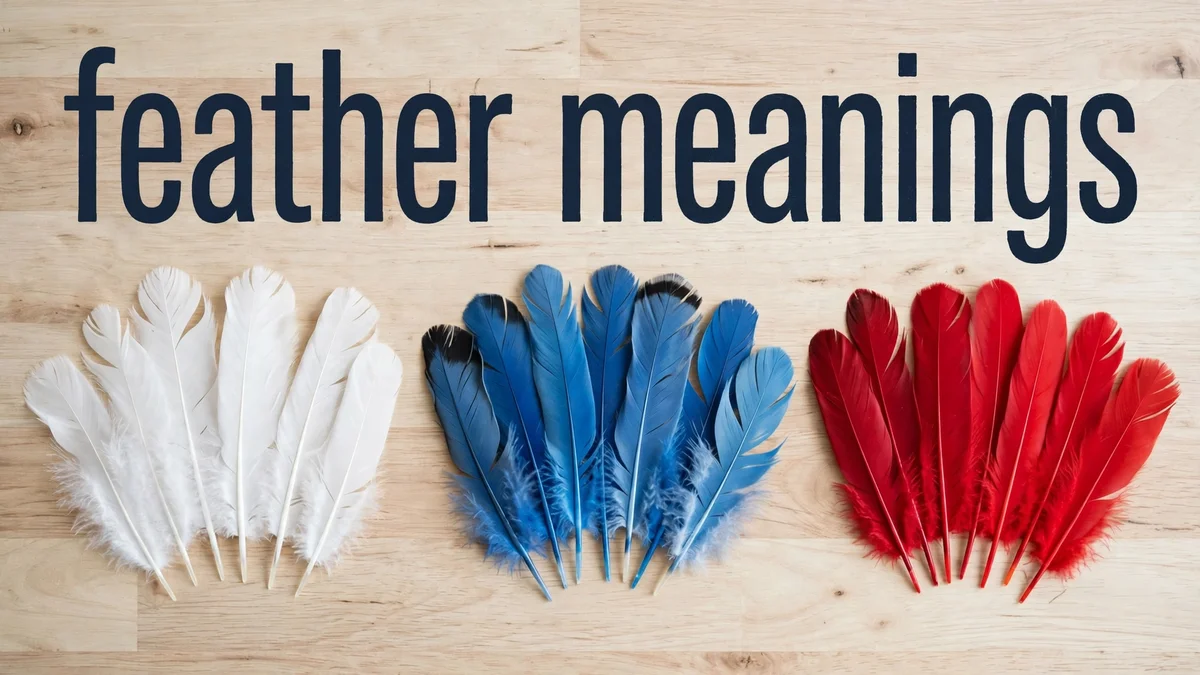
Color adds another layer, and the traditional meanings are consistent across most guides:
- White: purity, peace, and angelic presence — the most common sign of comfort and guidance.
- Black: protection, mystery, and transformation — a call to release fear and embrace change.
- Blue: calm, clarity, and communication — inner peace and intuition.
- Red: vitality, passion, and courage — aligning with your purpose and embracing life fully.
- Green: growth, healing, and abundance — expanding your gifts and welcoming what is good.
- Yellow: joy, optimism, and intellect — sunshine, curiosity, and mental clarity.
If you find a feather, tradition says to notice both its color and its bird: the two together are the message.
A practical note: look, don’t keep
One honest, practical warning belongs here. In the United States, the Migratory Bird Treaty Act makes it illegal to possess feathers from most native birds — including common ones like blue jays and hawks — even feathers found on the ground. The law protects the birds, not the feathers, and it applies whether or not you meant any harm. So admire a found feather, photograph it if you like, and leave it where it lies. The meaning travels with you; the feather itself belongs to the wild.
The bottom line
Feathers represent freedom, truth, and messages from the divine — from the feather of Ma’at weighing a heart against truth, to the eagle feather marking honor, to the white feather found on a hard day and read as comfort. Light as air, they carry the heaviest meanings we have: rise above, tell the truth, and know you are watched over. Birds and their signs are a thread that runs through this site — the blue jay with its bold message, the owl with its quiet wisdom, and the small ladybug whose landing is read as luck — and the feather belongs beside them all, as the lightest sign of the largest ideas.