
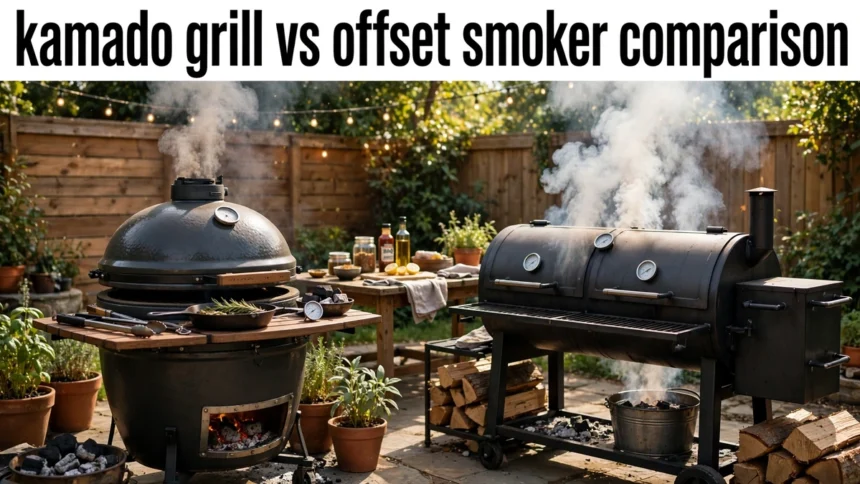
This kamado grill vs offset smoker comparison starts with a simple point: neither cooker is better in every way. A kamado is a controlled, versatile cooker that holds heat well. An offset smoker is a hands-on, traditional cooker built around wood smoke and large cooks. The right choice depends on how much time you want to spend tending a fire, how many people you usually cook for, and how much space you have.
How each cooker works
A kamado is a thick-walled, egg-shaped ceramic cooker. You control temperature mainly with vents at the bottom and top: open them a little for a low, slow smoke, open them more for high-heat grilling. That sealed ceramic body is why it holds a steady temperature for a long time once it settles.
An offset smoker has two parts: a smaller firebox on one side and a larger cooking chamber beside it. Heat and smoke from the firebox travel through the cooking chamber and out the chimney. That separation is the point — the food cooks indirectly, in moving wood smoke, rather than sitting over the fire.
The kamado’s ceramic-cooker design has a long history, and the barbecue grill overview describes how ceramic cookers retain heat and moisture and work for grilling, smoking and barbecuing. The offset design, by contrast, is built for one job done in the traditional way: low-and-slow smoking over a live wood fire.
The comparison at a glance
The figures below are approximate ranges from published comparisons, not measurements from testing done for this article. Prices vary widely by size, material and brand, so treat them as starting points for shopping, not as fixed prices.
| Kamado grill | Offset smoker | |
| Heat on one charcoal load | About 12–24 hours | Needs fuel every 2–3 hours |
| Typical cook size | About 15–20 pounds of meat in most models | 50+ pounds in larger models |
| High-heat cooking | Reaches 700°F+ for pizza and searing | Around 350–400°F at the top end |
| Entry price range in comparisons | Around $300 for entry models | Around $800–$1,200 for quality models |
If you read only one row, read the first one. It tells you how the two cookers will feel on a real cook day: one mostly looks after itself, the other asks you to stay involved.
Heat management and fuel use
Heat control is where the two designs diverge most. A kamado’s insulation does much of the work. Once the vents are set and the temperature is stable, it needs little attention, which makes long overnight cooks far less demanding. It also uses fuel efficiently, because less heat escapes through the walls.
An offset smoker gives you more direct control over smoke flavour, because you choose the wood and feed the fire through the cook. That control comes with a cost in attention: you will be checking the fire, adding fuel and adjusting airflow far more often. If you enjoy tending a fire, that is part of the pleasure. If you want to set a cook going and get on with your day, it can feel like a chore.
Cooking capacity: who are you cooking for?
Capacity should follow your normal guest list, not your biggest party of the year. Most kamado grills suit a family meal comfortably, with room for a main cut and sides, but they fill up quickly when you cook for a crowd. You can add tiered racks, but you cannot change the basic footprint.
Offset smokers are built for volume. Their long cooking chamber suits several racks of ribs, a large brisket and shoulders at once, which is why they suit gatherings, competitions and anyone who cooks in bulk. The trade-off is that you are heating and managing a large cooker even when you only want a small cook.
Temperature range and versatility
A kamado is the more versatile cooker of the two. The same unit can smoke low and slow, roast, grill steaks at high heat and bake pizza, simply by changing the vent settings and setup. That range makes it a good choice if you want one backyard cooker rather than several.
An offset smoker is more specialised. It excels at low-and-slow smoking between low and moderate temperatures, and some models have a grill grate over the firebox, but it is not designed as a high-heat grill or an oven in the same way. If smoking is the main thing you want to do, that focus is a strength. If you want one cooker to do everything, it is a limitation.
Learning curve and the day itself
A kamado takes practice at first — learning how small vent changes affect temperature, and how to arrange charcoal — but once you understand it, it becomes close to set-and-forget for steady cooks. That makes it the easier first smoker for most beginners.
An offset smoker teaches fire management from the start: building and maintaining a clean fire, reading smoke, and adjusting for wind and weather. That learning curve is steeper, and a long cook becomes a full outdoor day in the best sense, much like Gus swims on a summer afternoon — unhurried, outside, and better for not rushing it. Buy an offset because you want that kind of day, not just because you want smoked food.
Space, build and upkeep
A kamado fits a patio or a smaller garden well, but it is heavy, and ceramic needs care: avoid hard knocks and sudden temperature shocks, and protect it with a cover. Day-to-day upkeep is light — mainly ash removal and occasional gasket replacement.
An offset smoker needs real space, including clearance to work both ends safely, and a spot where it can stay put. Steel models need rust prevention, especially cheaper thin-steel versions, and the cooking chamber benefits from seasoning and a protective coating. A smoker is a stay-at-home commitment, quite unlike the kind of day out described in our trip to San Francisco — you plan around it, you do not take it with you.
Cost: what to budget for
Published comparisons put entry-level kamado grills at around $300, with premium models costing considerably more, while quality offset smokers start at around $800–$1,200, with professional-grade units higher again. Do not judge either type by its cheapest version alone: thin steel on an offset hurts heat retention, and a kamado’s value lies in its ceramic build and seals.
Running costs differ too. A kamado uses less charcoal per cook, so fuel lasts longer. An offset uses more fuel, but gives you freedom to experiment with different woods through the cook. Over a season of regular cooking, that fuel difference is worth factoring in alongside the purchase price.
Which one should you choose?
Choose a kamado if you want one versatile cooker, steadier temperatures with less tending, better fuel efficiency, and high-heat cooking as well as smoking — especially if your space is limited and you usually cook for a family rather than a crowd.
Choose an offset smoker if you want traditional wood-smoke flavour above all, regularly cook for large groups, enjoy managing a live fire, and have the space to keep a large cooker permanently set up.
If you are still torn, ask yourself one practical question: on a long cook, do you want to be free to do other things, or do you want the fire to be the activity? Your honest answer to that question will usually pick the cooker for you.
Questions people ask
Can a kamado replace an offset smoker?
For most home cooks, yes — a kamado smokes well, grills, roasts and bakes, and needs less attention. It will not match an offset for very large cooks or for the same hands-on wood-fire experience.
Do offset smokers make better-tasting barbecue?
Both can make excellent barbecue. Offsets give you more control over smoke intensity and wood choice through the cook, which many pitmasters prefer. A kamado’s flavour is still strong, just produced with less fire-tending.
Which is better for a beginner?
A kamado is generally easier to learn, because its heat retention forgives small mistakes. An offset is better for a beginner who specifically wants to learn traditional fire management and does not mind a steeper start.
Final thought
There is no losing choice here, only a mismatch to avoid: a kamado bought for huge crowd cooks will feel small, and an offset bought for quick weeknight meals will feel like too much work. Match the cooker to how you actually cook — and to how you actually spend a cook day — and either one will reward you. After a long cook, something cold and simple to finish with is always welcome, and that is exactly why pupsicles have earned their place on hot days: good food, outside, without fuss.