
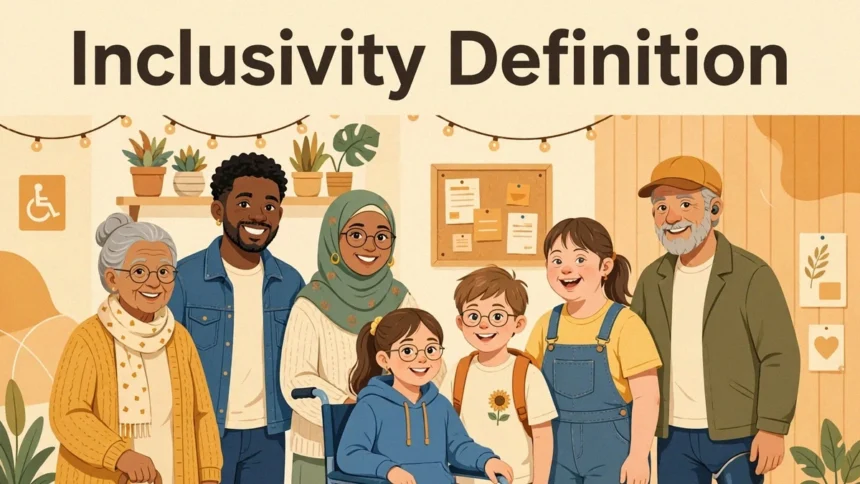
inclusivity definition: inclusivity is the practice or policy of including everyone fairly, so that nobody is left out because of their background, identity, or abilities. It is the idea that everyone should have the same chance to take part, be heard, and belong — whether at work, at school, or in the wider community. Inclusivity is not just about opening the door; it is about making sure everyone who comes through it feels welcome once they are inside.
What Does Inclusivity Mean?
Inclusivity defined simply means not excluding people. The Oxford Advanced Learner’s Dictionary defines it as “the fact or policy of providing equal opportunities and resources for people who might otherwise not get them, for example people who are disabled or belong to minority groups.” In plain terms, it is the habit of asking who might be left out — and then changing things so they are not.
The word comes from “inclusive,” which means including everyone, and it is closely related to social inclusion — the process of making sure people are not shut out of everyday life. Inclusivity is the attitude and the practice behind that process: it is what a school, a workplace, or a community does, day after day, to keep its doors genuinely open.
Inclusivity is also a mindset, not a single action. A place can be inclusive on paper and still leave people feeling unwelcome if nobody listens to them or takes their needs seriously. Real inclusivity shows up in small, everyday decisions: who gets invited, whose voice is heard in a meeting, and whether the rules work for everyone or only for some.
Inclusivity vs Diversity
Inclusivity and diversity are often used together, but they mean different things. Diversity is about who is present — a mix of people with different backgrounds, ages, abilities, cultures, and beliefs. Inclusivity is about how those people are treated once they are there.
A simple way to keep them apart:
| Diversity | Inclusivity | |
|---|---|---|
| What it describes | Who is in the room | How people in the room are treated |
| The question it asks | Is everyone represented? | Does everyone belong and get a fair chance? |
| What it looks like | A mixed group of people | A group where every person is heard and valued |
| What it needs | Recruitment and representation | Everyday habits, rules, and attitudes |
A team can be diverse without being inclusive — for example, if people from different backgrounds are hired but their ideas are never taken seriously. And a small group can be inclusive without being very diverse, if it welcomes whoever joins and treats them fairly. The two ideas work best together: diversity brings different people in, and inclusivity makes sure they can all take part.
Inclusivity vs Inclusion
Inclusivity and inclusion are close cousins, and the Oxford dictionary lists inclusion as a synonym of inclusivity. The difference is mostly one of emphasis. Inclusion is the act of being included — the result. Inclusivity is the quality, policy, or ongoing practice that produces that result.
Think of it this way: inclusion is the door being open; inclusivity is the habit of keeping it open, checking who is still outside, and widening the doorway when someone cannot get through. Like the principal vs principle pair, the two words look close but do different jobs — one names the outcome, the other names the way of working that gets you there.
What Inclusivity Looks Like in Practice
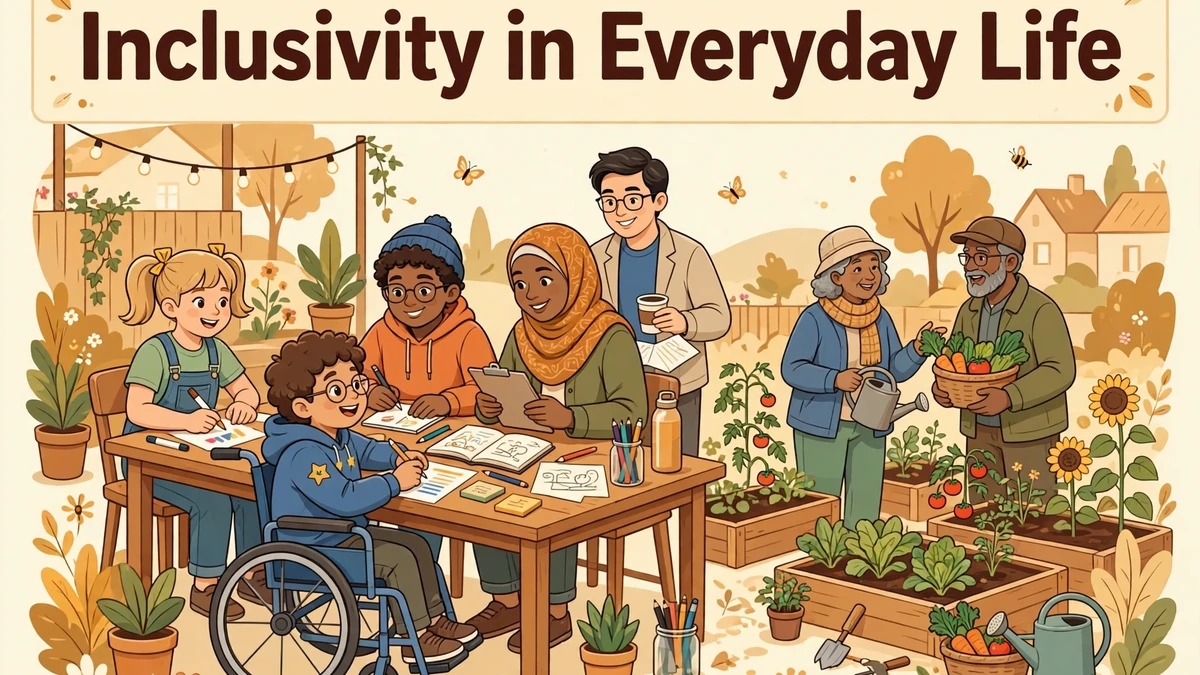
Inclusivity is easiest to understand through everyday examples. It looks different in each setting, but the pattern is always the same: notice who might be left out, and remove the barrier.
At work, inclusivity means hiring fairly, paying fairly, and making meetings work for everyone — for example, sharing notes in advance so people who need more time to prepare can contribute, and making sure credit goes to the person who did the work. It also means accessible offices, flexible working where possible, and a culture where people can raise a concern without fear.
At school, inclusivity means every child can learn in the same classroom wherever possible, with the support they need — step-free access, lessons in formats every pupil can use, and teachers who adapt their approach rather than expecting every child to fit one mould. It also means no child is left out of trips, clubs, or playground games because of who they are.
In the community, inclusivity means public spaces, events, and services that everyone can use: ramps and lifts alongside stairs, information in plain language and more than one format, and neighbourhood events that welcome new arrivals as well as long-time residents.
Synonyms for Inclusivity
The closest synonym for inclusivity is inclusion. Other related words carry part of the meaning, though none matches it exactly:
- Inclusion — the act of including someone; the nearest true synonym.
- Openness — being willing to welcome different people and ideas.
- Acceptance — receiving people as they are, without judgement.
- Belonging — the feeling of being part of a group, which inclusivity aims to create.
- Equal access — everyone being able to reach the same opportunities and resources.
The opposite of inclusivity is exclusivity — the practice of keeping people out. A useful memory trick: “inclusive” contains “include,” so inclusivity is always about bringing people in, never shutting them out.
Some words are easy to mix up in the same way. The compulsory definition shows how one word can carry a precise meaning that a near-synonym does not — and inclusivity is the same: it is not just being friendly, it is a deliberate practice of fairness.
Inclusivity in Example Sentences
- “The school’s inclusivity policy means every child joins the same class, with extra support where it is needed.”
- “Inclusivity is about welcoming every voice and valuing every difference.”
- “The club prides itself on its inclusivity: new members are welcome no matter their religion, race, language, physical ability, or gender.”
- “We aim to promote greater inclusivity across the sport, so that everyone who wants to play can play.”
- “True inclusivity shows in the small things — who is invited, who is heard, and who feels they belong.”
The related adjective is inclusive (“an inclusive workplace”), and the noun for the result is inclusion (“the inclusion of all pupils in the school trip”). The same root also gives us inclusiveness, a near-synonym of inclusivity itself.
Frequently Asked Questions
What is the simple definition of inclusivity?
Inclusivity is the practice or policy of including everyone fairly, so that nobody is excluded because of their gender, race, class, sexuality, disability, or any other part of who they are. In short: everyone gets a fair chance to take part and belong.
What is the difference between inclusivity and diversity?
Diversity is about who is present — a mix of different people. Inclusivity is about how those people are treated and whether they can fully take part. A group can be diverse without being inclusive, and inclusive without being very diverse, but the two work best together.
Is inclusivity the same as inclusion?
Almost. Inclusion is the act or result of being included; inclusivity is the quality, policy, or ongoing practice that makes inclusion happen. They are listed as synonyms, but inclusivity puts the emphasis on the habit and the mindset behind it.
What is an example of inclusivity?
A school that adapts its lessons so a child who uses a wheelchair, a child who speaks another language at home, and a child with a visual impairment can all learn in the same classroom is practising inclusivity. So is a workplace that shares meeting notes in advance and makes sure every voice is heard.
Why does inclusivity matter?
Because without it, people are shut out of opportunities, decisions, and everyday life simply because of who they are. Inclusivity matters because it turns fairness from an idea into a habit — one that gives everyone the same chance to contribute and belong.
What is the opposite of inclusivity?
The opposite is exclusivity — the practice of keeping certain people out. Where inclusivity opens doors, exclusivity closes them.
Inclusivity is a simple idea with a big job: nobody left out, everybody able to take part. It is the difference between a door that is open and a room where everyone inside is genuinely welcome — and, like the inalienable rights that belong to every person, it starts from the belief that fairness is not a favour but a baseline.