
If you have heard someone chanting “tralalero tralala” on TikTok or seen a shark in sneakers pop up in your feed, you are not alone. Tralalero Tralala meaning is one of the most searched slang questions of 2025, and the short answer is simple: the phrase has no literal English translation. It is a playful, sing-song chant that sounds Italian, and it is the name of the viral AI-generated shark that started the whole Italian brainrot trend. This guide explains what the words mean, where the shark came from, and what people actually mean when they say it.
What Does Tralalero Tralala Mean?
Tralalero Tralala has no literal meaning in English or Italian. It is a rhythmic, nonsense-style refrain, closest in English to “tra-la-la” or “la-la-la” — the kind of sound you sing when you have forgotten the words, or when the song does not need words at all.
| Term | Meaning |
|---|---|
| Tralalero Tralala | A catchy, non-literal singing refrain |
| Closest English equivalent | “Tra-la-la” or “la-la-la” |
| Literal sentence translation | None |
| Meme meaning | The name of the viral AI shark and the start of Italian brainrot |
| Offensive by itself? | No — the phrase on its own has no offensive meaning |
That is the whole answer, in one sense. But the phrase is worth a longer look, because it sits on top of two very different stories: a real Italian singing tradition, and a 2025 internet meme.
Is Tralalero Tralala Real Italian?
Partly. The meme phrase is not a normal Italian sentence, and no Italian speaker uses “tralalero tralala” as an everyday expression. But the sounds it is built from are real.
The Italian form trallallero is documented in the Nuovo De Mauro dictionary, where it connects to trallallà — a monotonous chant or refrain — and to a traditional form of Ligurian choral singing. Trallalero is a genuine polyphonic singing style from Genoa, in the Liguria region of Italy, where groups of singers perform complex harmonies and one voice imitates instruments with rhythmic syllables like “tra-la-la-lero.”
So the meme did not invent its sounds from nothing. It borrowed a musical, Italian-sounding chant and dropped it into an absurd internet context. The shark has nothing to do with the singing tradition — the two only share the sound.
Meet the Shark: What Is Tralalero Tralala?
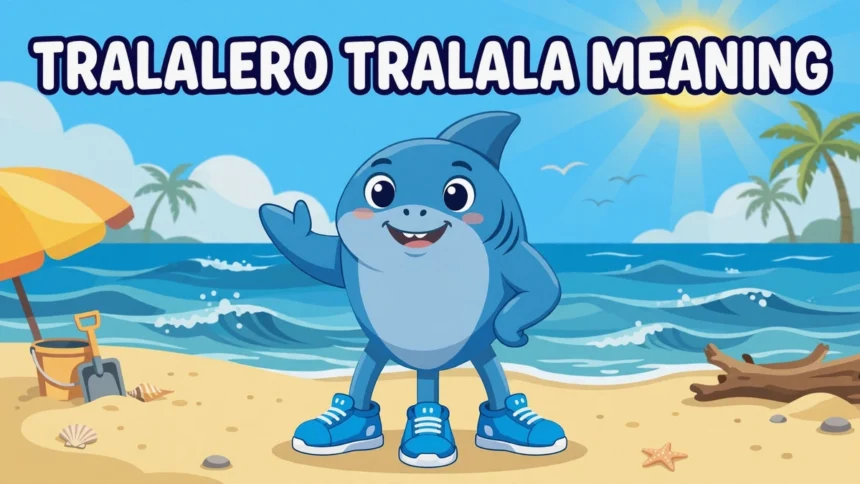
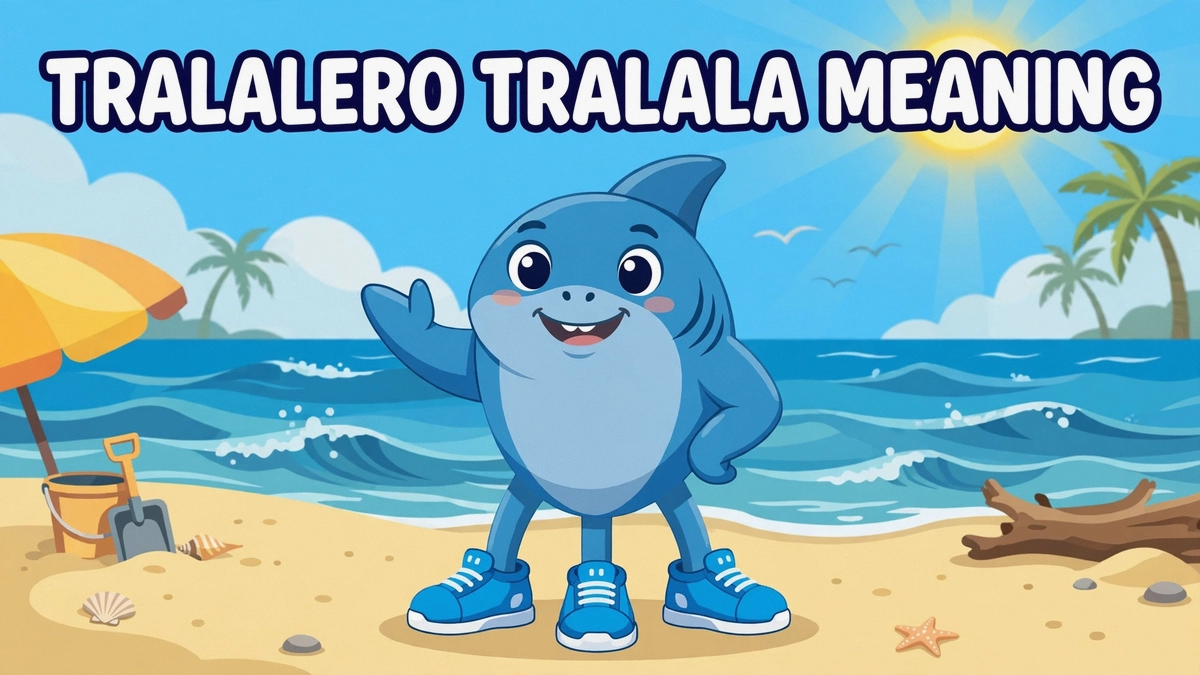
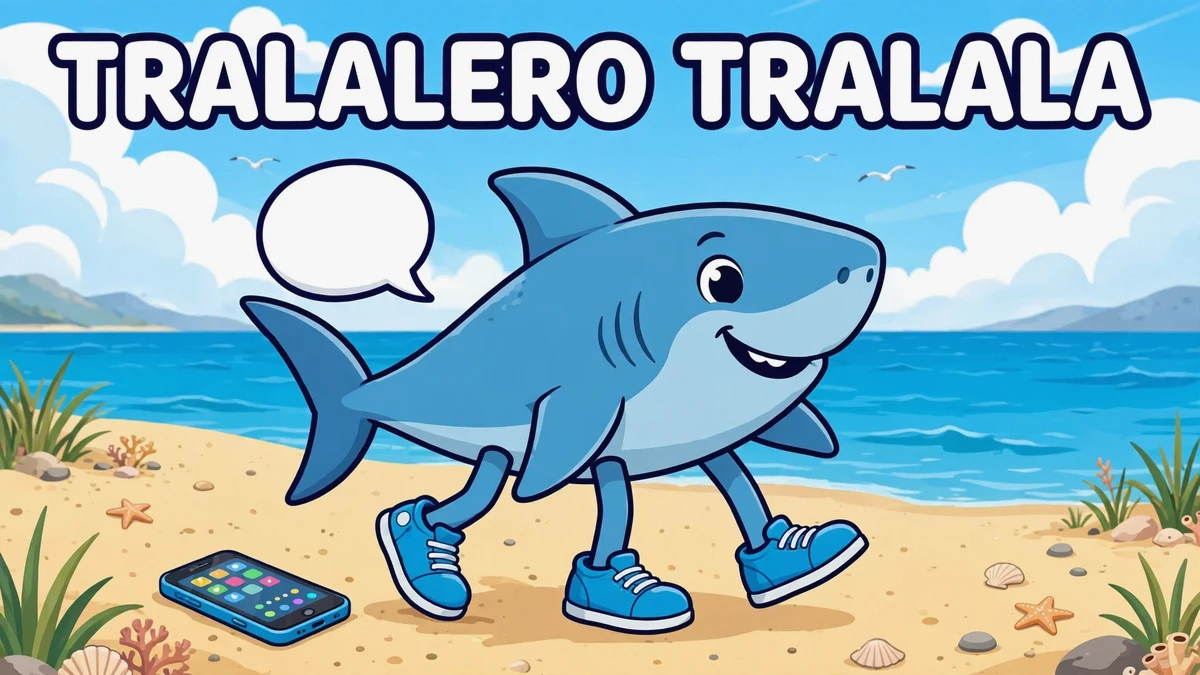
Tralalero Tralala is a character: an AI-generated blue shark that stands on three legs, each wearing a bright blue sneaker, usually shown on a beach. The character is widely considered the first of the Italian brainrot characters, and the one that set the format for everything that followed: an animal fused with something unexpected, given a rhyming pseudo-Italian name, and introduced by a dramatic, robotic Italian voiceover.
The character is usually described as athletic — a super-fast runner and a high jumper — which is part of the joke. A shark has no business running on a beach in trainers, and that is exactly why people remember it.
When Did Tralalero Tralala Become Popular?
The story has two chapters, and mixing them up is why different websites give different dates.
October 2023 — the phrase. Internet users made memes of actor and wrestler Dwayne Johnson rhyming about absurd topics, and one of those edits used the nonsense phrase “Tralalero tralala.” The phrase stuck around in internet culture from there.
January 2025 — the shark. TikTok user @eZburger401 reportedly posted a video pairing the chant with an AI-generated shark, and the clip took off. The account was later banned, which makes the original post hard to verify. On 13 January 2025, another user posted a video using the same audio with an AI-generated image of a shark wearing shoes, and that video gained around 7 million views. From there, the format exploded — new characters, new names, new remixes, all following the same recipe.
What Is Italian Brainrot?
Italian brainrot is a series of internet memes that emerged in early 2025, built around surreal, AI-generated creatures given pseudo-Italian names. The formula is simple: take an animal, fuse it with a random object, generate the image with AI, give it a rhyming Italian-sounding name, and add a robotic voiceover narrating its “lore” in dramatic, broken Italian.
Tralalero Tralala was the first big hit. Other well-known characters followed in the first wave, including Bombardiro Crocodilo (a crocodile fused with a bomber plane), Ballerina Cappuccina (a ballerina with a cappuccino theme), Chimpanzini Bananini (a chimpanzee and a banana), and Tung Tung Tung Sahur. The list is not fixed — the format invites people to invent new characters, and thousands have appeared since.
The name “brainrot” is self-aware: it jokes that watching this stuff rots your brain. The term itself was big enough that “brain rot” was named Oxford’s Word of the Year for 2024, as Oxford University Press announced.
Does Tralalero Tralala Mean Something Bad?
The phrase itself does not. This is the most common misunderstanding about the meme, so it is worth stating clearly.
The confusion comes from the longer viral audio. The original sound that made the shark famous contains profanity and blasphemous language further into the recording, after the opening chant. Because the audio starts with the recognizable “Tralalero Tralala” refrain, some people assume the whole phrase translates into the offensive material that follows. It does not.
That distinction matters for two reasons:
- The “God is a pig” claim is wrong. Some online discussions reduce the entire audio to one offensive line and describe it as the meaning of the phrase. There is no linguistic connection between the sounds in “tralalero” and those words. The phrase is a singing refrain; the offensive line is a separate part of the longer audio.
- The name is not the same as the full audio. A child chanting “tralalero tralala” in the playground usually knows only the shark’s name and the catchy sound. Someone playing or repeating the full original audio may be repeating profanity. Parents who hear the chant should know the difference — the words themselves are harmless, but the original clip is not child-friendly, which is why many remixes replace the audio.
How Do You Pronounce Tralalero Tralala?
A rough pronunciation for an English speaker is: trah-lah-LEH-roh trah-lah-LAH
The exact sound varies, because people are usually imitating the exaggerated, theatrical delivery of the viral synthetic voice rather than speaking natural Italian. The dramatic delivery is part of what makes it recognizable — the chant is meant to sound over the top.
How Is Tralalero Tralala Used on TikTok and in Text?
On TikTok and in comments, the phrase almost always works as a meme reference rather than a sentence with a meaning. Someone using it is usually referring to the shark, the viral sound, Italian brainrot in general, or a meme edit — or just being intentionally random.
You will see it as a comment under a strange or absurd video, as a caption on an AI-generated image, or as a reply when someone wants to answer nonsense with nonsense. Unlike abbreviations such as “LOL” or “BRB,” it does not stand for a longer phrase. It is a name and a sound, not a code.
Like other slang that spreads through the same chats, it travels with its neighbours — if you want the same kind of guide for the abbreviations you meet in those DMs, read GTS meaning in text and GNG meaning in text. And if someone opens a chat with a question you do not recognise, WYF meaning in text covers another three-letter opener from the same world.
Why Did Tralalero Tralala Become So Popular?
The meme has several traits that suit short-form video perfectly:
- A catchy sound. The repeated syllables are easy to remember and imitate.
- A strange visual. A shark with legs and sneakers stands out instantly in a feed.
- AI-generated imagery. Generative AI makes it easy for anyone to create bizarre characters and variations.
- Absurd humour. The joke needs no logical explanation — the lack of logic is the entertainment.
- Easy remixing. Anyone can reuse the recognisable sound while making their own character, image, or edit.
From TikTok, the characters spread into games, fan content, toys, and playgrounds. The format was so repeatable that the shark became a template rather than a one-off joke: once people understood the recipe, they could make a new character in minutes.
Frequently Asked Questions
What does Tralalero Tralala mean in English?
It has no literal translation. It is a playful, Italian-sounding singing refrain, similar to “tra-la-la” in English. Online, it is best known as the name of the viral AI-generated shark that started the Italian brainrot trend.
Is Tralalero Tralala a real Italian word?
Not as a sentence. The related form trallallero is a real Italian word connected to a traditional singing style from Genoa, but “Tralalero Tralala” as a phrase is a meme invention built from those sounds.
Who created Tralalero Tralala?
The creation is often attributed to TikTok user @eZburger401, who reportedly posted the first video featuring the character in January 2025. The account was later banned, so the original post is hard to verify. The phrase itself appeared earlier, in October 2023 memes of Dwayne Johnson rhyming nonsense.
Is Tralalero Tralala offensive?
The phrase on its own is not offensive — it is a nonsense singing refrain. The longer original viral audio does contain profanity and blasphemous language, so the full clip is not the same as the name. Many remixes replace the audio for that reason.
What is Italian brainrot?
Italian brainrot is a meme trend from early 2025 built on surreal AI-generated creatures — usually an animal fused with an everyday object — given Italian-sounding names and introduced by a synthetic Italian voiceover. Tralalero Tralala, the three-legged shark in sneakers, is widely considered the first character of the trend, as the Wikipedia article on Italian brainrot explains.
Why does the shark have three legs?
There is no story reason. The three legs and sneakers are part of the deliberate absurdity — the character is an impossible hybrid, and the oddness is the joke.