
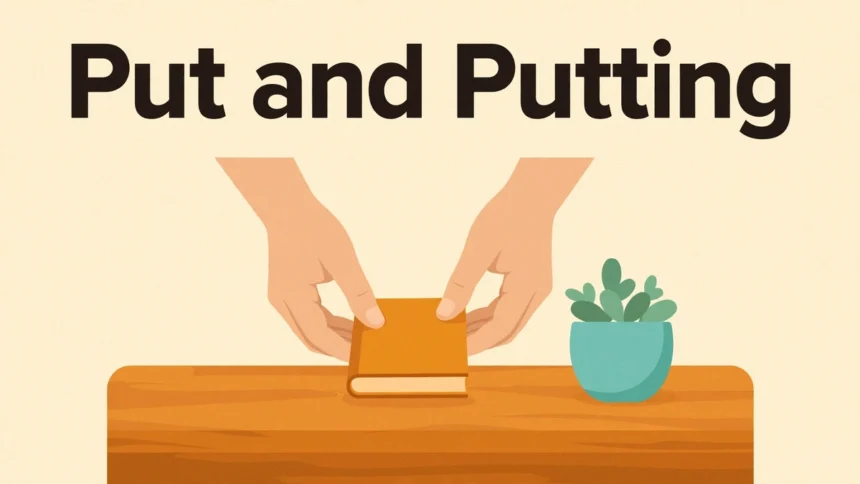
Put and putting look almost identical, and that is exactly why they confuse people. Put means to place or move something to a particular position: “Put the book on the table.” Putting is the -ing form of the same verb, used for actions in progress: “She is putting the book on the table.” One letter changes — a doubled “t” — and the whole job of the word changes with it. This guide covers the meaning of each form, the spelling rule, the tenses, and the mistakes to avoid.
What Does Put Mean?
Put (pronounced /pʊt/) is a verb meaning to move something into a particular place or position, especially using your hands. It is one of the most common verbs in English, and it is irregular in a useful way: it never changes its spelling.
| Form | Spelling | Example |
|---|---|---|
| Base form | put | “I put the keys on the hook every day.” |
| Past tense | put | “Yesterday I put the keys on the hook.” |
| Past participle | put | “I have put the keys on the hook.” |
| Present participle | putting | “I am putting the keys on the hook.” |
| Third person singular | puts | “She puts the keys on the hook.” |
Notice the pattern: the past tense of “put” is “put,” not “putted.” “Putted” is only correct in golf, where it is the past tense of “putt” (to strike a golf ball gently). Outside of golf, “putted” is always wrong.
“Put” also carries many other meanings: to express something in words (“to put it simply”), to write something down (“put your name at the top”), to estimate (“I’d put the distance at fifty miles”), and to assign or impose (“the delay put us in a bad mood”).
What Does Putting Mean?
Putting (pronounced /ˈpʊtɪŋ/) is the present participle and gerund of “put.” It does two jobs:
- Continuous tenses — actions in progress: “She is putting the dishes away.” “They were putting up the tent when it started to rain.”
- Gerund — the action used as a noun: “Putting the puzzle together was challenging.” “Putting others before yourself is an act of kindness.” A gerund is simply the -ing form of a verb acting as a noun, and you can read more in Wikipedia’s article on the gerund.
Watch out for one trap: “putting” is a homograph. Spelled the same way, it is also the -ing form of “putt” in golf — but pronounced differently, /ˈpʌtɪŋ/ instead of /ˈpʊtɪŋ/. Same spelling, two pronunciations, two meanings. In everyday writing, the “placing” meaning is the one you will meet.
The Spelling Rule: Why Putting Has Two T’s
The most common question about this pair is whether it is “puting” or “putting.” The answer is putting — always, with two t’s. “Puting” is not a word.
The rule: when a short verb ends in a consonant-vowel-consonant pattern, double the final consonant before adding -ing. “Put” ends in t (consonant), u (vowel), t (consonant) — so the t doubles: put + ing = putting.
The same rule explains other familiar spellings. It is also why transferred spelling works the way it does: “transfer” doubles its r before -ed because the stress falls on the last syllable — transfer → transferred. Compare that with “offer,” where the stress falls on the first syllable, so there is no doubling: offer → offering.
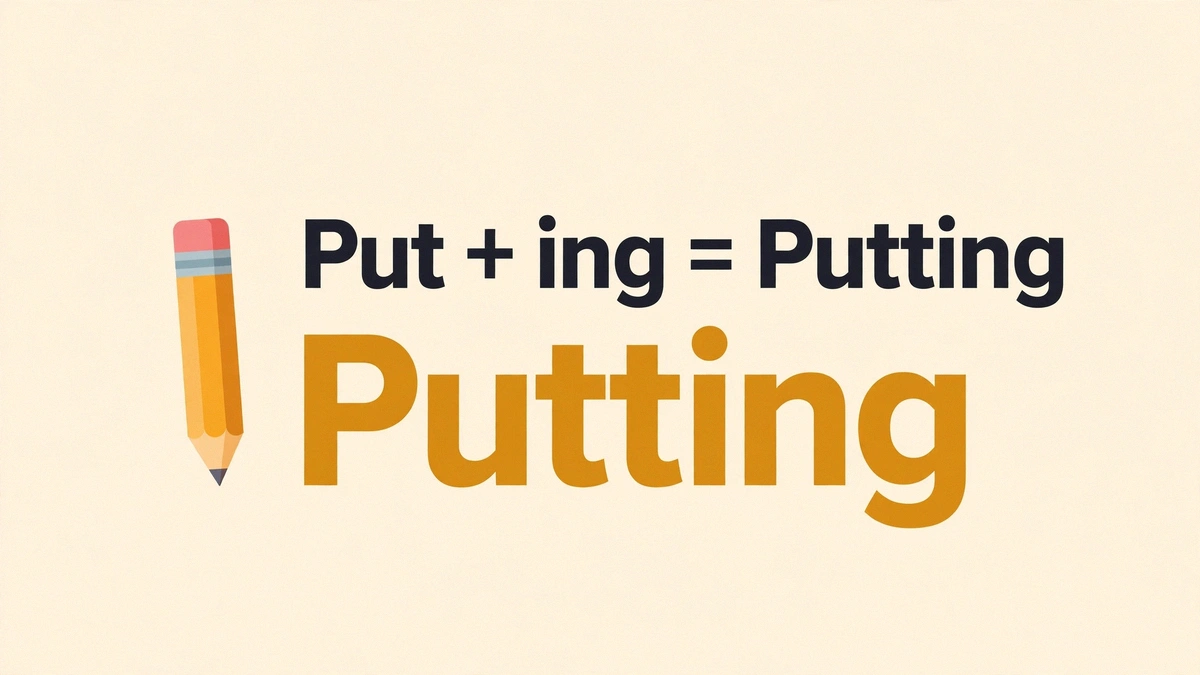
More examples of the doubling rule:
- run → running
- stop → stopping
- sit → sitting
- big → bigger
- swim → swimming
Put vs Putting in Sentences
The choice between “put” and “putting” is a choice between a finished or habitual action and an action in progress:
- Put (simple): “He puts the bins out every Tuesday.” (habit)
- Put (past): “She put the letter in the post this morning.” (finished)
- Putting (continuous): “She is putting the letter in the post right now.” (in progress)
- Putting (gerund): “Putting the letter in the post took five minutes.” (the action as a subject)
The infinitive “to put” has its own job: purpose and intention. “I need to put the groceries away” states a purpose; “Putting the groceries away took ten minutes” describes the activity itself. The present continuous tense — “am/is/are + putting” — is the form you reach for whenever the action is happening right now.
Common Phrasal Verbs with Put
“Put” combines with small words to make phrasal verbs with entirely new meanings. The most useful ones:
- put off — to postpone: “We put off the meeting until Friday.”
- put up with — to tolerate: “I can’t put up with the noise any longer.”
- put down — to write down, or to criticise: “Put down your name on the list.”
- put on — to wear, or to switch on: “Put on your coat.” / “Put on the light.”
- put out — to extinguish, or to inconvenience: “Put out the fire.” / “Sorry to put you out.”
- put away — to store: “Put away your toys before dinner.”
- put up — to erect, or to accommodate: “They put up a tent.” / “Can you put me up for the night?”
- put across — to communicate clearly: “She put her ideas across well.”
In every one of these, the -ing form follows the same rule: “putting off,” “putting up with,” “putting down” — always two t’s.
Dos and Don’ts for Put and Putting
- Do double the t: put → putting, never “puting.”
- Do use “putting” for actions in progress: “I am putting the kettle on.”
- Do use “put” for the past tense: “I put the kettle on an hour ago.”
- Don’t write “putted” outside of golf — the past tense of “put” is “put.”
- Don’t use “putting” for a finished action: “I putting the book down” is wrong; say “I put the book down” or “I am putting the book down.”
- Do check the stress when doubling other verbs: transfer → transferred, but offer → offering.
Putting It into Practice
The best way to remember the difference is to use both forms in one sentence: “I put the shopping away, and now I am putting the kettle on.” One word finishes the job; the other is still doing it. Getting this right matters most in writing that other people read carefully — a formal letter is no place for “puting,” and a semicolon in the wrong place can confuse a reader just as surely as a misspelled verb. And if you are ever stuck for words, remember that putting feelings into words is a skill worth practising — these brother quotes for sister are a good example of simple words carrying real feeling.
Frequently Asked Questions
Is it puting or putting?
Putting, with two t’s. “Puting” is a misspelling. The final t in “put” doubles before -ing because “put” ends in a consonant-vowel-consonant pattern.
What is the past tense of putting?
The past tense is “put.” “Putting” is the -ing form; to talk about the past, use “put”: “I was putting the dishes away” (past continuous) or “I put the dishes away” (simple past).
Is “putted” a word?
Only in golf, where “putted” is the past tense of “putt.” For the verb “put,” the past tense is always “put.”
What is the difference between “to put” and “putting”?
“To put” is the infinitive, used for purpose or intention (“I need to put this away”). “Putting” is the gerund or present participle, used for an action in progress (“I am putting this away”) or as a noun (“Putting this away took a minute”).