
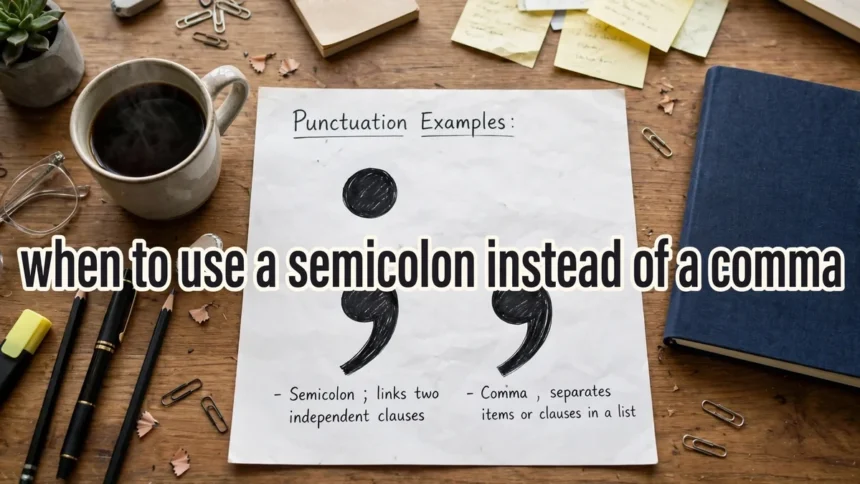
The semicolon is the most feared punctuation mark in English, and it should not be. It has exactly two jobs, and once you see them, the mark stops feeling fussy. So when to use a semicolon instead of a comma? When you are joining two complete, closely related sentences without a conjunction — or when you are separating list items that already contain commas. Everywhere else, a comma (or a period) is the right choice.
Job 1: joining two complete sentences
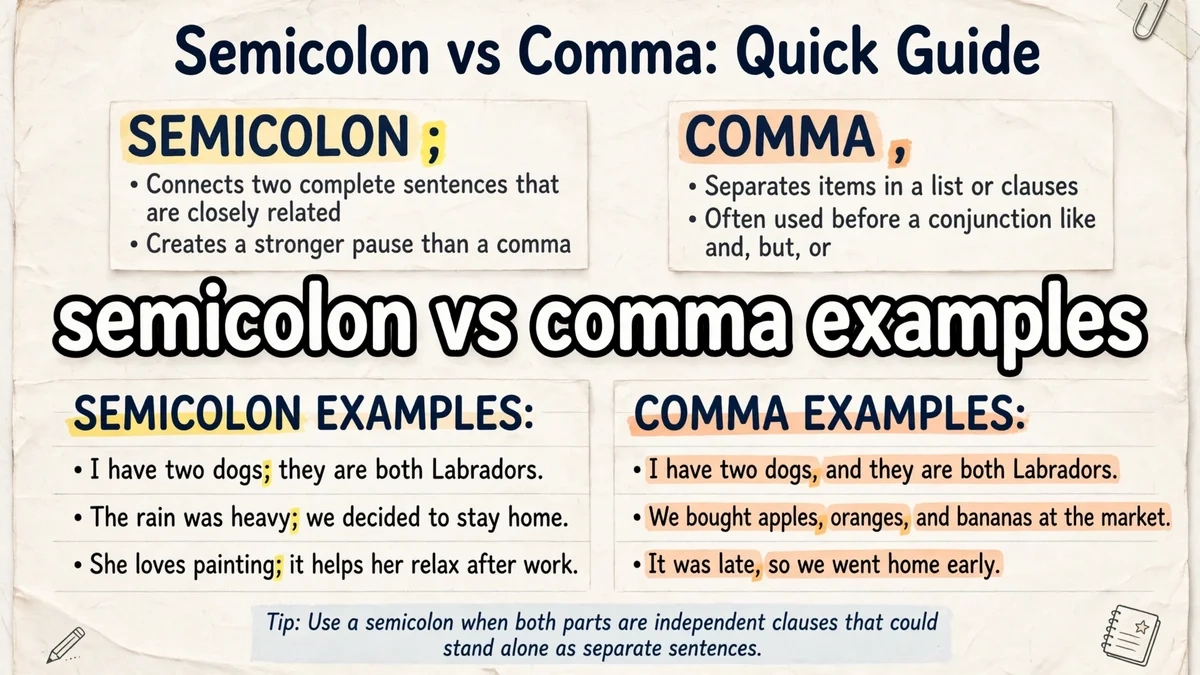
A semicolon joins two independent clauses — groups of words that could each stand alone as a full sentence — when the two thoughts are closely related and no coordinating conjunction (and, but, or, so, for, nor, yet) joins them.
- Correct: “The rain finally stopped; we stayed on the porch.” Both halves could stand alone, and the semicolon keeps their connection closer than a period would.
- Correct: “I finished the project early; now I can relax.”
- Incorrect as a comma: “I finished the project early, now I can relax.” That is a comma splice — a comma trying to do a semicolon’s job — and it is one of the most common punctuation errors in English.
A handy test: can both sides stand alone, and do they still belong in one breath of thought? If yes, the semicolon fits. If the second half cannot stand alone, the semicolon has nothing solid to join: “I stayed home; because I felt sick” is wrong, because “because I felt sick” is a dependent clause. That sentence wants a comma or no punctuation at all.
The semicolon also pairs with linking words such as however, therefore, instead, and moreover when those words connect full clauses. In that pattern, the semicolon goes before the linking word and a comma after it: “Mia wanted to leave early; instead, she stayed for dessert.” The same rule applies mid-clause: when the linking word appears in the middle or at the end of the second clause, the semicolon still goes between the clauses.
Job 2: separating list items that already contain commas
The semicolon’s second job is list control. When list items already contain commas, plain commas stop helping, because the reader cannot tell where one item ends and the next begins. A semicolon steps in and marks each chunk with a clearer border.
- Confusing with commas only: “We visited Paris, France, London, England, and Rome, Italy.” Are those three cities or six items?
- Clear with semicolons: “We visited Paris, France; London, England; and Rome, Italy.”
The same rule applies to any complex list: “The team includes Rachel, the project manager; John, the developer; and Priya, the designer.” Without semicolons, the roles blur into the names. With them, each person and their role form one clear item.
Note the final semicolon before “and” in that example: in a semicolon-separated list, the last item is conventionally introduced with a semicolon before the conjunction, just as the Oxford comma does in a comma-separated list.
When a comma is the right choice
A comma cannot join two full clauses by itself, but it does most of the lighter work in a sentence:
- Simple lists: “Red, white, and blue.” No semicolon needed — nothing inside the items contains a comma.
- Before a conjunction joining full clauses: “I ran, but I tripped.” The comma plus “but” does the joining; a semicolon here would be wrong, because a semicolon does not pair with a coordinating conjunction.
- After an introductory phrase: “After the meeting ended, we grabbed coffee.”
- Setting off nonessential information: “My sister, who lives in Seattle, is visiting.” Remove the middle and the sentence still works.
The quick decision table:
- Simple list, no internal commas → comma.
- Two full clauses with and/but/or → comma before the conjunction.
- Two full clauses, no conjunction, closely related → semicolon.
- List items containing commas → semicolons between items.
- A dependent clause on either side → comma or period, never a semicolon.
Common mistakes to avoid
- Using a semicolon to introduce a list. “She brought three things; bread, cheese, and olives” is wrong. That sentence wants a colon, not a semicolon, because the semicolon is not an introducer.
- Placing a semicolon after a verb or preposition. “The winners were; Ana, Jules, and Priya” breaks the sentence in the wrong spot.
- Using a semicolon to look smarter. If the sentence is short and plain, a comma or period usually reads better. Readers can feel a forced semicolon, and the mark works best when the sentence would feel clumsy with a period and broken with a comma.
- Swapping in a semicolon for a colon. A colon introduces or explains; a semicolon joins or separates. They are not interchangeable.
The bottom line
Use a semicolon instead of a comma in exactly two places: between two complete, related sentences with no conjunction, and between list items that already contain commas. Everywhere else, trust the comma — and when in doubt, a period is never wrong. Clear writing is a skill that pays off far beyond punctuation, whether you are explaining a rule, telling a story, or comparing two things side by side, as in town vs city — and the same care with words shows up in old texts as well as new ones, from short bible verses to the playful logic of two truths and a lie ideas, where a statement only matters because the group hears it together.