
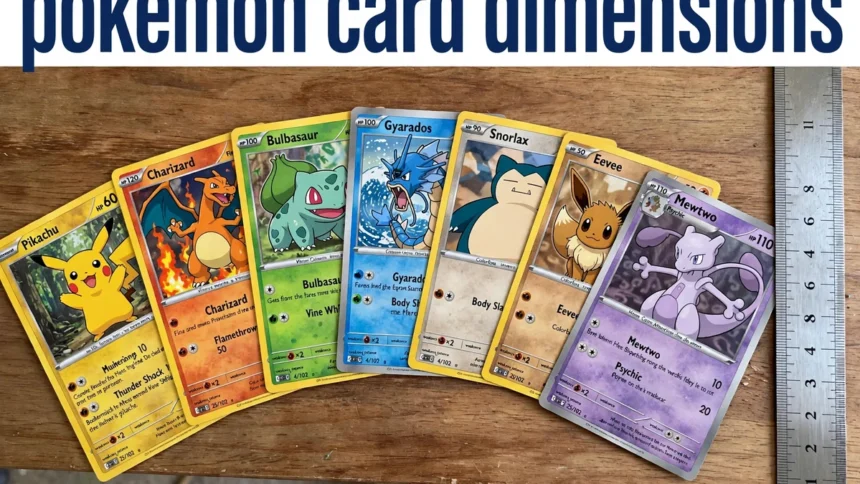
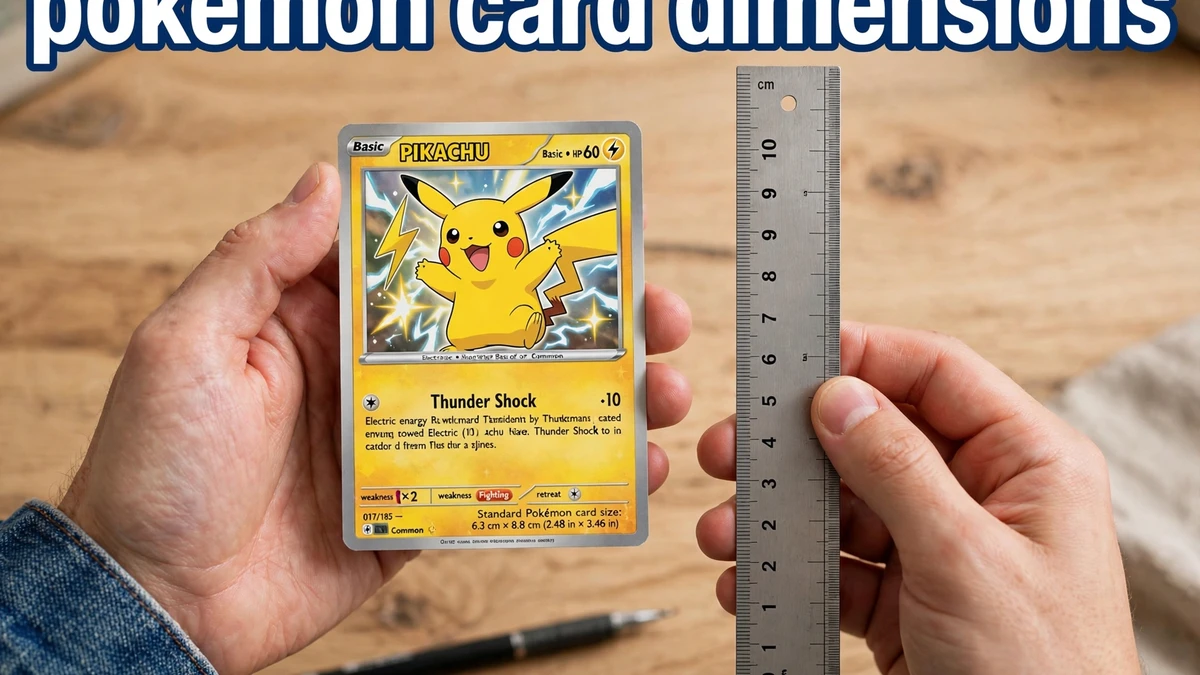
If you are buying sleeves, a binder or a deck box for the first time, one number matters more than any other: the size of the card itself. The short answer to pokemon card dimensions is that a standard Pokemon card measures 2.5 inches wide by 3.5 inches tall, which is 63 millimetres by 88 millimetres in metric. That size has stayed the same since the game launched, so a card from an old set and a card from a new set fit the same sleeve.
The standard size at a glance
| Measurement | Imperial | Metric |
|---|---|---|
| Width | 2.5 inches | 63 mm (63.5 mm precise) |
| Height | 3.5 inches | 88 mm (88.9 mm precise) |
| Thickness | About 0.012 inches | About 0.3 mm |
| Weight | — | Roughly 1.8–2 grams |
You will see both rounded and precise metric figures quoted: 63 by 88 mm is the rounded version most guides use, while 63.5 by 88.9 mm is the exact conversion of 2.5 by 3.5 inches. Both describe the same card; sleeve and grading companies work from the precise figure, while the rounded figure is easier to remember. Corners are rounded, at roughly 3 mm radius, which is why a card slides into a sleeve instead of catching on a sharp corner.
The standard size is not unique to Pokemon. It matches the poker-size format used by most modern trading card games, including Magic: The Gathering, which is why accessories made for one game so often fit the other. A trading card in this standard size also matches a traditional playing card footprint, so if you have ever sleeved a playing card, you already know the size in your hand.
Why the size has never changed
Consistency is the point. The Pokemon Trading Card Game launched in Japan in 1996 and kept the same card size when it reached English-speaking markets in 1999, and every set since has used it. That stability means a collection spanning decades still fits one binder system, one sleeve size and one style of deck box, and it means players can shuffle old and new cards together without a tell-tale size difference. The game itself is described on the Pokemon Trading Card Game page, but the physical standard is what collectors feel every time they open a pack.
Full-art, gold and textured cards share the same footprint too. Special finishes change how a card looks and feels, not how big it is, so they fit the same sleeves as ordinary cards. The only cards that break the rule are the oversized promotional cards below.
Jumbo and special cards
Jumbo cards are promotional display cards, not playable cards, and they do not have one single size. Different releases have measured differently over the years, with commonly quoted examples around 5 to 6 inches wide and 7 to 8 inches tall, and some display editions larger still. Because there is no fixed jumbo standard, always measure a jumbo card before buying a sleeve or display holder for it, rather than assuming a “jumbo sleeve” will fit.
Mini cards and box toppers are the other exceptions, and the same rule applies: measure first. If a card looks obviously larger or smaller than the rest of your collection, it almost certainly is, and guessing the accessory size is how cards end up loose, bent or crushed.
How to measure a card yourself
You do not need special tools: a ruler with both inches and millimetres is enough. Lay the card flat, measure the short edge for width and the long edge for height, and measure at the widest points, ignoring the rounded corners. A standard card should read 2.5 by 3.5 inches, or 63 by 88 mm. If it reads noticeably smaller — for example around 59 by 86 mm — it is probably a different game’s card, not a Pokemon card: that smaller size is the Yu-Gi-Oh! format, and it is a common source of confusion when sorting a mixed collection.
Measuring matters for fake-spotting too. Counterfeit cards often get the artwork close but the dimensions slightly wrong, so a card that is the wrong size, or noticeably thicker than its neighbours, deserves a closer look before you buy or trade it.
Sleeves, binders and toploaders that fit
Buy accessories labelled “standard size” for ordinary Pokemon cards. Standard sleeves are made to this exact footprint, standard 9-pocket binder pages hold them without bending, and standard toploaders protect single valuable cards. Penny sleeves are the cheapest option for bulk storage; thicker sleeves suit cards you handle often. For a deck you play with, use one consistent sleeve brand and size across the whole deck, so no card stands out by feel.
For jumbo cards, buy oversized sleeves and pages sized to that specific card’s measurements, and for a card you are grading or selling, a toploader plus a team bag keeps it flat and clean in transit. Getting the fit right is the same principle as getting any piece of gear sized to its user: a harness that fits keeps a dog safe in the car, as covered in dog safety in the car, and a sleeve that fits keeps a card safe in a binder.
Storing and travelling with cards
Store cards upright, not stacked in a pile, and keep them cool, dry and out of direct sunlight. Heat and humidity warp cards and fade ink, and a damp box can ruin a collection faster than any amount of play. A binder is best for a collection you browse; a deck box is best for a deck you play; toploaders are best for individual cards worth protecting on their own.
Travelling with cards needs the same care as travelling with anything you value: a closed deck box or binder inside a bag, not loose cards in a pocket. A collection that survives a journey intact is usually one that was packed with a little thought, much like planning a trip to San Francisco with the right gear for the days ahead. And fit matters in small things too: a collar that is the wrong size is uncomfortable and useless, as Gus discovered when a tie collar made for another dog came his way, in stay classy gus.
The bottom line
A standard Pokemon card is 2.5 by 3.5 inches (63 by 88 mm), about 0.3 mm thick, and that size has not changed since 1996. Buy standard-size sleeves, binders and toploaders for ordinary cards, measure any jumbo or unusual card before buying accessories for it, and remember that a different game’s smaller format — 59 by 86 mm — is not a Pokemon size at all. Get the size right once, and every accessory decision after it becomes easy.